Showdown on West Coast Docks: The Battle of Longview
(November 2011).
click on photo for article
Chicago Plant Occupation Electrifies Labor
(December 2008).
click on photo for article
May Day Strike Against the War Shuts Down
U.S. West Coast Ports
(May 2008)
click on photo for article

July 2026
Solidarity with ILWU Warehouse Workers!
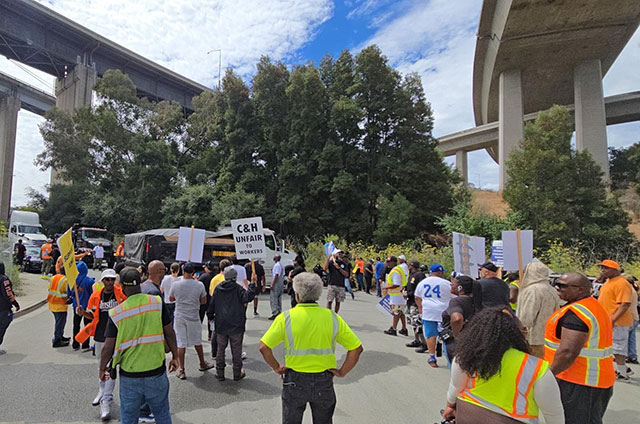
Picketers outside of the C&H sugar refinery on the July 21. At least 400 people showed up on the picket lines that day, blocking trucks from unloading a shipment of raw sugar. (Internationalist photo)
For 42 days starting on June 15, warehouse workers of International Longshore and Warehouse Union (ILWU) Local 6 struck the C&H Sugar refinery in Crockett, California, refusing to accept a “take-it-or-leave-it” contract ultimatum from the company. The mobilization of hundreds of ILWU Local 10 members, shutting down all Northern California ports, along with strike supporters from around the region on June 21, organizing mass picket lines that blocked trucks and scabs, sent a powerful message to the union-busting bosses. The arrest of ten picketers was headlined across local media. The stage was set to escalate the strike into a major battle that could mobilize labor and union supporters all across the San Francisco Bay Area. (See the Internationalist Group leaflet, reprinted below, putting forward a program for just that.)
Instead, both the company (the American Sugar Refining [ASR] conglomerate that bought up C&H in 2005 in its effort to get a monopoly lock on the U.S. cane sugar industry) and the ILWU International leadership decided to pull back, seemingly worried by the tough stance of the angry picketers. So as picketers arrived on Monday, July 27, they were met with a joint press release from the ILWU and C&H Sugar announcing that they had agreed to a 60-day period of contract negotiations, that the company would withdraw its declaration of impasse in bargaining (that is, their refusal to bargain) and the Local 6 members would return to work. Some union supporters have portrayed this as a win, saying that “the ILWU forced C&H back to the bargaining table” (Struggle/La Lucha, 31 July). From the standpoint of class-struggle unionism, we in the Internationalist Group disagree.
In the first place, four C&H warehouse workers were fired during the strike. A bottom-line condition for returning to work, even if only to resume bargaining, must be no reprisals. The ILWU should demand that those workers be reinstated immediately as a condition for moving forward. Moreover, such “cooling-off periods” usually serve to head off militant labor action (for example in the looming rail strike in late 2022, which Democrats in the White House and Congress ultimately squelched by pushing through no-strike legislation), calling off the strike gives up the union’s ability to put economic pressure on the bosses. And they will still be bargaining over company demands to give back past union gains. Also, the membership must be allowed to vote on any contract, including to reject it if it has givebacks or otherwise doesn't meet their needs. That is in the ILWU Constitution..
Although returning to work was, in our opinion, a mistake and set back the struggle, the struggle is not over and ILWU supporters have continued to push for labor solidarity with the Local 6 warehouse workers at C&H. This has included working to get declarations of solidarity from port workers unions around the world. A roster of the most militant waterfront, transport and metal workers unions have clocked in, including the Dockers union of the port of Le Havre, France; the Coordinamento Porti of the USB dockworkers in Italy; La Coordinadora, the Spanish dockworkers union; the ENEDEP port workers union of Piraeus, Greece; the Doro-Chiba rail workers union in Japan; and the National Union of Metalworkers of South Africa (NUMSA), the largest union on the African continent. By clicking on the facsimiles below you can enlarge the letters to readable size.
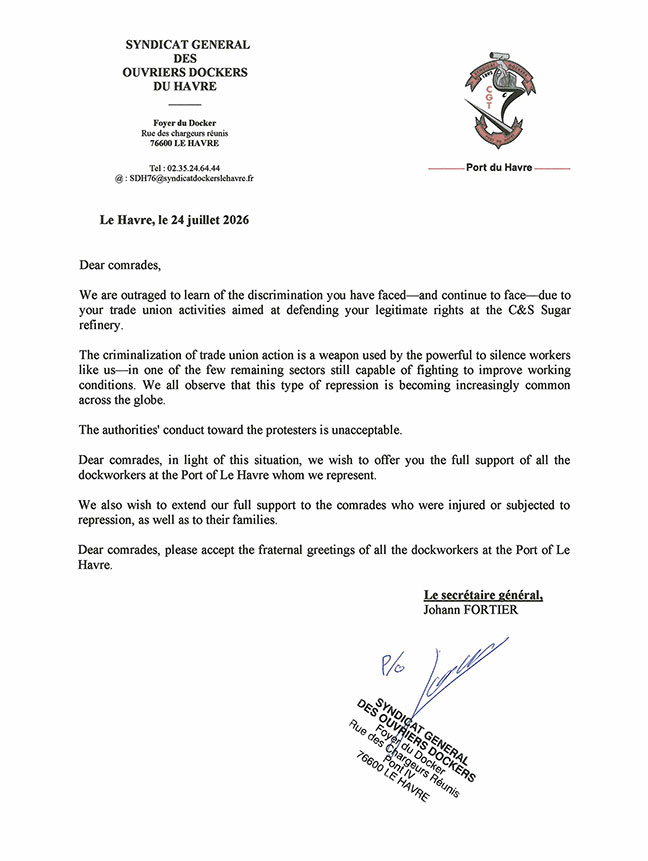
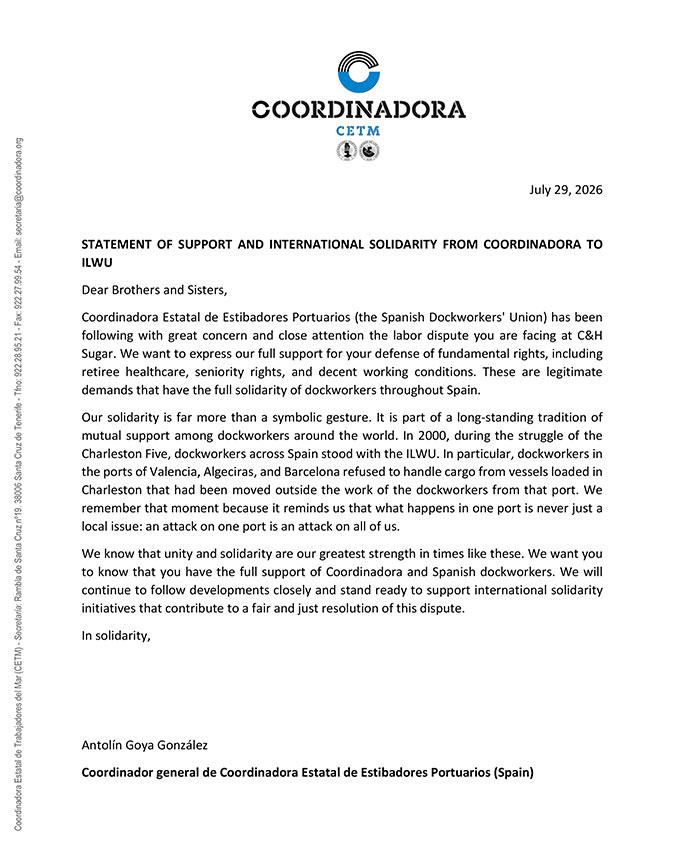
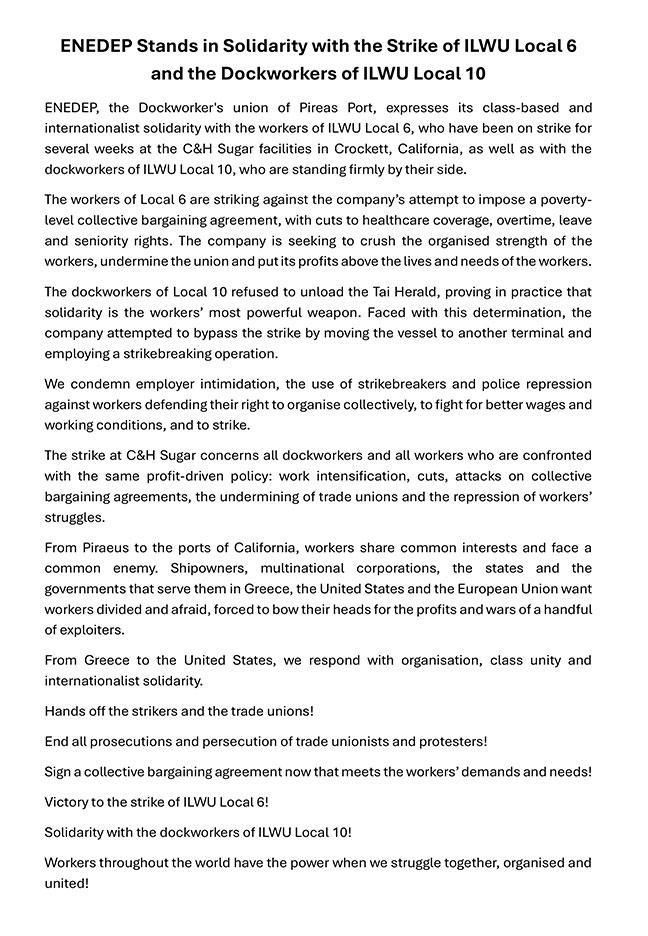
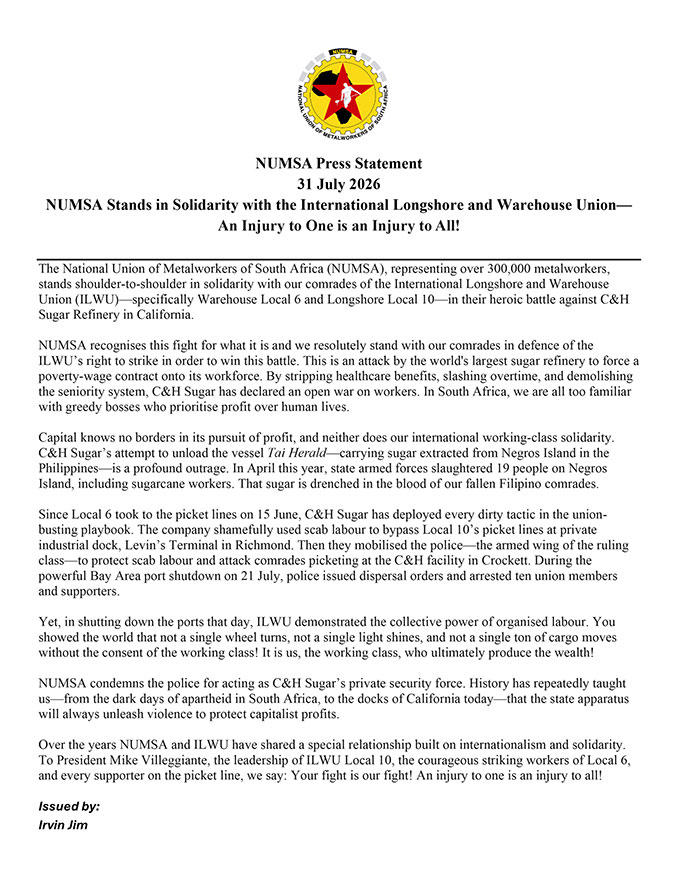
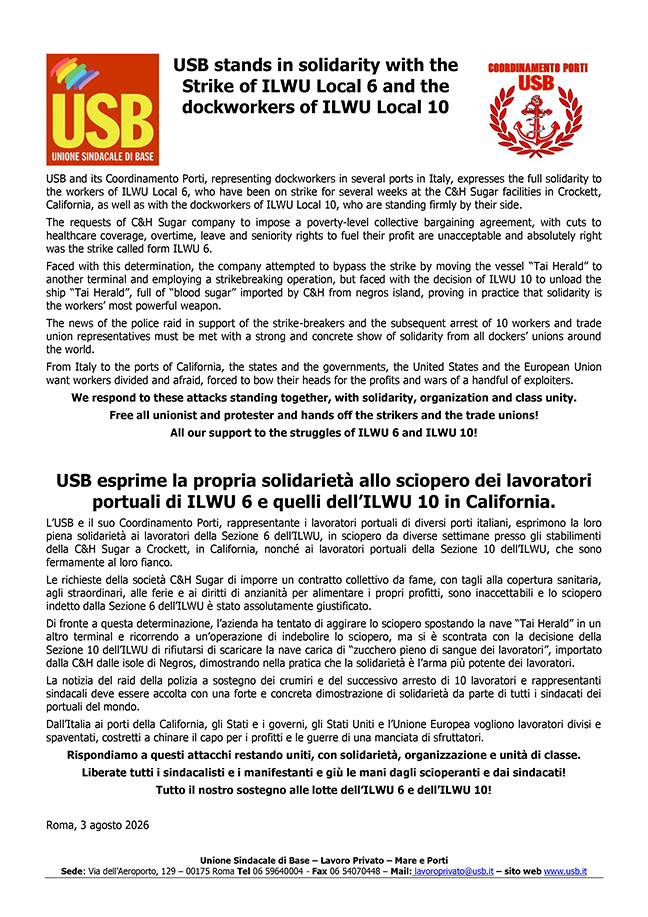
These statements should alert the owners of C&H Sugar that behind the representatives of ILWU Local 6 whom they face across the bargaining table stand some of the most powerful and militant labor organizations in the world. This list includes some of the main unions that have stopped arms shipments to Israel in protest against the genocide in Gaza, as ILWU Local 10 called for in 2025 (although the resolution was later sunk by the bureaucracy at the union’s convention in Vancouver, British Columbia). They are some of the same unions represented at the European Port Workers meeting in September 2025, to which Jack Heyman, a longtime maritime/longshore militant and supporter of the Internationalist Group, brought greetings from ILWU Local 10, of which he is a retired member. It is in response to his appeal that they have expressed their support for the Bay Area longshore and warehouse workers in this important battle.
These unions pack a punch, and in the past have made
labor solidarity with U.S. unions real (for example,
over the 2000 Charleston, South Carolina longshore
struggle1 referred to
in the letter from La Coordinadora). The owners of ASR,
the Fanjul brothers, who are thirsting to get back their
former sugar cane estates that were expropriated by the
Cuban Revolution in 1959, should know that if they
continue on their union-busting course, they are in for
a fight. The ILWU itself shut down all U.S. and Canadian
Pacific Coast ports on May Day 2008 to demand an end to
the U.S. wars on Afghanistan and Iraq, and it could
certainly do so to stop union-busting at home. The key
is having a program for militant class struggle, and
against class collaboration.
C&H bosses got a small taste of that struggle on July 21. What follows is the text of the Internationalist leaflet, issued just before the strike was called off, drawing the lessons of that mobilization. Let's make sure the lessons sink in. Labor has the power – we must use it.
ILWU Strikers Show the Way – For Mass Pickets to Shut It Down!
Bay Area Labor:
All Out
to Win C&H Strike!
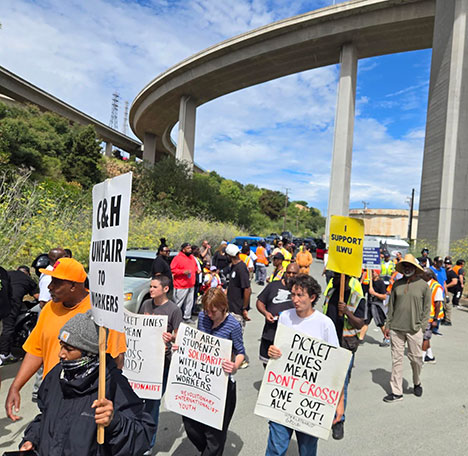 Picketers outside of C&H
Sugar refinery on July 21, as workers chanted "No one
in, no one out!" shutting down entrances to the
plant. (Internationalist
photo)
Picketers outside of C&H
Sugar refinery on July 21, as workers chanted "No one
in, no one out!" shutting down entrances to the
plant. (Internationalist
photo)JULY 26 – Finally! For the first time in a long time, in a key labor struggle in the United States, a mass picket line was organized to actually stop people and cargo from going in and out during a strike. And it is no accident that strikers are members of the powerful International Longshore and Warehouse Union (ILWU) in the San Francisco Bay Area.
On July 21, the union acted against the unloading of a shipload of raw sugar at the C&H Sugar refinery in Crockett, California, as hundreds of determined picketers blocked trucks trying to enter and exit the facility to transport the refined product. They also picketed the entrance for refinery workers, members of a separate union whose leaders had them cross the lines, which means scabbing on the strike and undermining the interests of all the workers. The hundreds-strong picket of July 21st must not be a one-shot deal. Mass pickets to shut the plant down are needed daily.
For the past six weeks (since June 15), C&H warehouse workers, members of ILWU Local 6, have been on strike after rejecting the company’s insulting contract “offer” that would cut sick days in half, eliminate retiree health benefits altogether, drastically slash overtime hours and attack seniority protections, with wage “increases” that would barely cover the current (4%) rate of inflation. ILWU Local 10, whose longshoremen handle the unloading of ship cargo, took up Local 6’s struggle when the longshore workers refused to cross the warehouse workers’ picket line to unload a ship, the Tai Herald, carrying sugar from the Philippines bound for the refinery.
The fight came to a head on the 21st, when company bosses started to have the ship unloaded. Local 10 shut down the port of Oakland along all with all the other Northern California ports, from Stockton to Eureka, and brought members to Crockett to beef up the lines. By 10 a.m., some 400 ILWU members and supporters fanned out, picketing at every entrance to the plant. At the truck entrance, closest to where the ship was docked, picketers chanted “Close the hatch” and “You ain’t gonna get no sugar today, go on and turn that truck away!” Sure enough, no sugar got through their line. Trucks were backed up for half a mile, up to the freeway offramp.
Picketers were full of energy. At the employee entrance used by scabbing refinery workers, picketers formed a line to keep anyone from going into or leaving the refinery, chanting “No one in, no one out!” Even after two picketers were struck by scabs’ cars ramming their way through the line, they were undeterred. Several expressed the sentiment, “This is what we have been waiting for.” It was only when police arrived in force that the company regained the upper hand. Acting as armed enforcers for the bosses, cops herded scabs to and from C&H. It was made crystal clear that the picket line is the literal class line between labor and capital.
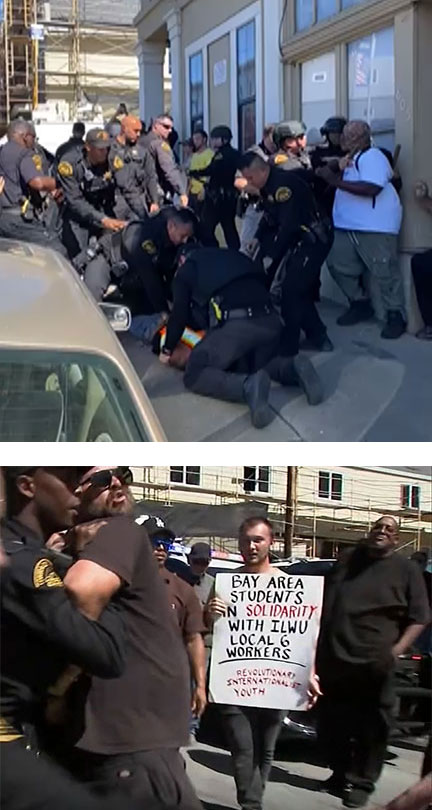 On July 21, police ordered
the picket line to disperse, and after the last
picketers left, the cops surrounded them, tackling and
injuring two ILWU members (top photo), and arrested ten,
including five from ILWU Local 10 and five supporters of
the Internationalist Group, Revolutionary
Internationalist Youth and the Internationalist
Club. This is a clear example of how the police
are the enforcers for the capitalist bosses. (Top: Internationalist photo, Bottom: ABC7)
On July 21, police ordered
the picket line to disperse, and after the last
picketers left, the cops surrounded them, tackling and
injuring two ILWU members (top photo), and arrested ten,
including five from ILWU Local 10 and five supporters of
the Internationalist Group, Revolutionary
Internationalist Youth and the Internationalist
Club. This is a clear example of how the police
are the enforcers for the capitalist bosses. (Top: Internationalist photo, Bottom: ABC7)After the police issued a dispersal order, union leaders called on picketers to leave. Initially, many weren’t having it, but numbers dwindled gradually from around 100 on the line. As the last dozen or so exited, the police surrounded them after they had left the picket site. Cops charged into the group targeting a black worker, breaking a plate glass window in tackling him, and pinning him to the ground with a knee in the back. Another’s legs were kicked out from under him. Two picketers were injured and ten arrested, five Local 10 members and five from the Internationalist Group and students from the Internationalist Club. We demand charges against all ten be dropped, now!
The labor battle at the Crockett refinery is not just a local fight. With over 500 workers, the Californian and Hawaiian Sugar Company refinery produces 15% of the U.S.’ cane sugar and is part of the American Sugar Refining (ASR) conglomerate that dominates the industry. The ASR Group is owned by the Fanjul brothers, Cuban exiles who are big donors to both Democratic and Republican parties, are credited with launching Marco Rubio’s Senate tenure and are deeply embedded in the Trump administration. The Fanjul operations in the Dominican Republic have been denounced for using forced labor, and they have declared their intent to recover their properties that were expropriated in the Cuban Revolution.
Meanwhile, the sugar being unloaded at the C&H refinery from the Tai Herald comes from Negros Island, known as the “sugar bowl” and also the “massacre capital” of the Philippines, where numerous mass killings of sugar cane workers and activists have taken place from 2018 on. Most recently, the Philippine Army commanded by U.S. ally Ferdinand Marcos Jr., as part of its decades-long war of extermination against the Maoist New People’s Army, killed 19 people in April. Among the civilians murdered were Filipino American activist and San Francisco State University graduate Lyle Prijoles. C&H is bringing in sugar drenched with the victims’ blood.
The ILWU has taken up the fight in a major class battle against a union-busting employer, C&H, one of the oldest industrial companies in the region. Messages of solidarity are coming in from dockworkers around the world, including CGT port workers in Le Havre, France. ILWU Local 500 in Canada and Local 142 in Hawaii sent support to the picket line. Local 6 and Local 10 members showed the way on July 21. It’s high time for the longshore and warehouse workers to wage a joint struggle and elect strike committees,2 and for all of Bay Area labor to answer a call to action and mobilize militant picket lines until the strike is won.
To start, there should be a Bay Area-wide labor day of action to shut C&H down tight!
For Class-Struggle Unionism!
The battle over the C&H refinery underlines at every turn the need for union policies of militant class struggle. In the first place, there is the urgent need to overcome divisions to present a solid front against the owner, the ASR Group, which is out to break the unions. When ILWU Local 6 warehouse workers walked out on June 15, the refinery workers were told by the leaders of Sugar Workers Union (SWU) Local 1 to keep working. Local 1’s leadership collaborated with C&H management in telling workers that refusing to cross the picket lines, which any self-respecting union member is duty-bound to respect, would cost them their jobs. In effect, the SWU misleaders acted as a transmission belt for the union-busting bosses.
The Sugar Workers are an affiliate of the Seafarers International Union (SIU), which at its founding in 1938 acted as a racist attack dog against the integrated CIO3 maritime unions (ILWU and National Maritime Union). SIU president Harry Lundeberg pushed anti-Communism as the U.S. government tried for years to deport ILWU founder Harry Bridges on the grounds of Communist sympathies. This reached a fever pitch during the post-World War II Cold War “red purge” in fights over the predominantly black and gay Marine Cooks union, that was destroyed in the McCarthyite witch-hunting. The Inlandboatmen’s Union broke away from the SIU and joined the ILWU in 1980 as its Marine Division. At C&H, although SWU tops told workers to cross the lines, their contract explicitly says they have the right to respect pickets.
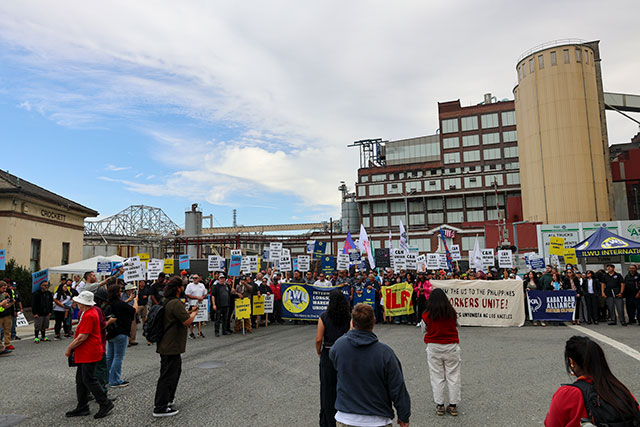
June 2026, strikers and supporters outside the refinery, including a number from Filipino groups protesting the murder of 19 people by the Philippine military on Negros Island, where the sugar for C&H is imported from. ILWU Local 10 passed a motion of solidarity with the Filipino community against the repression. (Photo: KQED)
On July 16, a month into the warehouse strike, the SWU membership met and discussed what to do about it. Although the union bureaucrats managed to convince a majority to continue working – that is, to keep on scabbing on the strike of their fellow workers – some 78 reportedly voted to respect the picket lines. If the refinery workers refuse to cross, it would effectively shut down the plant, a key step to win the strike, and there is talk of a possible revote. In any case, an outpouring of support from Bay Area labor must drive home the basic union principle that “Picket lines mean don’t cross, period!” The fact that this basic principle has been watered down more and more over the years is a big part of why so many strikes have been lost. This one must be won!
Then there is the matter of Levin Richmond Terminal, where C&H had the ship from the Philippines moved when ILWU Local 10 refused to cross the Local 6 picket lines to unload it. Local 10 picketed in Richmond, as it had every right to do because diverted cargo is scab cargo. The port of Richmond is ILWU jurisdiction, but that industrial pier is organized by the International Operating Engineers (IUOE), which is notorious for poaching and raiding other unions. In the early 1980s, the ILWU campaigned to bring Levin under its jurisdiction, but called it off when the company proposed to pay ILWU workers while the IUOE did the work. This deal expired in 1990, but while the ILWU defeated RICO (Racketeer Influenced and Corrupt Organizations) conspiracy charges over the “ghost rider” deal, the Operating Engineers still run the pier.
So both in Crockett and Richmond, there are what the bosses pretend are inter-union disputes when in fact the ILWU is facing a union-busting offensive using divisions in the labor movement fostered by the capitalists and their government. What’s needed to fight this treacherous class collaboration is a program of militant class struggle extending to the whole of the working class. This goes for ILWU Locals 6 and 10 as well, which instead of picketing separately should be waging a joint strike. Playing by the bosses’ rules, under which the capitalist courts presume to regulate labor’s struggles, only weakens the union.
A class-struggle policy also requires an international perspective. The sugar processed at C&H originally came from Hawaii, where the ILWU organized the sugar plantation workers and dockworkers. The last Hawaiian sugar came in 2017, and since then the refinery uses Philippine sugar. The killings in Negros go back to the 1985 Escalante massacre of 20 cane workers on a picket line under Ferdinand Marcos Sr., the dictator who served U.S. imperialism (much as did Fulgencio Batista, the dictator overthrown in Cuba in the Revolution of 1959). And as a recent Local 10 motion of solidarity with the Filipino community noted, Marcos sent agents to murder Filipino American ILWU Local 37 labor leaders Gene Viernes and Silme Domingo at their union hall in Seattle in 1981.
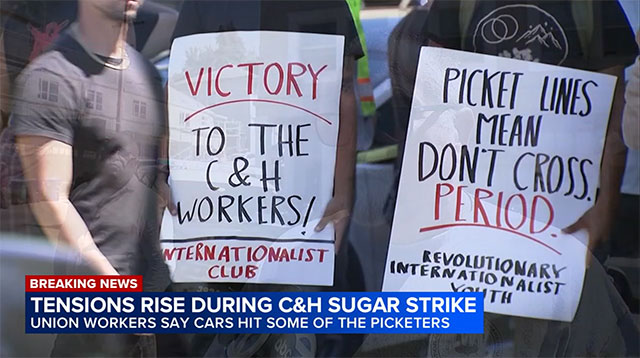
Internationalist signs at the picket on July 21. Students in the East Bay Internationalist Club had regularly joined in picketing. (Photo: ABC7)
Local 10’s solidarity has brought scores of Filipino activists to the picket lines and points to the potential for the battle over C&H Sugar to cohere wide support. Sentiment in Crockett, once a company town, is running heavily against cold-hearted privately held multinational now running C&H. Working people are already “hot summer mad” about budget-busting $6.50 per gallon gasoline due to Donald Trump’s criminal war on Iran. Sympathy with Cuba against the Trump regime’s attempt to strangle the island with a total oil boycott is widespread, and a fight against the gusano Fanjul slave-labor exploiters could awaken wide sympathy.
With the ILWU, the most powerful union on the coast, in the lead, there is clear potential for a Bay Area labor offensive against union-busting that can win the strike. The Longshore and Warehouse Union showed its power by shutting down all ports on the U.S. and Canadian West Coast against the U.S. war on Iraq and Afghanistan on May Day 2008. It stopped work to protest the racist police murder of George Floyd and so many others in 2020. Local 10 shut the port of Oakland demanding freedom for former Black Panther Mumia Abu-Jamal, and over the police murder of Oscar Grant. And on July 21, the Bay Area ILWU locals gave a taste of what real class struggle looks like.
What is needed is to mobilize picket lines so massive and militant that no one will cross, shutting the struck plant down. By linking the struggles of all workers, ILWU Locals 6 and 10 can beat back the union-busters and point the way forward for the labor movement in organizing the unorganized. This highlights the need to break with both the Democratic and Republican parties, the pillars of U.S. imperialism, and taking up the fight to build a class-struggle workers party, a party that can lead all the oppressed in the fight to replace capitalist rule with a workers government. Bay Area labor must mobilize now to win the C&H battle! ■
- 1. See "Defend the Charleston Five!" The Internationalist No. 5, June 2001.
- 2. An elected strike committee representing the membership can play a big role in mobilizing for and holding the line in a major battle. This is very different from situations where some unionists and others just proclaim one without serious backing from or participation by the strikers themselves.
- 3. Congress of Industrial Organizations, consisting of industry-wide unions rather than the craft unions of the American Federation of Labor (AFL).