

October 2026

Brazil
2026 Elections:
Mobilize Workers to Crush
the Military / Police Threat
By
Defending Capital, Lula Opens the Way to Bolsonaro
At the Polls: Vote No – In the Streets: Class Struggle
On October 25, Luiz Inácio Lula da Silva won Brazil’s
second-round presidential election by 52% (64 million
votes) to 48% (60 million votes) for the ultra-rightist
Flávio Bolsonaro. This dramatic turnaround, picking up an
additional 10 million votes over his showing in the first
round of voting on October 4, will mean an
unprecedented fourth term as president for Lula.
However, he will face a Congress in which his
“center-left” Broad Front has barely one-fifth of the
seats, facing a right-wing and ultra-rightist
majority.
The 2026 presidential elections, for which the second round of voting is this Sunday, October 25, will be one of the most significant since the establishment of Brazil’s “new republic” in 1985. Luiz Inácio Lula da Silva of the Workers Party (PT) is running for reelection for a fourth term as the candidate of the Broad Front together with his vice president Geraldo Alckmin, generally described as a pro-business “center-right” (bourgeois) politician with deep ties to Brazil’s capitalist establishment. Lula is facing off against Flávio Bolsonaro of the Liberal Party (PT), son of ex-president Jair Bolsonaro, presently under house arrest for his attempt to stage a coup d’état in January 2023 in order to stay in office. The Bolsonaro clan is closely identified with the military dictatorship which ruled Brazil with an iron fist for two decades beginning in 1964.
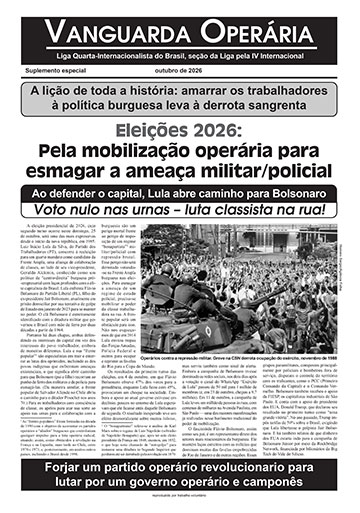 Front page of
the leaflet, translated here in English, published by the
Liga Quarta-Internacionalista do Brasil, the Brazilian
section of the League for the Fourth International.
Thus there are two slates, both of which defend the interests of capital rather than those of the working people, although in different ways. Lula and his “popular front”1 specialize in selling out and burying struggles of the oppressed, including by indigenous peoples facing existential threats, which means paving the way for the Bolsonaros (father and son) to resort to the iron fist of the military and the police to crush them. (Similarly, Salvador Allende’s popular front in Chile paved the way for the dictator Pinochet in the 1970s.) For class-conscious workers, calls to tie their fate to support at the polls for collaboration with the bourgeoisie pose a mortal danger in the face of the threat of a brutally repressive, “Bonapartist”2 military/police regime. This danger will not be defeated by voting for the bourgeois Broad Front in the elections. To crush the threat of a police-state regime we must mobilize the power of the working class in the streets. The popular front will be an obstacle to that. Let's not forget that in 2014 Lula sent troops of the Armed Forces, the Federal Police and other agencies to occupy and repress the favelas3 in Rio for the World Cup.

The results of the first round of voting on October 4, in which Flávio Bolsonaro received 47% of the votes for president while Lula got 45%, sent shock waves through society. While support for the present government had been waning, few in Lula’s entourage expected him to come in behind the second-rate fascistic Bolsonaro knock-off. The unexpected result had a demoralizing effect on many lulistas, but served as a wake-up call. While the Bolsonaro camp had dominated social media, in the two days after the vote the WhatsApp channel “Exército de Lula” (Lula’s Army) went from 50,000 to 1 million members (and by October 23 reached 9.7 million). On October 11, the Lula campaign brought a million people into the streets, with hundreds of thousands in São Paulo’s Avenida Paulista, one of the biggest demos ever in that barometer of mobilization power.
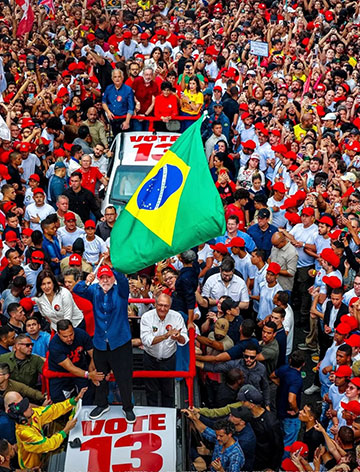 Lula at a massive final
campaign rally on Avenida Paulista, in São Paulo, October
24. (Photo: Ricardo Stuckert /
Brasil de Fato)
The fascistic Flávio Bolsonaro, like his father, is a representative of the most reactionary sections of the bourgeoisie. He is closely tied to the militias which dominate many of the favelas in Rio de Janeiro and elsewhere. These paramilitary squads, mainly of off-duty and retired police and firemen, compete with drug-trafficking gangs like the PCC (First Command of the Capital) in São Paulo and Comando Vermelho (Red Command) in Rio for territorial control. Bolsonaro has also received the support of the FIESP, the association of industrial capitalists of São Paulo. And he has the favor of U.S. president Donald Trump, who declared his first-round showing “a great victory.” Last year, Trump slapped 50% tariffs on Brazil, demanding that Lula free the coup plotter Jair Bolsonaro. And there are also reports of U.S. money flowing to the Bolsonaro Jr. campaign via the Rockbridge Network funded by Silicon Valley Big Tech billionaires.
Lula, on the other hand, is the candidate of an alliance, the Broad Front, that binds the PT, a reformist workers party, to sections of the bourgeoisie, like the “popular fronts” of the 1930s (France, Spain) and 1970s (Chile). These class-collaborationist electoral lash-ups are bourgeois formations, in which even the smallest bourgeois parties serve as guarantors that the coalition won’t transgress the bounds of capitalism. In the 2026 elections, Lula is not only allied with Alckmin (a former leader of the PSDB, the main “center-right” capitalist party) but also with the PSB (Brazilian Socialist Party), the PDT (Democratic Labor Party), the environmentalist REDE and Green Party, all minor bourgeois parties, along with the PCdoB (Communist Party of Brazil) and PSOL (Party of Socialism and Liberty), both reformist social-democratic parties
The bottom-line principle of all genuine communists is to fight for the political independence of the working class, to draw the class line in refusing to vote for any bourgeois party, coalition or candidate. As Karl Marx wrote in 1871, “The workers party must never be the tagtail of any bourgeois party” (“Apropos of Working-Class Political Action”). This is precisely what the formation of a popular front, no matter how “broad,” negates. Such fronts serve as a roadblock to revolution, and hold back radical workers struggles. In office, popular fronts may enact a few secondary reforms, but by blocking any measures that could potentially threaten the rule of capital, they serve to demobilize and demoralize the workers. In Brazil, as the PT has always sought bourgeois “partners,” that is exactly what has happened.
So the role of Lula’s Broad Front, and its predecessors like the Brazil Popular Front, Brazil of Hope, etc., has been to act as the gravedigger of workers’ struggles and fireman to put out the flames of revolution. The role of Bolsonaro is to be the hangman, the executioner. Between the executioner and the gravedigger there is a difference, but neither is a political ally. We may, and must, fight in the streets and on the barricades together with the lulista masses, but we must do so maintaining the political independence of the working class and fighting for a revolutionary workers and peasants government, not to put the Broad Front in power again. The governments of Lula (and his successor, Dilma Rousseff) limited themselves to welfare-state measures for the poorest of the poor, like Bolsa Família and Bolsa Escola (stipends for poor families and children enrolled in school). Yet workers’ living standards have sharply fallen, and deep discontent among working people has fueled support for Bolsonaro.
Of the threats cited to justify voting for Lula, Washington’s interference in the Brazilian elections is palpable. Everyone is aware that the White House supports Bolsonaro, whose father is often called the “Trump of the tropics.” In addition to on-again, off-again punitive tariffs, there is Trump’s designation the PCC and Comando Vermelho as “terrorist” organizations (after a visit to the White House by Flávio Bolsonaro and his brother Eduardo), which could open the way to death squads and direct U.S. military intervention. The social media platform Meta (Facebook, WhatsApp) has admitted that its algorithms have cut back access to Lula’s campaign, citing “technical incidents.” And Trump is demanding control of Brazil’s rare earth resources. But don’t expect an antiimperialist stance from Lula: in April his government approved the purchase of Brazil’s only working rare earths mine, Serra Verde, by USA Rare Earth.
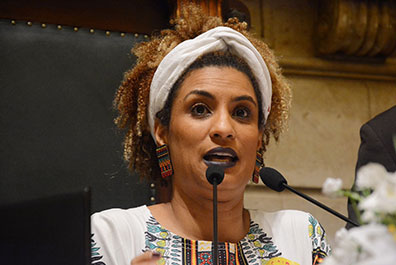 Marielle Franco, the Rio
de Janeiro city councilwoman and advocate for the oppressed
who was shot and killed in March 2018. The “Escritório do
Crime” militia — with which Flávio Bolsonaro had ties
through its member Adriano da Nóbrega — is suspected of the
crime.
(Photo: Mario Vasconcellos / CMRJ)
The threat of the imposition of police-state rule is also quite real. After a visit to El Salvador, Flávio Bolsonaro adopted a platform calling for maximum security mega-prisons like those of tinpot dictator Nayib Bukele. And on October 13 he added “I’m starting to think El Salvador is not enough.” Moreover, he has longstanding ties to the militias that impose iron-fisted control in the favelas and morros of Rio, the home base of the Bolsonaro clan. During the campaign Flávio reiterated his praise for militia leader Adriano da Nóbrega, a member of the Escritório do Crime (Crime Desk) militia which is suspected of involvement in the assassination of leftist Rio city councilor Michelle Franco, and claimed that the militias provide “security” for residents when they are notorious for shaking down the population. It’s no accident that in the favelas and morros of Rio controlled by the militias, 86% voted on the first round for Bolsonaro.
And the political climate today is certainly more favorable to installing a Bonapartist military / police regime than in 2022-23, when Bolsonaro Sr. attempted his coup. That included detailed plans to kidnap or assassinate Supreme Court justice Alexandre de Moraes and president-elect Lula, but it was called off when Army and Air Force commanders refused to go along, possibly due to pressure by the Biden administration. The current U.S. administration is sure to go all-out to put Bolsonaro Jr. in the Planalto Palace, even by extra-legal means. That would make Brazil the eighth country in Latin America to have installed a far-right president since Trump took office in January 2025, in almost all cases with direct intervention from Washington. And a fascistic Bolsonaro regime would sign on to the Trump-sponsored Shield of the Americas, joining the governments of Argentina, Bolivia, Chile, Colombia, Ecuador, El Salvador, Honduras, Peru and other Trump toadies.
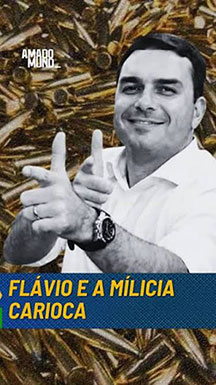 Image shows candidate
Flávio Bolsonaro mimicking his father Jair’s signature
“two-gun” posturing. The Bolsonaro clan’s ties to the
militias, which compete with rival drug-trafficking cartels
in imposing iron control of the favelas (slum areas), are
notorious.
(Photo: Mario Vasconcellos / CMRJ)
The military is ready to pounce. Already Air Force commander Marcelo Kanitz Damasceno and Army general (ret.) Augusto Heleno, under house arrest for the failed 2022-23 putsch, are selecting top military and police officials for a new Bolsonaro government. These include Alexandre Ramagem, who fled to the U.S. to avoid serving a 16-year sentence for his role in the coup plotting, as head of the Federal Police. Naturally, the putschists expect to be pardoned. But both Kanitz Damasceno and Heleno were appointed to their positions by Lula (just as Salvador Allende named General Augusto Pinochet defense minister just months before the bloody coup of Santiago de Chile on 11 September 1973). Popular-front governments are based on the repressive organs of the capitalist state, and again like Allende, Lula would try to stop potentially revolutionary workers mobilizations to block a military / police regime.
These bourgeois political formations are also beholden to another pillar of the capitalist state machinery, the judiciary. So when Lula was sent to prison by the court on bogus charges in the Operation Lava Jato (car wash) corruption case in a transparent move to prevent him from running in (and likely winning) the 2018 election that put Jair Bolsonaro in office, the PT leader refused to call his supporters into the streets. But then in 2021 when the bourgeoisie needed Lula to keep a lid on protests against Bolsonaro, the Supreme Court freed him on a technicality. Now the evangelical Supreme Court judge André Medonça is trying to tie Lula, and Supreme Court judge de Moraes (who sent the Bolsonaro putschists to prison), to the bankruptcy of the Banco Master on dubious fraud charges, even though the bank’s main owner Daniel Vorcaro funded Flávio Bolsonaro to produce a biopic (“Dark Horse”) about his father. This is Lava Jato II.
Faced with ominous prospect of a Bonapartist Bolsonaro II regime and the involvement of key sections of the state apparatus and U.S. imperialism in plotting to install military / police rule, almost the entire left is calling to vote for Lula in the second round of voting. This class collaboration will only lead to defeat. If Lula wins, the left parties who called to vote for him will be responsible for the actions of a new Broad Front government to sabotage workers struggles and implement anti-worker reforms by previous rightist regimes, as the current government has done. If he “loses” due to anti-democratic maneuvers by the Bolsonaro camp, they will be stymied by Lula’s submission to the capitalist state, just as in 2018. What’s needed is militant mobilization of the power of the working class, in the streets and in the factories in militant strikes like those that brought down the military dictatorship but have been extremely rare since.
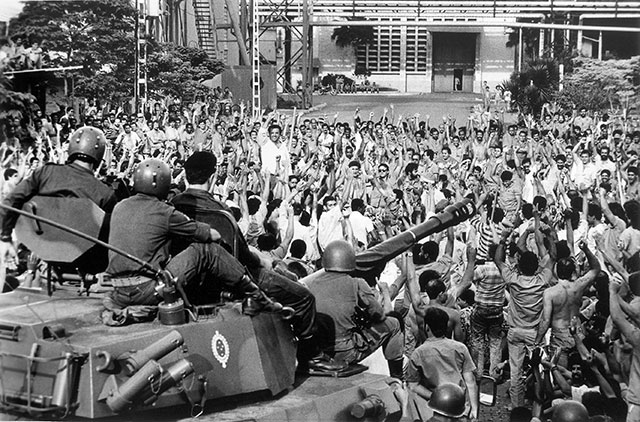
Workers against military repression. Strike at CSN steel plant in Volta Redonda won despite army occupation, November 1988. (Photo: Homero Sergio/Agência Folha
For the PT, PSOL and PCdoB, it is only logical that they call to vote for Lula, as they are members of the popular-front coalition, and have been for at least 20 years. Others, including several groups that falsely claim to be Trotskyist, jump through hoops to justify this treacherous opportunism. The Revolutionary Movement of the Workers (MRT), the Brazilian section of the Current for Permanent Revolution (formerly Trotskyist Fraction), argues that even though the Lula government demoralized workers by implementing pro-capitalist, anti-worker “reforms” inherited from previous administrations the approval of the PEC (constitutional amendment) ending the six-day workweek (escala 6 x 1) by the Senate was a “a victory over skepticism that shows the far right can be defeated” (Esquerda Diário, 15 October) and “a victory that demonstrates the social strength that can counter Bolsonaroism” (Esquerda Diario, 18 October).
But the final result was only a five-day, 40-hour workweek common in many capitalist countries, whittling down the original for a four-day workweek (4 x 3), and Lula only decided to push it through for electoral reasons, to whip up support after his stunning defeat on October 4. Meanwhile, Bolsonaro supporters already have bills to roll back this reform. So after calling to back candidates “with Independence from the Broad Front and the Regime”4 in the first round, what is the MRT’s watchword in the second round? It calls to “Defeat Flávio Bolsonaro!” and “No Vote for the Far Right!”5 Well, that’s not hard to figure out for any experienced reader of the left press. This is a shamefaced call to vote for Lula and the Broad Front without the courage to say so openly. And the reason for that is that the MRT knows well that by giving political support to this bourgeois front, they are betraying Trotskyism.
The organization Brasil Comunista (BC), formerly Esquerda Marxista, part of Alan Woods’ Revolutionary Communist International (the former International Marxist Tendency after an image makeover), is even more contorted. In one article6 it takes the left to task for incorrectly referring to a Bolsonaro regime as “fascist,” and goes on at length about Trotsky’s concept of Bonapartism as a police-state regime without saying if that is what Bolsonaro II government is aiming at (which it is). In an earlier article it opines that Bolsonaro in office would set off big class clashes (quite likely), but “For this reason, the pendulum is likely to swing even more sharply to the left in the coming period.”7 But if the left should not be alarmist, if a Bolsonaro regime would not be fascist (they don’t even call it Bonapartist), if the political pendulum is just swinging to and fro, what is their conclusion? BC calls “to help the most advanced sectors of the working class to defeat Flávio, their most dangerous enemy, with a critical vote for Lula.”
In other words, what these pseudo-Trotskyists are doing is capitulating to the sentiment of working people who are terrified of the prospects of a new Bolsonaro regime, and using this to drive them back into the arms of the Lula/Alckmin Broad Front whose capitalist program paved the way for Bolsonaro in the first place. What’s needed instead is not to join a social-media “Lula’s Army” but to organize working-class power. The Liga Quarta-Internacionalista do Brasil, section of the League for the Fourth International, calls to vote no (voto nulo) in the elections and to form workers committees in the plants, workers councils in industrial areas and workers defense committees to confront the threat of police-state rule.
Above all, it is necessary to forge a genuinely Leninist communist party on the Trotskyist program of permanent revolution, and to fight for a workers and peasants government to expropriate the bourgeoisie and extend socialist revolution from Latin America to the imperialist heartland. ■
- 1. “Popular Fronts” were formed in the 1930s in order to chain workers parties to bourgeois “allies” that would rein in impulses toward radical workers struggle, and thus acted as roadblocks to revolution in France and Spain, later in Chile in 1970-73 and subsequently in many other countries, including Brazil since 1998.
- 2. “Bonapartism” refers to Karl Marx’s analysis of the regime of Louis Napoleon (nephew of Napoleon Bonaparte), who having been elected president of France in 1848 staged what would be called today a “self-coup” in 1852 to install a dictatorship (the Second Empire) that lasted until he was overthrown by the revolution of 1870.
- 3. The favelas and morros (hills) are the impoverished slum areas in and around major Brazilian cities, particularly Rio de Janeiro. Many are controlled by drug-trafficking gangs while others are under the boot of militias composed of off-duty and retired military police and military firemen.
- 4. MRT Editorial, “Enfrentar a extrema direita, o imperialismo e todos os ataques com independência da Frente ampla e do regime” (Confront the Far Right, Imperialism and All the Attacks with Independence from the Broad Front and the Regime), Esquerda Diário, 16 September.
- 5. MRT Editorial, “Derrotar Flávio Bolsonaro! Fora Trump da América Latina! Nenhum voto na extrema direita! Construir a mobilização anti-imperialista,” Esquerda Diário, 7 October.
- 6. “Contra o alarmismo da esquerda: O que é e o que não é o fascismo,” Brazil Comunista, 21 October.
- 7. “O reformismo no banco dos réus nas eleições de 2026,” Brasil Comunista, 1 September.