

April 2026
Trump Orders Oil Blockade to Strangle the Rebel Island
For International Workers
Mobilization
to Defend the Cuban Revolution!
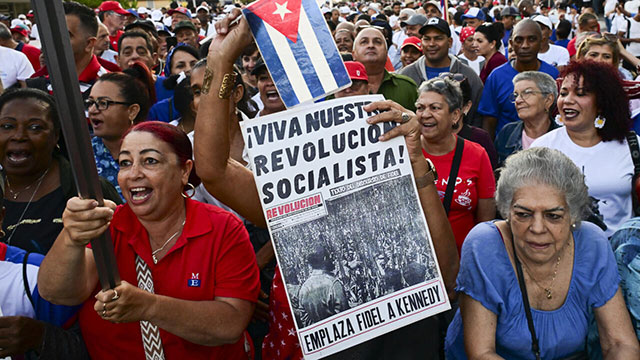
On April 16 Havana celebrated the 65th anniversary of the Bay of Pigs invasion, when Cuban forces crushed the invasion by counterrevolutionary exiles (gusanos) organized by the U.S. Central Intelligence Agency (CIA). That was when Fidel Castro declared the Cuban Revolution “socialist.” (Photo: Yamil Lage / AFP)
The following article is translated from the upcoming issue of Revolución Permanente, the newspaper of the Grupo Internacionalista, Mexican section of the League for the Fourth International.
In the early hours of January 3, helicopters from the U.S. armed forces flew low over Caracas. Their mission: to “extract” – that is, to kidnap – the president of Venezuela, Nicolás Maduro, along with his wife, Cilia Flores. During the attack, 32 officers of the Cuban armed forces and security services who were part of the Venezuelan president’s security detail were killed in combat, after putting up fierce resistance, according to a statement from the Cuban government. It was clear that the U.S. imperialist onslaught was “intended to seize control of the enormous oil reserves of the Bolivarian Republic, the largest in the world, and to prepare the way for a counterrevolutionary assault on Cuba,” as we stated in a declaration by the League for the Fourth International issued that same day. “Defense of Cuba begins in Venezuela,” proclaimed LFI placards in protests.
Asked by reporters the following day whether the Cuban government would be the United States’ next target, U.S. secretary of state Marco Rubio – who grew up in the Miami community of counterrevolutionary Cuban exiles – responded that every Cuban official should be worried. For years, Venezuela under Maduro and his predecessor Hugo Chávez has been Cuba’s main supplier of oil, sending some 35,000 barrels per day to the island. But on January 11, President Donald Trump railed on his Truth Social network, “THERE WILL BE NO MORE OIL OR MONEY GOING TO CUBA – ZERO!” And then on January 29, Trump signed Executive Order 14380, in which he pronounced that “Cuba constitutes an unusual and extraordinary threat … to the national security and foreign policy of the United States,” and he therefore declared a “national emergency” to impose tariffs on “imports of goods that are products of a foreign country that directly or indirectly sells or otherwise provides any oil to Cuba.”
Latin American governments, starting with the Mexican government of President Claudia Sheinbaum, immediately complied with the imperialist order. In 2025, Mexico supplied 44 percent of Cuba’s oil imports. On January 9 of this year, the tanker Ocean Mariner docked in Havana with a cargo of 85,000 barrels of light crude from the PEMEX1 complex in Pajaritos, Veracruz. But after that, nothing. When the same ship set sail from Barranquilla, Colombia, on January 29 with a new cargo of fuel oil, it was prevented from reaching Cuba by U.S. warships. Not even the shadow fleet2 has functioned. The website Razones de Cuba (run by the Ministry of the Interior) revealed that between December 2025 and February 2026, U.S. naval forces seized “at least ten tankers linked to the Cuban supply network,” carrying almost 9 million barrels. For nearly three months, not a single oil tanker reached the island.
The impact has been drastic. Diesel fuel, essential for trucking, is in such short supply that it is often impossible to find even at high prices on the black market. The fuel shortage has been a factor behind an escalation of blackouts, with a total grid collapse on March 16 and another on March 21, leaving Cuba’s 11 million residents in the dark for many hours. Another factor is equipment breakdowns resulting from a lack of foreign currency to modernize facilities due to the “normal” blockade of Cuba by U.S. imperialism, which has now lasted 62 years, since the first years of the Cuban Revolution. In addition to the longstanding attempt to economically paralyze the island, now there is “energy suffocation.” The empire of the North always seeks to “make the economy scream” in the countries targeted by its anti-communist fury, as Richard Nixon’s infamous secretary of state Henry Kissinger said of Salvador Allende’s Chile in the run-up to the bloody coup d’état of 11 September 1973.
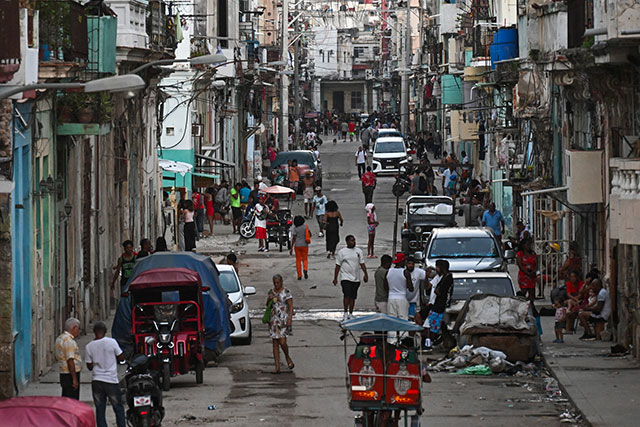
A street in Havana during the March 16 blackout that cut off power across the island. (Photo: Yamil Lage / AFP)
The current energy blockade against Cuba is an act of war intended to destroy the socialized economy of this bureaucratically deformed workers state in order to provoke a counterrevolution. With his January 3 attack on Venezuela, turning it into a U.S. client state, Trump paved the way for a full-scale offensive against Cuba. “I think I’ll have the honor of taking Cuba,” he boasted on March 17, the day after the massive blackout. The restoration of capitalism in Cuba would mean the dismantling of the impressive achievements in the fields of education and health care, as well as a resurgence of racism against black people, the elimination of key social rights such as free access to abortion within a high-quality socialized health care system, endangering the massive participation of women in social life, and threatening democratic and social rights for gay, lesbian and trans people, among others.
The Cuban Revolution is in danger. In this hour of extreme need, Cuba must not be left to stand alone. It is incumbent upon the workers movement – from Mexico and Brazil to the very heart of U.S. imperialism – to mobilize its class power in defense of Cuba! This includes taking to the streets to demand an end to the economic, commercial and financial “embargo” against Cuba and to break the oil blockade that is suffocating the island. Defying the capitalist governments complicit with Trump, the workers of PEMEX in Mexico and Petrobras in Brazil3 should use union power to send oil to Cuba. This should include union fundraising to finance the shipment and sending expert technical assistance to help repair the island’s deteriorating electricity production infrastructure. In the face of military action, working people and youth in the U.S. should flood Wall Street to shut down the center of capitalist high finance.
This urgent need for proletarian mobilization in defense of the Cuban Revolution demands that the exploited and oppressed break with all capitalist politicians and parties. However, the sellout labor leaders, instead of mobilizing the power of the working class, limit themselves to begging the bourgeois governments of Claudia Sheinbaum in Mexico, Lula da Silva in Brazil, and Delcy Rodríguez in Venezuela (!) – the very same governments that have bowed to Trump’s diktat and are no longer sending a single drop of oil to the besieged island. In Mexico, some toothless “anti-imperialist fronts” have been formed, whose main aim is to put pressure on and whitewash the bourgeois populist government of MORENA (Sheinbaum’s National Regeneration Movement). Instead, it’s necessary to forge a class-struggle workers leadership, independent of all wings of the bourgeoisie, and to build Leninist-Trotskyist revolutionary workers parties.
Imperialism, Economic Blockade and Energy Strangulation
On the same day of the U.S. attack on Venezuela, in demonstrations in Mexico City, Puebla, and Oaxaca, along with our comrades of the Internationalist Group in the United States, we emphasized the urgent need to mobilize the power of the working class on a continental scale to defeat the U.S. imperialists and defend Cuba against counterrevolution. A spokesperson for the Grupo Internacionalista, speaking from the podium at the demonstration in front of the U.S. Embassy in the Mexican capital, said:
“The ultimate goal of this imperialist onslaught is not merely to get rid of the Chavista regime in Venezuela.4 It is, essentially, to destroy the Cuban Revolution, which more than 60 years ago expropriated the bourgeoisie on the Caribbean island, just 90 miles from the imperialist beast. It must be clear that defense of the Cuban Revolution and its gains begins in Venezuela. It must also be clear that this is about defending socialized property, the planned economy, etc., which can only be accomplished by extending those gains throughout the hemisphere, fighting for international socialist revolution.”
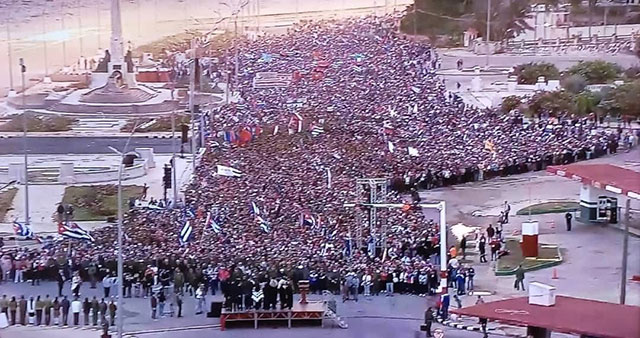
On January 16, tens of thousands of people took part in a memorial service in Havana honoring the 32 Cuban officers who fell in combat against the U.S. imperialist attack on Venezuela. (Photo: Prensa Latina)
Meanwhile, in several cities across Cuba, thousands of people took to the streets to protest the attack on Venezuela. Days later, tens of thousands gathered in front of the Armed Forces Ministry headquarters to pay tribute to the 32 slain officers, the largest number of Cubans killed in combat against the Yankee imperialists since the gusano5 Bay of Pigs invasion, defeated by the forces led by Fidel Castro, including workers militias, in April 1961. The following day, on January 16, tens of thousands once again gathered in José Martí Anti-Imperialist Square in front of the U.S. Embassy to condemn the U.S. imperialist assault and stand up to the threats by would-be emperor Trump to cut off oil supplies to Cuba. “No one is surrendering here,” declared Cuban president and first secretary of the Communist Party (PCC) Miguel Díaz-Canel, repeating the iconic phrase shouted by Commander Juan Almeida Bosque in December 1956 when the few survivors of the Granma yacht landing were surrounded by troops of the bloody dictator Batista.6
In the weeks following the attack on Venezuela – and with the shameful collusion of the Mexican government (and also with the acquiescence of the governments of Colombia and Brazil, other supposed “allies” of Cuba) – Trump has succeeded in imposing the most severe military and economic blockade against Cuba since the island was surrounded for 13 days during the Missile Crisis of October 1962.7 A detailed article in the New York Times (20 February), “A New U.S. Blockade Is Suffocating Cuba,” starkly describes this process of strangulation:
“Cuban tankers have hardly left the island’s shores for months. Oil-rich allies have halted shipments or declined to come to the rescue. The U.S. military has seized ships that have supported Cuba. And in recent days, vessels roaming the Caribbean Sea in search of fuel for Cuba have come up empty or been intercepted by the U.S. authorities.”
Recently, Trump’s threats have become more strident. Although a Russian oil tanker, the Anatoly Kolodkin, managed to reach Cuba on March 31 with a cargo of 730,000 barrels of crude oil, that will only cover the country’s oil needs for about two weeks. When asked by a journalist whether Mexico would be allowed to send oil to Cuba, White House spokesperson Karoline Leavitt emphasized that “there has been no firm change in our sanctions policy.... We still reserve the right to seize vessels, if it’s legally applicable, that are headed toward Cuba and that violate the United States sanctions policy” (New York Times, 31 March). Is it “legally applicable” for the U.S. government to seize Mexican oil tankers? The very fact that Claudia Sheinbaum’s government feels the need to seek U.S. approval to send oil to Cuba is clear proof of Mexico’s semicolonial status.
Cuba produces only 30 to 40 percent of its oil needs. That supply is largely limited to powering the country’s electricity generating plants, as Cuban crude is too heavy to be distilled in the island’s refineries. Virtually all the oil used for gasoline, diesel and jet fuel must be imported. And the aging network of thermoelectric plants (half of which date from before 1959) provides a very unstable electricity supply, partly because burning sulfur-rich Cuban crude produces sulfuric acid, which damages boilers, turbines, and other equipment. Even before the current strangulation campaign, Cuba’s energy situation was quite difficult, and today, with only seven out of ten thermoelectric plants in operation, even they are running at only a fraction of their installed capacity, resulting in repeated blackouts that not only hamper the island’s economy but also weigh heavily on the daily lives of its inhabitants.8
Economic Blockade Aims to Incite Counterrevolutionary Riots
The effects of the current stranglehold compound those caused by more than six decades of imperialist siege. When an undersecretary of state under President Dwight Eisenhower wrote a 6 April 1960 memorandum suggesting the imposition of an “embargo” against Cuba, he bluntly stated that its purpose would be “to decrease monetary and real wages, to bring about hunger, desperation, and overthrow of government.” As we noted five years ago, the blockade “continued under executive orders by successive U.S. presidents, until Democrat Bill Clinton made it a law and intensified it in the 1992 Cuban Democracy Act and the 1996 Cuban Liberty and Democratic Solidarity (Helms-Burton) Act.”9 In 2017, Republican Trump imposed his infamous “243 measures” to intensify the blockade, and now he has completely cut off the supply of oil.
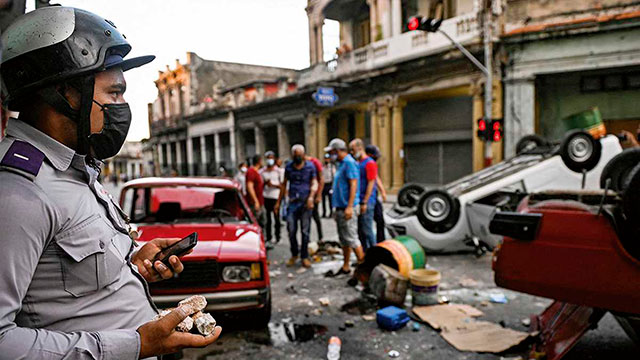
Police cars overturned during anti-government riots on 11 July 2021. (Photo: Yamil Lage / AFP)
This has forced the Cuban government to take drastic measures to conserve fuel. Fuel will be sold only in dollars, with a limit of 20 liters per person. The workweek has been reduced to four days in public workplaces. Intercity train and bus service has been limited. University education will be conducted remotely or in a hybrid format, with different arrangements in secondary schools, while teachers, students and parents are making enormous efforts to keep schools open for basic (elementary) education. Twenty thousand solar energy systems are being installed in housing, with 10,000 delivered on an expedited basis to healthcare and education workers. In hospitals during blackouts, surgeries have had to be performed by the light of cell phones. Even so, it is reported that “Cuban Patients Are Dying Because of U.S. Blockade, Doctors Say” (New York Times, 26 March).
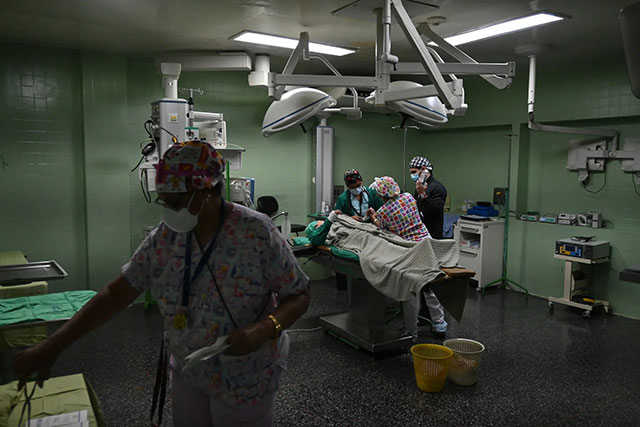 The William Soler
Pediatric Hospital in March. Due to fuel shortages caused by
the U.S. blockade, many hospitals have had to perform
surgeries using light from cell phones. (Photo: Jorge Luis Baños / New York
Times)
The William Soler
Pediatric Hospital in March. Due to fuel shortages caused by
the U.S. blockade, many hospitals have had to perform
surgeries using light from cell phones. (Photo: Jorge Luis Baños / New York
Times)In mid-February, the Canadian mining company Sherrit (which extracts cobalt and nickel through a joint venture with the Cuban government in Moa, in Holguín province) announced the suspension of its operations due to a lack of fuel. The once-thriving industrial sector of the Cuban economy lies in ruins, a result also of the counterrevolutionary destruction of the Soviet Union and the bureaucratically deformed workers states of Eastern Europe during 1989-92. Even the tourism sector, once seen as a way to shore up the Cuban economy, has failed to recover since the 2020-21 pandemic period, when international travel was drastically reduced. Today, the situation is only getting worse: more than half of airlines with flights to Cuba have indefinitely suspended their service due to a lack of jet fuel on the island.
On the political front, the energy blockade the U.S. has imposed on Cuba is having an effect – though nowhere near as much as the Miami-based counterrevolutionary elements or the U.S. intelligence and provocation agencies would like. They want to see a repeat and escalation of the anti-government protests of 11 July 2021 until they turn into openly counterrevolutionary riots. As we wrote at the time: “While fueled by desperation over food shortages, lack of medicine and blackouts that have beset the island in the wake of the coronavirus pandemic, the marches were instigated, manipulated and exploited by forces seeking to overthrow the Cuban Revolution” (“The Truth About Cuba Protests – Defend the Revolution Against U.S. Imperialism and Its Frontmen!” The Internationalist No. 64, July-September 2021).
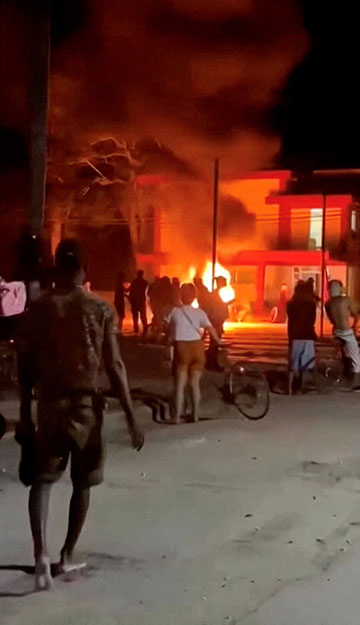 Anti-communist riot
outside the PCC headquarters in Morón, Ciego de Ávila
province, on March 13.
Anti-communist riot
outside the PCC headquarters in Morón, Ciego de Ávila
province, on March 13. (Photo: social media)
This past March 13, a nighttime demonstration in the municipality of Morón in Ciego de Ávila province ended with the sacking of the local Communist Party headquarters. Videos, widely circulated on social media by counterrevolutionary outlets and the bourgeois press, showed a dozen young people instigating the destruction of the office (which was burned down), along with computer equipment and furniture. Some of the protesters can be heard banging on pots and pans while shouting “Down with communism!” There is now a media campaign to present this as part of a wave of pot-banging protests (cacerolazos) and roadblocks. “We are all Morón!” wrote the U.S.-financed blogger Yoani Sánchez. There have been a few incidents of protests banging pots, expressing frustration and calling for government action during or after prolonged blackouts, but they have been neither widespread nor overtly political.
What there is, however, is an obvious anti-communist campaign to incite riots. If it comes to that, class-conscious workers and all defenders of the Cuban Revolution must mobilize to thwart any counterrevolutionary and pro-imperialist action.
No to Suicidal “Reforms” Aimed at Restoring Capitalism!
After announcing in capital letters that Cuba would not receive a single drop of oil, Trump – in his typical bully-boy tone – urged the Cuban government to “make a deal.” What kind of agreement might that be, with a gun pointed at its head? In late February, U.S. secretary of state Rubio declared, after a meeting with Caribbean leaders, that if the island’s government “want[s] to make those dramatic reforms that open the space for both economic – and eventually, political – freedom,” the United States would be for it. He did not specify what “reforms” he was talking about. Two weeks later, word was leaked from Washington that Cuban president and PCC leader Díaz-Canel would have to go as a precondition, but that “regime change” could be postponed. This caused discontent in the gusano milieu in Florida. In any case, there is no doubt that the “reforms” the U.S. is demanding are aimed at dismantling the socialized economy.
And Cuban leaders are not saying emphatically “no.” On the contrary, on March 2, Díaz-Canel stated: “We must focus, immediately, on implementing the urgent, most necessary changes that need to be made to the economic and social model” (La Jornada [Mexico City], 2 March). These "transformations" would be linked to “business and municipal autonomy, and the downsizing of the state apparatus, the government and institutions.” Even more ominous was the announcement by the Cuban minister of commerce and foreign investment, Óscar Pérez-Oliva Fraga, that the government will allow investment by “Cubans residing in the United States and their descendants.” In an interview with the U.S. network NBC, Pérez-Oliva said this policy will apply “to investments – not only small investments, but also large investments, especially in infrastructure.” He summed up: “Cuba is open to having a fluid commercial relationship with U.S. companies.”
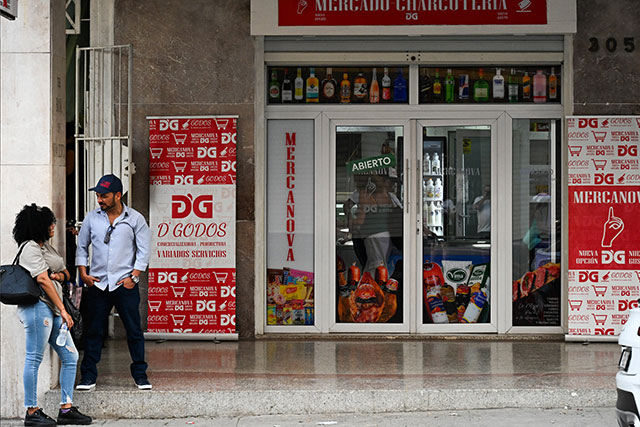 One of the 10,000 private
micro, small, and medium-sized enterprises established since
2024 that have contributed to the rise in inequality in
Cuba. (Photo: Yamil Lage
/ AFP)
One of the 10,000 private
micro, small, and medium-sized enterprises established since
2024 that have contributed to the rise in inequality in
Cuba. (Photo: Yamil Lage
/ AFP)The economic “reforms” proposed by the Cuban government are encouraging pro-capitalist forces within the island. The recent proposals by Díaz-Canel and Pérez-Oliva come on top of the 2019 amendments to the Constitution, which provided a constitutional basis for private ownership of certain means of production, as well as measures approved in 2020 aimed at strengthening the private sector of the economy at the expense of centralized economic planning through the implementation of the so-called “Tarea Ordenamiento” (Ordering Task).10 In late 2021, following the July protests, the opening of micro, small and medium-sized enterprises (MIPYMES) was permitted. As a result, “there are now ‘bodegones’ – small stores – well-stocked with high-quality domestic organic and imported products at high prices, where only the upper-middle class shops frequently,” notes University of Havana sociologist Mayra Paula Espina.
The sociologist is quoted in an in-depth BBC (10 March) report titled “How the opening of private grocery stores in Cuba exposed ‘invisible’ inequality.” By the end of 2024, some 10,000 MIPYMES had been registered, 60 percent of them in Havana, according to official statistics. Although the private sector is still small – a fact acknowledged even by U.S. secretary of state Rubio – it is already gaining both strength and recognition as a vehicle for restoring capitalism in Cuba. In an informative and interesting article, Cuban academic Javier Gómez Sánchez (“Cuba Between the United States and ‘Disaster Capitalism,’” Insurgente, 26 March) analyzes the proposals put forward by economists close to the governing bureaucracy and by some Cuban-American investors already doing business on the island, who – unlike the early ex-Batista gusanos – envision implementing “reforms” to appease the imperialists while maintaining formal independence from Trump’s dictates.
One of those profiled is businessman Hugo Cancio (who left Cuba in 1980 with his family during the Mariel exodus and now runs several capitalist companies in the country), owner of the magazine On Cuba. In a recent article, Cancio – a longtime opponent of the U.S. embargo against Cuba who promoted the “Cuban-American thaw” during Barack Obama’s presidency – calls upon the island’s government to urgently implement free-market reforms to “influence the pace, scope and nature of their transformation” to prevent “events from being defined from outside rather than by the country’s own institutions.”11 Gómez Sánchez also quotes political scientist Rafael Hernández, editor of the magazine Temas, who states, “Many issues on the pending agenda of Cuban reforms lie in areas that overlap the U.S. agenda toward Cuba. Among these are, for example, the expansion of the private sector.”12
Of course, as the Cuban gusanos and the Yankee imperialists recognize, a new liberalization of the economy to favor private enterprises would, in and of itself, be far from a restoration of capitalist class rule. But it is an ominous step that would encourage the growth of pro-capitalist forces in Cuba. Hernández makes his aim clear. He proposes: “7. Replace the centralized economic planning for the allocation of material and financial resources inherited from the USSR. Establish the market as the regulator of the state and non-state economy.” Gómez Sánchez rightly points out that such proposals present “a false dilemma, in which the ‘overlapping’ agenda is to be achieved either through ‘Cuban’ capitalism or ‘pro-American’ capitalism. But capitalism, in short.” Every revolutionary communist must oppose such plans for capitalist restoration.
In an emergency situation, such as is currently unfolding in Cuba, limited measures allowing for private initiative to supply the population with energy and consumer goods – thereby overcoming some of the bottlenecks in the highly bureaucratized economy – cannot be ruled out, provided that control by the workers state is maintained and the dangerous rise in inequality is countered. Some of the shrewdest proponents of free-market “reforms” point to the experiences of China and Vietnam, or the NEP (New Economic Policy) of the 1920s in Soviet Russia. However, those situations were quite different from Cuba’s today, and all harbor a potential for fostering capitalist counterrevolution. The significant capitalist sectors in China and Vietnam are pushing forward bourgeois forces that will inevitably clash with the foundations of the deformed workers state in the long run.
One highly dangerous current measure is allowing private companies and individuals to import oil. This was announced on February 6 by the foreign trade minister Pérez-Oliva. Soon the Miami Herald (25 February) reported that the U.S. Departments of Commerce and the Treasury were issuing new guidelines for shipping oil to non-governmental entities in Cuba. This is already happening on a small scale through the shipment of ISO tanks13 of diesel fuel to MIPYMES. Now it could happen on a large scale. This would not only break the state monopoly on foreign trade but would also give the U.S. a lever to blackmail Cuba, potentially creating an existential crisis. The Miami Herald quoted a source saying, “There is nothing more in line with the Donroe Doctrine14 than making Cuba dependent on the United States.”
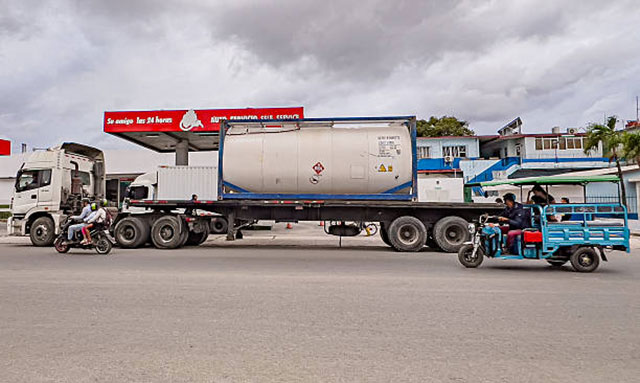
A truck belonging to a private company carrying an ISO tank of imported fuel, parked in front of a gas station in Havana on March 19. (Photo: Adalberto Roque / AFP)
A Cuban private entrepreneur explained to the Herald why the island’s government will not intervene: “It’s like what happened with chicken. The minute they confiscate a container with chicken, there won’t be more chicken entering the market. The same will happen with the ISO tanks.” Gómez Sánchez spells this out:
“In 2021, the market for staple foods was almost completely privatized. Now, in 2026, the goal is for another product with high social impact – such as fuel – to shift from being entirely managed by the state to being subject to private operations and control. Between 2023 and 2025, Cuba already experienced various episodes of deliberately induced shortages when the state tried to impose price controls on private chicken sales, or when the distribution chain and speculative hoarding drove up the price of flour. With fuel in private hands, a new product – of strategic value par excellence for a country’s stability – would fall prey to … economic destabilization operations.”
Faced with unprecedented imperialist pressure and the inefficiencies of bureaucratic management of the economy, the only way out that the governing Castroist bureaucracy in Cuba can see is to make concessions to the voracious U.S. imperialists in an attempt to “coexist peacefully” with them. But even if a whole series of privatizing “reforms” were implemented in Cuba, the truth is that not even that would appease the counterrevolutionary fury of Trump and his gusano hawk Marco Rubio. The only way they foresee avenging the affront represented by the expropriation of the bourgeoisie just 90 miles from the United States is through the counterrevolutionary destruction of the bureaucratically deformed Cuban workers state and the restoration of capitalist rule. The imperialists and the gusanos want to “take back” Cuba. And if they do, they will unleash a bloodbath of entirely predictable brutality.
Reformist “Socialists” Abandon Cuba
In mid-March, President Trump boasted: “I really believe I’ll have the honor of taking Cuba,” of “seizing Cuba in some way…. I think I could do whatever I want with it.” But “we’re going to deal with Iran before Cuba.” Faced with this brazen threat to rape Cuba, what has been the response? It is striking that the “progressive” bourgeois nationalist governments (Brazil, Colombia, Mexico) – all oil exporters – have not lifted a finger to send Cuba the vital liquid it needs in the face of deadly imperialist threats. Even the New York Times (17 March), the unofficial mouthpiece of Yankee imperialism, pointedly headlined an article, “Is Latin America Ready to Let Cuba Go?” And where are the mass protests against the imperialist shark that wants to devour the “first free territory of the Americas,” which for decades was the beacon of the Latin American left?
The fact is that much of the left has abandoned the Cuban Revolution in the face of the counterrevolutionary threat, and has done so for years. Among the most repugnant are certain social-democratic organizations that abusively use the name “Trotskyist,” but which merely continue the legacy of the late chameleon-like Argentine leader Nahuel Moreno. Morenoite propaganda against “the Cuban dictatorship” is often indistinguishable from that of the anti-communist gusanos. The leading voice in this counterrevolutionary chorus is the International Workers’ League – Fourth International (LIT, from its initials in Spanish), which maintains that a capitalist counterrevolution has already taken place in Cuba and that the ruling bureaucracy is an exploiting social class. A recent article15 by Eduardo Almeida Neto, leader of the Unified Socialist Workers’ Party (PSTU) of Brazil, the flagship section of the LIT, states:
“Following the restoration of capitalism in the USSR, led by the bureaucracy itself, Cuba began to follow the same path. In the 1990s, the bureaucratic regime itself ended the monopoly on foreign trade and economic planning and began privatizing state-owned enterprises. It opened the country to multinational corporations, a move exploited by European imperialism to occupy the island. A new Cuban bourgeoisie began to emerge, rooted in the state apparatus and linked to European multinationals.”
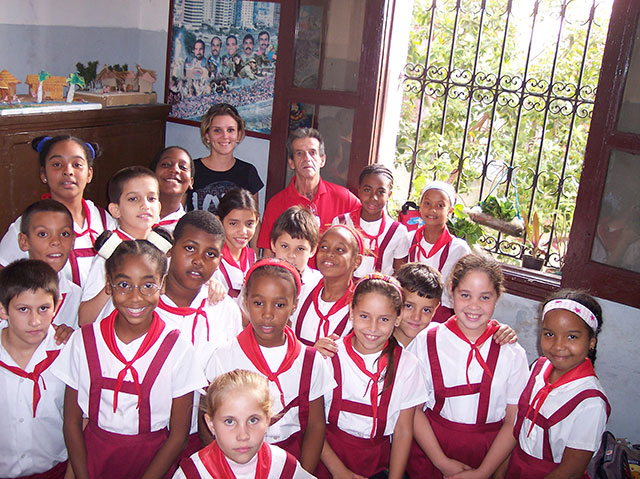 Children at an
elementary school in Havana. Some pseudo-socialists turn
their backs on the gains of the revolution, including Cuba’s
exemplary public education system, which is now under threat
from privatization pressures stemming from U.S.
imperialism. (Photo:
Rodrigo Barquera / Flickr)
Children at an
elementary school in Havana. Some pseudo-socialists turn
their backs on the gains of the revolution, including Cuba’s
exemplary public education system, which is now under threat
from privatization pressures stemming from U.S.
imperialism. (Photo:
Rodrigo Barquera / Flickr)The claim that Cuba is already capitalist would come as a big surprise to the U.S. imperialists, who have been trying to overthrow “Communist Cuba” for 65 years and have spent more than a billion dollars just since the 1990s to subvert it. The LIT’s thesis also stands in direct opposition to Leon Trotsky’s Marxist analysis regarding the dual nature of the Stalinist bureaucracy, which usurped political power in the Soviet workers state after Lenin’s death in 1924. This layer owed its privileges to the fact that it was a parasitic outgrowth seated atop the social and economic foundations of the workers state. Also false is the LIT’S claim that the bureaucracy led the counterrevolution in the USSR – a lie that serves as justification for the betrayal of the Morenoites, who cheered Boris Yeltsin’s seizure of power in 1991. After breaking with the bureaucracy, which paved the way for the counterrevolution, this ex-Stalinist went on to become the U.S. imperialists’ man in Moscow, leading the restoration of capitalist rule.
When today the reformist pseudo-Trotskyists of the LIT and others of the Morenoite lineage claim that capitalism has been restored in Cuba, it is to suggest that there are no more gains of the Revolution left to defend. They cannot explain why the imperialists and the real counterrevolutionary capitalists are so determined to overthrow the regime, even going so far as to impose a t otal cutoff of oil supplies that could lead to economic collapse. If the LIT/PSTU article is titled, “In Defense of Cuba Against Trump’s Imperialist Attack!” it is to pose the question on the bourgeois-democratic basis of sovereignty, just as the above-mentioned “patriotic” capitalist elements do. And the Morenoites will be no more successful than those elements, because a genuine capitalist restoration will inevitably lead to the island’s semicolonial subordination, just as in the days of the Platt Amendment,16 when for a quarter of a century Cuba had a fictitious “independence” as a U.S. protectorate.
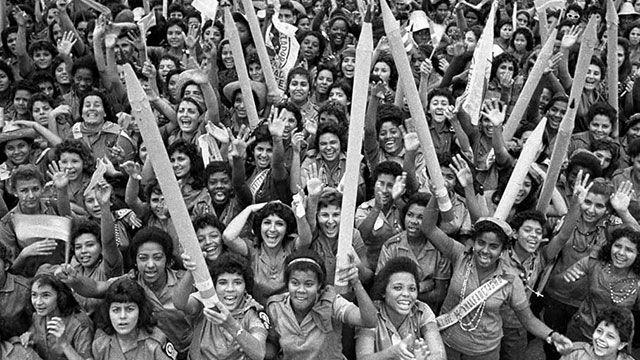 The March of the Pencils,
Havana, December 22, 1961: the conclusion of the historic
mass literacy campaign.
The March of the Pencils,
Havana, December 22, 1961: the conclusion of the historic
mass literacy campaign. Among the groups that have emerged from the Morenoite
fold, the misnamed “Trotskyist Fraction” (FT) – rebaptized
late last year as the Permanent Revolution Current – Fourth
International (CRP) – has adopted a critical stance toward
the “Maestro” (Moreno), while still retaining his
Stalinophobic perspective. In an article on the protests of
11 June 2021, the FT disagreed with the position of “some
currents that claim to be Trotskyist” (i.e., the various
Morenoite groups) who “consider that the restoration is a
completed process” and therefore one must fight against the
“capitalist dictatorship” in Cuba. At the same time, while
continuing to formally consider Cuba a bureaucratically
deformed workers state, the FT/CRP writes that “the main
forces of internal restoration lie within the state itself –
in the upper echelons of the Communist Party bureaucracy and
particularly in the leadership of the armed forces – and in
the proto-bourgeois sectors” of micro, small, and
medium-sized enterprises.17
Today, the CRP refers simply to “the restorationist bureaucracy of the Communist Party.”18 But if the PCC were indeed seeking to restore capitalism, or even if it were “only” a matter of the upper echelons of the state, one might ask: Why have these forces not succeeded in establishing capitalist rule? After all, they control all the levers of the state apparatus. The answer to this puzzle is that the premise is mistaken. Although the bureaucracy has enacted countless pro-capitalist reforms, dating back to the “special period” of the 1990s when Soviet aid ended, it still preserves its dual character and at times needs to defend, in its own bureaucratic way, the foundations of the workers state. Secondly, imperialism (and its agents among the Miami gusanos) is not interested in compromises with the PCC but seeks to destroy the workers state root and branch. This remains the case, despite Trump and Rubio’s sugarcoated proposals for a “deal” with the regime. Soon they would be after its heads, literally.
The centrist CRP habitually speaks from both sides of its mouth. For example, it reports on the recent looting of the PCC headquarters in an article, referring to the outbreak of “protests in Morón over repeated power outages and the social crisis exacerbated by the imperialist energy blockade” (Izquierda Diario, 14 March). But on the same date, it republished a post from the Blog Comunistas Cuba, linked to former academic Frank García Hernández regarding the counterrevolutionary riot:
“This action must be understood in the context of widespread frustration, compounded by the fact that the government lacks any political legitimacy. The assault on the PCC headquarters in Morón should not be seen as an anti-communist action, but as the typical social explosion that rises up against all structures of the established power.”
Although the protesters were shouting “Down with communism!” the article apologizes for them, stating that “The protesters are not attacking communism as an ideology, but as the system that has led them to their current dire situation.” The CRP has become the main promoter of the Blog Comunistas Cuba (BCC), whose policies have nothing to do with communism. Rather, it is serving as an anti-communist outlet for disillusioned former communists of the “The God That Failed” variety.
Both the FT/CRP and the BCC have adopted the famous “method” bequeathed by Nahuel Moreno: to tail after any “mass movement,” regardless of its political program. (Moreno successively presented himself as a Peronist, Castroist, Maoist, Guevarist, and Sandinista before settling down (more or less) as a left social democrat.) The International Communist League (ICL) has joined this flock of committed opportunists. On February 6, it published a superficial report based on impressions gathered by some of its supporters during a tourist trip to eastern Cuba. In addition to praising the Blog Comunistas Cuba – despite disagreeing with its “analysis” that capitalism has already been restored in Cuba (and China) – these ex-Trotskyists argue against us regarding the protests of 11 July 2021, which they portray as the result of the “erratic policy” of the Castro bureaucracy:
“The first round came amid the pandemic in July 2021, when protesters around the country took to the streets against the Covid lockdowns and shortages of food and medicine. While some were clearly animated by anti-communism (the U.S. media played up ‘Down with Communism!’ slogans), the sheer breadth of the protests in some 30 cities showed that this was not fundamentally a right-wing, U.S.-orchestrated revolt as claimed by the Díaz-Canel government and some Marxist groups (e.g., the League for the Fourth International).”
–“Cuba Under Siege. An Eyewitness Report,” 7 February.
To these delusionary people, the widespread nature of these simultaneous 2021 protests is seen as proof that they pose no threat! For those interested, we refer you to our article, (“The Truth About Cuba Protests. Defend the Revolution Against U.S. Imperialism and Its Frontmen!” which explains in detail how the gusanos exploited popular discontent in instigating these protests.
For Revolutionary Defense of Cuba!
In July 2021, Mexican President Andrés Manuel López Obrador, founder of the bourgeois populist National Regeneration Movement (MORENA), said that Cuba was the “new Numantia.” Expressing admiration for the people of the besieged island, AMLO compared Cuba to the Celtiberian city of Numantia, located in the north of what is now Spain, which in 133 BCE heroically resisted the siege imposed by Rome. After 15 months of siege at the hands of the famous general Scipio Africanus, the starving survivors decided to commit suicide rather than surrender to the Roman troops. AMLO’s perspective is that of a bourgeois nationalist politician who can admire the resistance of a population besieged by imperialism, but who is impotent to assist it. And this is no coincidence: AMLO and the current Mexican president, Sheinbaum, despite all their “good intentions,” have complied with the dictates of the empire of the north – under both Biden and Trump – acting as U.S. border guards and now cutting a key lifeline to Cuba.
Cuba must not be a new Numantia. Today, the Cuban Revolution finds itself in the most dangerous situation it has faced since its inception. Its enemies believe the island is more isolated than ever, without Soviet, Venezuelan or Mexican oil. The would-be emperor Trump demands that Cuban leaders surrender, or sacrifice their leader as an offering to the empire. Faced with the hardship imposed by the blockade and the regime’s inability to deal with this mortal danger, the governing bureaucracy sees the only “way out” as increasingly adopting capitalist measures to “revitalize” the economy – without success. We revolutionary communists, Trotskyists, advocate the opposite path. What is needed is to awaken the creativity, commitment and resolve of the working class and all those who defend Cuba’s historic gains in a proletarian political revolution that puts the workers in charge of running the workers state, through the proletarian democracy of workers councils (soviets) with a revolutionary internationalist leadership.
The fate of revolutionary Cuba has not yet been decided. Ultimately, it depends on mobilizing the working class internationally to come to the aid of the Cuban people. Beyond the oil blockade threatening to suffocate the country, the current crisis demonstrates the impossibility of building “socialism in a single country” – the hallmark dogma of Stalinism – particularly on an island 90 miles from the world’s most powerful empire. The attack on Venezuela and the siege of Cuba show that all the exploited and oppressed people of Latin America are in Trump’s crosshairs. Massive workers mobilizations in defense of Cuba and against imperialism can throw a wrench into the machinery of U.S. domination and link up with the struggle of the working people of the U.S. against racist repression of Black and Latino people, mass deportations and the endless wars unleashed by both imperialist parties. In this regard, we note that California’s Democratic governor, Gavin Newsom, is praising Trump’s attacks on Cuba.
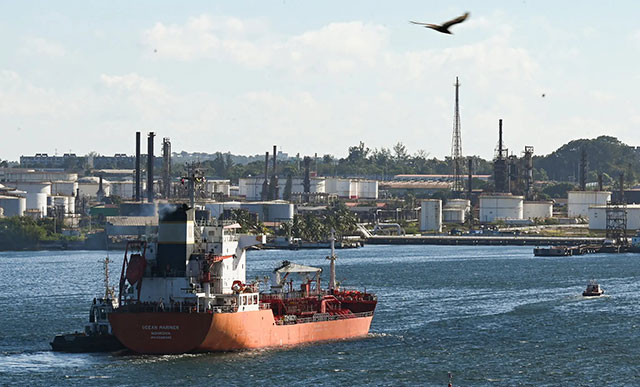
The arrival of the tanker Ocean Mariner at the Ñico López refinery in Regla, Cuba, on January 9, carrying the last shipment of Mexican oil. (Photo: Yamil Lage)
Today, it is urgent to fight for oil supplies to Cuba. In Mexico and Brazil, there have been protests by the left and even (in Brazil) a rally by oil workers demanding that their respective nationalist governments send crude oil to the besieged island. But given the bourgeois nationalists’ subservience to the imperialist masters, it is the working class itself that must take on this task. Let the unions raise funds to buy the fuel! Flotillas to Gaza and Cuba have become popular – so let oil workers themselves load a tanker to set off for Cuba from Rio de Janeiro, Coatzacoalcos, or Tuxpan, the Mexican port from which the Granma set out in 1956! We’ll see then what the Yankee pirates prowling the Caribbean will do. They could end up unleashing an explosion of rage across the entire continent.
Cuba’s power grid is in danger of collapsing. The 20,000 solar energy modules the government is installing are a drop in the bucket. We explained in 2021 that by forming workers councils the workers of the Unión Eléctrica (the network of large state electricity generating plants) and local “distributed generation” plants (which collect energy from various sources, including solar panels) could join forces to address power outages by organizing emergency measures in their communities. We call on electrical workers unions across the Americas to send teams with supplies to repair breakdowns and to dispatch specialists to resolve problems stemming from using outdated machinery. Furthermore, the working class should appeal to the People’s Republic of China to come to the aid of its brother Cuban workers state by sending ships loaded with millions of solar panels – of which it is the world’s largest producer – and technicians to assist in their installation. Such a gesture would encourage workers worldwide to rise up against the rampages of the wounded imperialist monster, which lashes out in all directions in its precipitous decline.
In Cuba, the task at hand is to form workers councils to defend the gains of the Revolution. Repel all attacks on the public education and health systems, the crown jewels of the Cuban people! Factory and workplace committees should unite in a national assembly of workers in the socialized economy. The delivery of food and basic necessities to endangered areas should be reorganized with teams of volunteer workers who can communicate with the poor population and encourage the implementation of joint projects to repair damage and make improvements collectively. There should also be a struggle for the freedom of political action for parties and organizations that defend the revolution and its achievements. And against the misdeeds and sabotage of a cumbersome bureaucracy, it’s necessary to unite genuine communists into a party based on the revolutionary and internationalist program of Lenin and Trotsky.
The struggle to defend Cuba is in reality inseparable from the fight for international socialist revolution. Throughout the world, it is necessary to break with the bourgeois parties – whether imperialist, like the Democrats in the United States, or nationalist-populist, like MORENA in Mexico – and with the reformist social democrats and Stalinists who work to subordinate the working class to capitalism, such as the Workers Party in Brazil. From the war on Iran to the siege of Cuba, the present situation highlights the urgent need to form Leninist-Trotskyist revolutionary workers parties, in the struggle to rebuild the Fourth International as the world party of the socialist revolution. To this end, League for the Fourth International, including its U.S., Mexican and Brazilian sections, work for the defense of Cuba and the struggle to defeat counterrevolution wherever it rears its head. ■
- 1. Petróleos Mexicanos, the Mexican state oil company.
- 2. As a result of imperialist (U.S. and European) sanctions on exports of oil from Iran, Venezuela and Russia, enforced by such methods as denying insurance to tankers transporting those cargoes, a huge “shadow fleet” of almost 1,000 vessels that carry sanctioned oil has arisen, amounting to 17% of all oil tankers sailing today.
- 3. Petróleo Brasileiro, the majority state-owned Brazilian petroleum company, headquartered in Rio de Janeiro.
- 4.The Bolivarian Republic of Venezuela, a bourgeois nationalist regime, was founded by Hugo Chávez in 1999 after being elected president the year before. It has been under constant attack by U.S. imperialism ever since, including multiple attempted coups d’état.
- 5. literally “worms,” referring to counterrevolutionary Cuban exiles, particularly those who fled in 1959-60 after the overthrow of the dictator Fulgencio Batista and the radicalization of the revolution.
- 6. In November 1956, 82 Cuban fighters crowded onto the yacht Granma on Mexico’s Caribbean coast and set sail for Cuba. After a disastrous landing in a mangrove swamp, they were surrounded by troops of the dictatorship of Batista, a former army sergeant. Only 12 survived, but three years later, on 1 January 1959, Batista fled the country into exile and the victorious rebels marched into the capital Havana.
- 7. Following the crushing of the U.S.-sponsored attack at the Bay of Pigs (Playa Girón) by a mercenary army of Cuban exiles in April 1961, the U.S. government of Democratic president John F. Kennedy stepped up a campaign of terrorism and sabotage inside Cuba. Meanwhile, the U.S. had stationed Thor nuclear missiles in Britain and in 1961 placed Jupiter nuclear missiles in Italy and Turkey, all targeted on the USSR. In July 1962, Soviet leader Nikita Khrushchev agreed with Fidel Castro to place nuclear missiles in Cuba to stave off a potential U.S. invasion of the island. After a U.S. spy plane detected missile launch sites in early October, Kennedy ordered a naval blockade (“quarantine”) of Cuba. As the spectre of nuclear war loomed, Khrushchev eventually backed down (over Castro’s objections) and withdrew the missiles in exchange for the U.S. publicly declaring it would not invade Cuba and secretly agreeing to remove the U.S. nuclear missiles in Turkey (and later removing those in Italy and Britain).
- 8. Cuba was forced to rely on domestic crude oil due to the interruption of Soviet oil supplies as a result of the counterrevolution that brought down the USSR in 1991-92.
- 9. See “U.S. Blockade of Cuba: ‘Bring About Hunger, Desperation, Overthrow’” (July 2021) in The Internationalist No. 64, July-September 2021.
- 10. See “The Truth About Cuba Protests…” for a discussion of these measures.
- 11. “Cuba ante el espejo venezolano: cuando postergar las decisiones deja de ser una opción,” On Cuba, 8 January.
- 12. “Cuba ante EEUU: lecciones y antilecciones de la intervención en Venezuela,” On Cuba, 14 January.
- 13. Stainless steel tanks holding up to 6,900 U.S. gallons of liquid, built to the specifications of the International Organization for Standards (ISO).
- 14. “Donroe Doctrine” is a play on words drawing a parallel between Donald Trump’s nakedly imperialist policies today and the “Monroe Doctrine.” In 1823, U.S. President James Monroe proclaimed a policy against “interference” by European powers in the Western Hemisphere that could be summed up in the slogan, “America for (North) Americans,” making Latin America the private preserve of the expansionist and later imperialist United States.
- 15. “¡En defensa de Cuba ante el ataque imperialista de Trump! ¡Ninguna confianza en el gobierno de Cuba!” LIT, 2 de febrero.
- 16. In 1901, after the United States had kicked out the Spanish colonial rulers (along with those of Spanish colonies in Puerto Rico, Philippines and Guam) in the 1898 war, the U.S. government under President Willim McKinley insisted, in order to head off Cuban revolutionary forces, that withdrawal of U.S. troops be dependent on Cuba accepting in its constitution a series of demands (the Platt Amendment) allowing the U.S. to intervene in case of popular unrest and giving it the military base at Guantánamo, which the U.S. has occupied ever since. Trotskyists demand that the Guantánamo base be returned to Cuba..
- 17. Claudia Cinatti, “Cuba: causas y consecuencias del 11 de julio,” Izquierda Diario, 18 de julio de 2021.
- 18. “Prepotencia imperialista”, Izquierda Diario, 18 de febrero.