

No. 7, September 2025
Poland’s Marxist Tradition
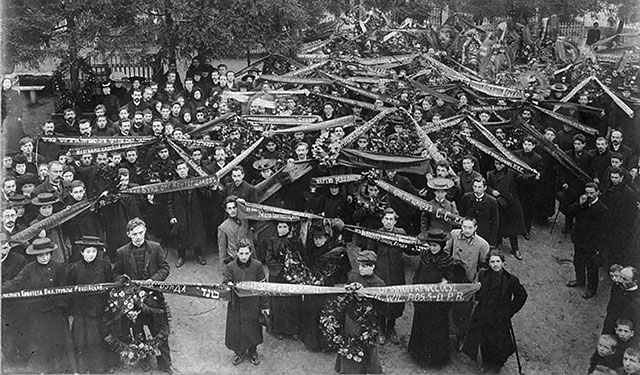 Polish, Russian and
Jewish workers and socialists commemorate victims of
Vikelya pogrom, October 1905. (Photo: Archives of the YIVO
Institute for Jewish Research)
Polish, Russian and
Jewish workers and socialists commemorate victims of
Vikelya pogrom, October 1905. (Photo: Archives of the YIVO
Institute for Jewish Research)Hail Rosa Luxemburg!
By Marjorie Stamberg
The following edited transcript of a presentation by
Marjorie Stamberg, a member of the Central Committee of
the Spartacist League, at a SL educational conference in
Chicago in April 1982 was printed in two parts in Young
Spartacus No. 100 (May 1982) and No. 101 (Summer 1982).
At the time, almost the entire left along with the
imperialist bourgeoisie had embraced the Polish
nationalist Solidarność movement. (By that point the
anti-communist movement was financed by the U.S. Central
Intelligence Agency, using the United Federation of
Teachers as a conduit.) Marjorie’s talk counterposed to
this the legacy of Poland’s greatest revolutionary
Marxist who was belittled by the Stalinists and reviled
by pro-imperialist Solidarność, a legacy our comrade
continued to uphold as a leader of the League for the
Fourth International and its U.S. section, the
Internationalist Group, until her death in May 2024.
Part 1
A part of the glorification of Solidarność as the standard-bearer of the “free world,” the Western commentators, Susan Sontag,1 the whole “god that failed”2 crowd once again proclaimed the “death of communism” in Poland. What they do, you see, is present the bankruptcy of the Stalinist bureaucracy as the bankruptcy of communism. Now, the regime is bankrupt, and not just politically. This band of venal, corrupt bureaucrats, who have made a holy mess out of the country and not incidentally brought it to the brink of counterrevolution, are justly hated. But to the bankruptcy of Stalinism they project Solidarność as the only alternative – that company union for the CIA and bankers, steeped in the traditions of Catholic nationalism and all of it presented as a great “democratic” movement.
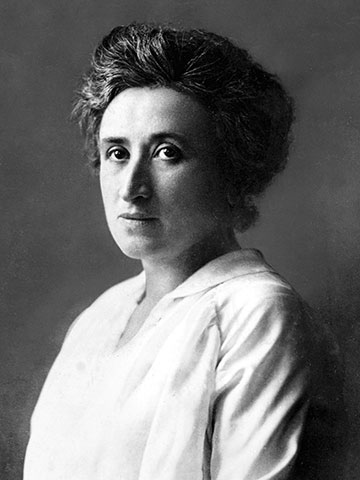 Rosa Luxemburg, ca.
1911.
Rosa Luxemburg, ca.
1911. (Photo: Universal History Archive)
As we have stressed over and over again, that is the tradition of bourgeois Polish nationalism crystallized in the figure of Marshal Pilsudski,3 the fascistic dictator of interwar Poland, whom Solidarność honors. Indeed, last year for the first time since World War II, the date of the "independence" of the Polish bourgeois republic was celebrated in Poland – a commemoration of Pilsudski, who was commander in chief of the army and who in 1920 led the attack on Soviet Russia. You know, a lot of leftists denied this was possible when we first said it, but here is a poster put out by Solidarność – a bust of Pilsudski with one of his most famous quotes.
But there is a socialist tradition in Poland which has not been bankrupted politically. They tried to exterminate it physically – through the joint efforts of the Nazis and Pilsudski, and also of the Stalinists. This is the tradition of the early Communist Party of Poland. Above all, this is the tradition of Rosa Luxemburg, who was the founder of the Socialist Party in Poland, which became the core of the early Communist Party. And the whole tradition of Rosa Luxemburg and her comrades in the Social Democracy of the Kingdom of Poland and Lithuania (SDKPiL) was the tradition of the most militant internationalism. It was a party steeled in the struggle against Pilsudskiite petty-bourgeois nationalism. That is the reason why the heritage of Rosa Luxemburg – a communist, a woman and a Jew – is suppressed by both the Stalinists and Solidarność.
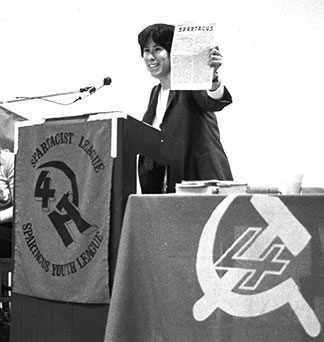 During her 1982 talk,
Marjorie Stamberg holds up a copy of Spartacus,
published by the Spartakusbund led by Rosa Luxemburg and
Karl Liebknecht in World War I.
During her 1982 talk,
Marjorie Stamberg holds up a copy of Spartacus,
published by the Spartakusbund led by Rosa Luxemburg and
Karl Liebknecht in World War I. You see, what’s happening today in Poland is, in the course of creating the myth of Solidarność, they're going back and reinterpreting all of Polish history – as if it was one long uninterrupted struggle for national destiny against Russian communism. The well-known Polish literary figure, Jan Kott, who returned to Poland in 1979 after 13 years in exile, describes how pervasive is this world view. In the 1960s he wrote, when one member of his “dissident” circle died, he had an agnostic burial and they sang the “Internationale” over his grave. Now, he was shocked to find, such occasions were celebrated with a funeral mass and the anthem “Still Poland Hasn't Perished.” And then he was appalled as he sat down to discuss with his old friends from the student struggles of ’68:
“Three names were passionately emphasized: Dmowski, Pilsudski and Daszynski. [Dmowski was a National Democrat who preferred the Tsar to the Kaiser’s Germany and Daszyriski was another right-wing member of the 1918 government.] For a time I simply couldn’t grasp what was going on. I rubbed my eyes. What did this recall? In which emigration in London, in which anachronistic Warsaw did I find myself? Before the war ... but before which war, the second? No, before the first! I had the impression that time had stood still. History was running backwards. In the space of those thirteen years while I had been away, quite different chapters of Polish history had returned. This furious dispute, in which names were brandished like evocative signs, was about the choices and alternatives of 1979.”
–quoted in Neal Ascherson, The Polish August (1981)
Today the Polish workers are at a crossroads. This is a period of reflection following the imposition of martial law. Various journalists have reported on such conversations as the workers who were overheard asking each other, “How did it go so wrong so fast?” The answer is, you were against all the right things, but what were you for? While the counterrevolutionaries are rewriting history to push their catechism of Polish nationalism, we Trotskyists seek the creation of educational and propaganda cells based on the tradition of socialist internationalism. In searching for this tradition, the Polish workers will reencounter their own past.
It’s curious, you know. In the 1960s, Rosa Luxemburg was very popular in the American “left” – particularly among what we call the “third camp” social democrats, who refused to defend the Soviet Union against the imperialists. They wanted to give themselves something of a left cover. (Today of course, now that they’re tailing Solidarność, you don’t hear much about Rosa Luxemburg.) So they picked up various writings by Rosa Luxemburg that were critical of Lenin, and based on them, called themselves Luxemburgists. And this is something I’m going to stress in this talk – there is no Luxemburgism in opposition to Leninism. This was invented after her death by her enemies – first by the social democrats, who wanted to separate themselves from Leninism and still look kind of left-wing. And also a creation by the Stalinists, who also wanted to separate Luxemburg out from Lenin – in order to smash her heritage of internationalism as the “Polish form of Trotskyism.”
So if you listen to these people, you would think that Rosa Luxemburg spent all of her life fighting with Lenin on one thing or another. Which, as we shall see, is a completely distorted view. Most of Rosa Luxemburg's life was spent fighting together with Lenin against the right wing of social democracy – in Germany, Poland and Russia – which eventually went over to open counterrevolution at the time of World War I.
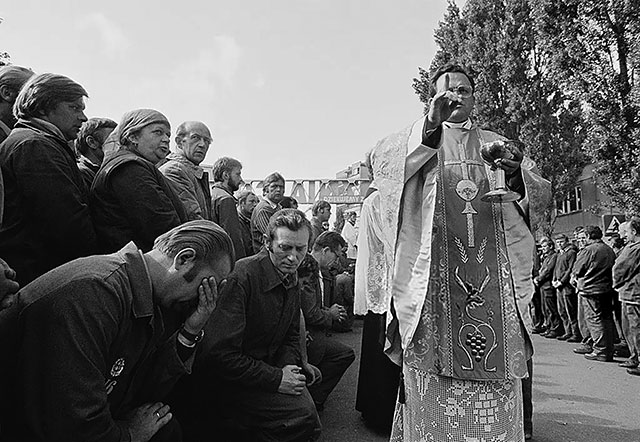
Priest blesses workers at Lenin shipyards in Gdansk, Poland, Agusut 1980. The Polish Solidarność movement had a strong Catholic clerical nationalist influence. (Photo: Jean-Louis Atlan / Sygma via Getty images)
Throughout her life, Rosa Luxemburg’s struggle was for internationalism. She understood that the key to the success of the revolution in Poland was the unity of the Polish and Russian workers, and also the German workers. Today, Solidarność and the West try to present the picture of “poor little Poland” caught between the two giants of Russia and Germany, and therefore destined always to suffer a tragic fate. Well, from a bourgeois nationalist perspective, they've got a point. But from the point of view of revolutionary internationalism, Poland is a vital connection between the two great revolutions that will determine European history – the Russian and the German.
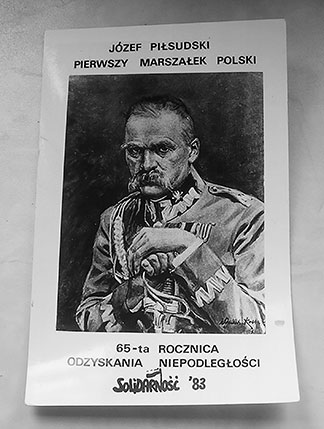 Solidarność poster hailing the
fascistic anti-communist
Solidarność poster hailing the
fascistic anti-communist dictator of interwar Poland, Jozef Pilsudski.
And you can see this very concretely in the life of Rosa Luxemburg, a woman who played an important role in the 1905 Russian Revolution – as a major leader of the left wing of German Social Democracy and as a founder of the party which formed the core of the Polish CP. You can see it also in the “Three Ws.” You know, some people find it comical that we raise the “Three Ws.” We had a sign at our March 27 El Salvador demonstration, “Long Live the Party of Warski, Walecki, and Wera Kostrezewa.” Alexander Cockburn in the Village Voice thought this sign was evidence of our Marxism-Leninism-Bonkerism – reflecting on his part more than a touch of Anglophile chauvinism. You know, how could anybody with so many “Ws” in their names be relevant to us? (Of course, they've got their own “Three Ws” – Wojtyla, [Archbishop Stefan] Wyszynski, and [Solidarność leader Lech] Walesa – the pope, the primate and the puppet.)
Well, the “Three Ws” are plenty relevant. There was a saying in the Comintern: the German party is the biggest, the Polish party is the best. In fact, this was one of the few parties that protested over the campaign of the troika against Trotsky in 1923. The letter they sent at the time stated:
“For our party, nay for the whole Comintern, for the whole revolutionary world proletariat, the name of Comrade Trotsky is insolubly connected with the victory of the Soviet revolution, with the Red Army, with Communism .... We refuse to admit any possibility of Comrade Trotsky being put outside the ranks of the leaders of the Russian Communist Party and those of the Communist International.”
This was the party of the “Three Ws.” It was the party built on the traditions of Rosa Luxemburg. And it was so solidly internationalist that Stalin did something to it unique in the history of Stalinism – for the Polish CP, purges weren't enough. In addition to murdering hundreds of its central cadre, Stalin had to literally dissolve the entire party in 1938 as a nest of “Trotskyite saboteurs” shot through with the influence of Rosa Luxemburg.
Rosa Luxemburg
So let’s see why the reformists and counterrevolutionaries have so much trouble with Rosa Luxemburg. She was born in 1871 in the province of Lublin, which was then under Russian rule. She came from a middle-class Jewish family – her father was a timber merchant. Her family was very assimilationist and they took little part in Jewish politics. When Rosa was two years old, the family moved to Warsaw. There she went to a girls’ high school where she was one of the very few Jewish students, in fact one of the very few Polish students, since most of the places were reserved for children of Russian officials in Warsaw. In high school she graduated first in her class, but did not receive the gold medal because of her “rebellious attitude toward the authorities.” She always had a little trouble with that.
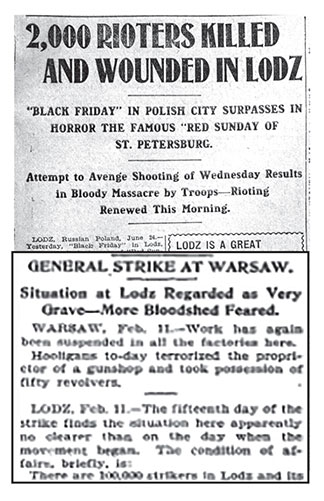 In response to the Bloody
Sunday massacre in St. Petersburg
In response to the Bloody
Sunday massacre in St. Petersburgon 9 January 1905, strikes broke out in Warsaw and the
textile center of Lodz, uniting Russian and Polish workers
against the autocracy. (Photo: Universal History Archive)
Now, it’s important to understand that there was no Polish state in those days. Poland was carved up between Russia, Prussia and Austria. For the tsarist empire, Russian Poland was a key industrial region with the textile factories in Lodz and the center of Warsaw and so forth. This was also a period of big economic boom for the Russian Empire – industrial production was soaring. This is one of the main reasons that at the time almost nobody but the nobility was for creating a Polish state.
Rosa’s first known political activities were in high school, where she joined one of the last remaining cells of the party Proletariat, just before it was smashed. Proletariat was the first socialist organization in Poland and its founder, Ludwik Waryński, rejected the program of a national uprising as “harmful” and called for proletarian social struggle against the bourgeoisie, not just tsarism. Proletariat was closely aligned with the Russian Narodniks. During the years Rosa was in high school, many members of party Proletariat were rounded up by the tsar and sentenced to many years' hard labor or execution. Waryński was arrested at this time and died in prison. In 1889 Rosa, learning her own arrest was imminent, went to Zurich, Switzerland.
But by the late 1880s, the strike movement was actively beginning to pick up. Much of this was under the influence of another group with whom Rosa Luxemburg would soon be closely linked: the Union of Polish Workers. In 1893 this group joined together with the remnants of Proletariat to form the Social Democracy of the Kingdom of Poland. They saw themselves following in the traditions of Proletariat in rejecting the call for the restoration of the Polish state. They wanted an all-Russian party even before there was a Russian party – the RSDRP [Russian Social Democratic Workers Party] of Lenin was not formed until 1898. In 1899, Felix Dzerzhinsky put the ‘L’ in SDKPiL, when the Lithuanians attached themselves, and it became the Social Democracy of the Kingdom of Poland and Lithuania.
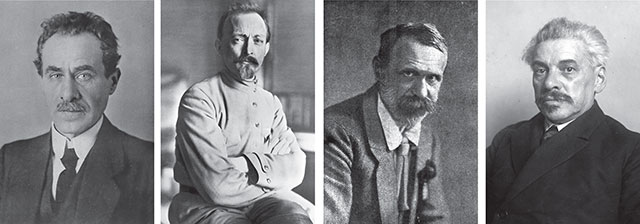 Members of the SDKPiL
(Social Democracy of the Kingdom of Poland and Lithuania)
of which Rosa Luxemburg became a main leader. From left:
Leo Jogiches, Felix Dzerzhinsky, Julian Marchlewsky and
Adolf Warszawski. Photos
(from left): Lebendiges Museum online; RIA Novosti
Archive; Polona; National Digital Archives of Poland
Members of the SDKPiL
(Social Democracy of the Kingdom of Poland and Lithuania)
of which Rosa Luxemburg became a main leader. From left:
Leo Jogiches, Felix Dzerzhinsky, Julian Marchlewsky and
Adolf Warszawski. Photos
(from left): Lebendiges Museum online; RIA Novosti
Archive; Polona; National Digital Archives of PolandAround this time also, another group was formed – the Polish Socialist Party (PPS) – also out of some remnants of Proletariat. They were for restoring the Polish state. And soon to emerge as their historic leader would be Josef Pilsudski. For the next 25 years PPS and SDKPiL would be locked in combat against each other to win the allegiance of the Polish masses and to decide what the future course of Polish history would be.
Now you don't hear much about SDKPiL, for reasons that were stated earlier. But it was a very real party which produced a. number of leaders who played major roles in the Russian and German communist movements as well as in Poland. Besides Rosa Luxemburg there were: Leo Jogiches, the man who was to be associated with her most of her life. Jogiches was a Jewish Russian emigre who fled to Switzerland after escaping military service in the tsar’s army. Jogiches had organized Jewish workers in Vilna. He went on to become one of the principal organizers of SDKPiL and he was also the main organizer for the Spartakusbund when Rosa and Karl Liebknecht were in jail There was Felix Dzerzhinsky, who went on to become head of the Cheka – the Bolsheviks’ state security apparatus. There was Julian Marchlewski, who also became a prominent Comintern leader. And Adolf Warszawski – who was Warski of the “Three W s.” Also Karl Radek, who, although he much later capitulated to Stalin, was during World War I Lenin’s closest collaborator in the German left, and who was also one of the first figures to go over to Trotsky’s Left Opposition. It is not unimportant that many of these original founders and leaders of SDKPiL were Jewish. At the time, Poland had a huge Jewish population – about 10 percent of the population until World War II.
The 1905 Revolution
By the beginnings of 1900, SDKPiL had a few hundred, maybe 600 members and nuclei in most of the major industrial areas. But it was the 1905 Russian Revolution which was the major event in the development of SDKPiL and also the major event in the consciousness of the revolutionaries and socialists. By 1904 all over Russian Poland, revolutionary ferment was mounting; strikes and demonstrations were spreading throughout the country, sparked by Russia's losing war against Japan. And then in St. Petersburg on 9 January 1905, a demonstration led by Father Gapon ended with the massacre of hundreds. This, of course, was Bloody Sunday, signaling the outbreak of the revolution. Almost immediately after Bloody Sunday the Poles came out in a spontaneous response to the events in Russia-and with equal fervor. A general strike started in Warsaw and soon spread to all major industrial centers. The civil administration almost collapsed; a state of siege was proclaimed; there were huge clashes between demonstrators and police, street battles, armed skirmishes.
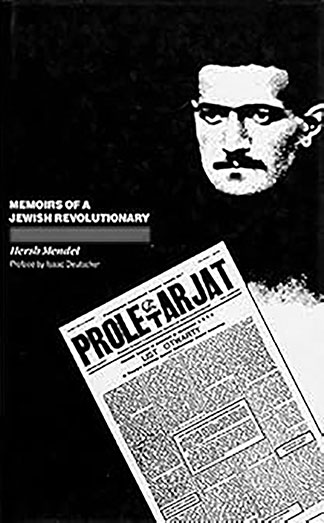 Hersh Mendel, who lived
through the 1905 Revolution in Warsaw, recounted how
Polish and Jewish workers
Hersh Mendel, who lived
through the 1905 Revolution in Warsaw, recounted how
Polish and Jewish workersformed defense squads against the pogroms
instigated by the tsarist regime.
Now this was of tremendous significance for Rosa Luxemburg and for SDKPiL, for they had always insisted on the need for the Russian and Polish workers to join forces, while the PPS had opposed an all-Russian movement. So in 1905, when the Russian Revolution surged forward, it was the vindication of all that SDKPiL had envisioned. The connection between Russia and Poland was there for all to see – instead of acting like separate entities, the workers of both countries behaved as if no ethnic barrier separated them.
No wonder SDKPiL was the main beneficiary of these events. The resulting upheavals turned SDKPiL into a small mass party as the layers of radicalized youth and workers swept up in the revolutionary process streamed into the party. As Rosa Luxemburg’s biographer, J.P. Nettl said, “By February 1906, the party had some 30,000 members, artisans and proletarians, in spite of the fact that its activities had been plunged once more into illegality after a brief fortnight of open agitation.” So the party went from 600 to 30,000 in little more than a year! Meanwhile, PPS was splitting down the middle as its members had to decide whether to support the Russian Revolution or abstain from struggle.
Pilsudski, who did not want to support the Russian workers, instead started organizing armed cadres for a nationalist uprising – these were the Fracy detachments. The PPS-left supported the revolution and the mass action of the workers. It was in opposition to Pilsudski's putschist nationalist bands that Rosa Luxemburg fought for the mass strike of the Polish workers.
Now the question of nationalism or internationalism was posed not only in the common fight of the Polish and Russian workers, but also within Poland itself over the anti-Jewish pogroms. In late 1905 the tsar was employing one of his standard tactics to split the workers movement – tsarist agents were instigating the Black Hundreds fanatics into attacking Jewish ghetto communities throughout Eastern Russia. These were eventually brought into Poland by Dmowski's National Democrats – but they were stopped, crushed by the revolutionary action of the workers. Joint Polish-Jewish workers defense guards sprang up and stopped the pogromist terrorists in their tracks. Rosa Luxemburg commented on this development, writing from Warsaw in i906 that “the instigation of pogroms was impossible where enlightened workers groups existed – the persecution of Jews was impossible in Poland, Petersburg, Moscow, Riga and all important centers of the revolution.” And there is a powerful description of these workers defense guards by Horst Mendel, who wrote “Memoirs of a Jewish Revolutionary.” Horst was a young boy at the time and later became a member of the Polish Trotskyists in the mid-1930s.
“I concluded that there couldn’t be any indigenous Poles [among the pogromists] from the fact that in the self-defense organizations there were also Polish workers involved. In Pawia Street, in fact, there were more Polish than Jewish workers in the self-defense organization. The Polish workers assured us constantly that Poland was not Russia and there would be no pogroms here.
“Every apartment house had its committee. There was also such a committee in our area. At night the door was locked and the self-defense groups would gather at certain points, while spotters would go through the streets. I remember that from time to time when the alarm was spread, the self-defense groups would rush into droskys [sort of horse-drawn cabs] which were standing ready especially for this purpose-and tear off to the threatened places.
“In addition to the active self-defense groups, there were also auxiliary groups including all the residents of the apartment complex, especially the Jews. People were armed with whatever they had-with axes, hatchets, knives. Every trade came armed with their work tools.
“My father-was also in such an auxiliary group. When the door to the courtyard was shut, they stood in the door entrance and waited. It was their task in case of an attack to defend the door. I stood for whole nights next to my father and looked at him.”
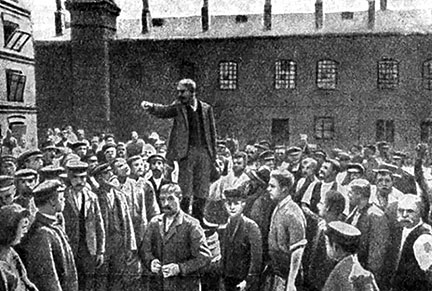 Workers meeting outside
textile plant in Lodz in response to lockout by the bosses
in 1906. (Photo: Academy of
Sciences of the USSR / Institute of History)
Workers meeting outside
textile plant in Lodz in response to lockout by the bosses
in 1906. (Photo: Academy of
Sciences of the USSR / Institute of History)This heroic action by the workers during the Russian Revolution was a far cry from the hideous experience in 1943 of the Warsaw ghetto uprising when the Polish nationalists at best turned their backs and others betrayed the Jews.
Now, when the Russian Revolution broke out, Rosa was in Germany. And by the time she was able to get to Warsaw on a lengthy circuitous route in the dead of winter, things had slackened off. The third general strike in a year had finally gone down to defeat and the Bolshevik-led Moscow insurrection was also over. For Rosa Luxemburg the Russian Revolution and the mass strikes were a powerful confirmation of the revolutionary possibility of the workers movement, and when she returned to Germany, she fought for them against the ossified trade-union bureaucrats and party center apparatus of Kautsky. I'll take that up more later.
So by March of 1906 it was clear the revolution was ebbing. A wave of arrests fell over the cities; police spies were everywhere. Now there were lockouts rather than strikes. SDKPiL lost most of its leadership in the police dragnet. Marchlewski was arrested. Jogiches was arrested. (Here’s an irony of history – Jogiches was arrested and sentenced to eight years’ hard labor in Siberia for advocating the independence of Poland! Boy, he must have been pissed, but the tsar didn’t recognize these subtle differences.) Luckily, Jogiches managed to escape before his transport actually left for Siberia. Rosa was arrested on March 4, 1906. She and Jogiches were both held in the notorious Pavillion X of the Warsaw Citadel, the fortress for dangerous criminals where years earlier the members of party Proletariat had been held.
Rosa Luxemburg and the Bolsheviks
When Rosa was released from prison she went off to Finland to talk with Lenin and the Bolsheviks on evaluating the Russian Revolution. During the time she was in jail, the SDKPiL had joined the RSDLP at the Fourth (“Unity”) Congress. And while in 1903, Rosa’s bias had been toward the Mensheviks, the revolution changed all that, and she came out of 1905 much closer to the Bolsheviks. She was strenuously opposed to the Mensheviks’ orientation to “make the bourgeoisie fight” and their policy of tailing the constitutional monarchists, the Kadets. Both Luxemburg and Lenin were convinced that the working class would be the main force in the revolution.
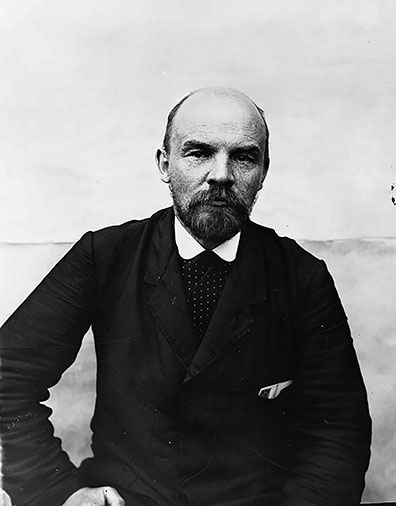 V.I. Lenin in 1914.
(Photo: B.D. Vigliev / Russian State Archive for Social and Political History)
Now the social democrats and Stalinists have tried hard to conceal this. But the fact is that for the next seven years SDKPiL and the Bolsheviks worked pretty much in tandem. Lenin and Luxemburg collaborated on a whole host of things – together the Bolsheviks and Rosa struggled against militarism within the Second International – for instance at the 1907 Stuttgart Conference where they put up a joint resolution and where Lenin even gave her the Bolshevik mandate to cast in that discussion. Luxemburg and Lenin fought together in the fight in the Russian party against the Mensheviks; and Lenin and Luxemburg fought together against the PPS and Pilsudski in Russian Poland.
Back in 1904 Rosa had written a sharp polemic against Lenin on his position for a communist vanguard party. It was quite sharp, it was quite wrong, and for this reason of course social democrats and Stalinists have seized upon it. Now this question of Luxemburg and Lenin on the party question has been incisively analyzed in comrade Seymour’s pamphlet, Lenin and the Vanguard Party, which was included in the readings for this talk. But I want to go over some of the ground, briefly.
We first have to understand that until the outbreak of World War I, all the parties – Lenin, Luxemburg, everybody – had Kautsky’s position on the doctrine of the “party of the whole class” or “one class – one party,” by which was meant that all tendencies of socialism belonged in one party. In practice, however, Lenin strove to create a disciplined, programmatically homogeneous vanguard party. This was a case in which his revolutionary thrust ran ahead of his theoretical generalization. And as our pamphlet says, the resolution of that dialectical contradiction is one of the elements creating Leninism as a world-historic doctrine in our epoch.
You see, Lenin as early as 1903, saw the need for a hardened homogeneous party and that was crystallized in the fight over the membership rules. But at the time he saw the split with the Mensheviks as a split that was Russian-specific. And he did not see the Mensheviks as a current within the working class, but as the petty-bourgeois intelligentsia. It was not until the outbreak of World War I that Lenin had fully worked out his concept of the party and understood that the opportunist current in the Second International as a whole was counterrevolutionary, that it was a reflection of the labor aristocracy created by imperialism, and therefore a split within the workers movement and a cohering of a separate communist vanguard was needed to successfully carry out a socialist revolution.
So, in 1904 when Rosa wrote “Organizational Questions of the Russian Social Democracy” she attacked Lenin’s conception of professional revolutionaries as “Jacobinism” characteristic of a bourgeois party. And she was quite acerbic, writing that “Nothing will more enslave a young labor movement than this bureaucratic straightjacket.” Now, in this period you could also cite Trotsky's Menshevik polemic here, “Our Political Tasks.” But the point is they transcended these views. Trotsky did so explicitly, Rosa in practice – as early as a year later when she saw the role of the Bolsheviks in the 1905 Revolution and by the very nature of the SDKPiL which was always a highly centralized and hard party. And of course, Rosa went on to become one of the founders of the KPD – the Communist Party of Germany in 1918.
Part 2
There’s been a long history of trying to justify support to national movements by citing Lenin against Luxemburg on the grounds that Lenin supported Polish independence, which, in fact, he didn’t. This is coming up a lot lately. For instance, this winter at a Solidarność forum in Boston all the speakers, from a counterrevolutionary Pilsudskiite emigré to the SWP [Socialist Workers Party] spokesman, had the line that Solidarność and the Polish nationalists justly hate Rosa Luxemburg because she was wrong on the national question! And in his book, The Polish August, Neal Ascherson simply repeats the common misconception that Lenin was for the independence of Poland as against Luxemburg:
“In her opposition to the restoration of a Polish state, which she considered a surrender to reactionary bourgeois nationalism, Rosa Luxemburg was in conflict not only with the much larger Polish Socialist Party (PPS), but with Lenin himself.”
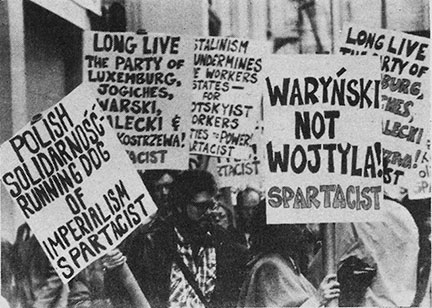 On 24 Sepember 1981, the
Spartacist League demonstrated outside the offices of the
United Federation of Teachers in New York protesting the
union acting as a conduit for CIA funds to Solidarność.
On 24 Sepember 1981, the
Spartacist League demonstrated outside the offices of the
United Federation of Teachers in New York protesting the
union acting as a conduit for CIA funds to Solidarność.(Photo: Workers Vanguard)
Not so. Lenin was not for Polish independence; and furthermore he energetically supported Rosa Luxemburg and the SDKPiL [Social Democracy of the Kingdom of Poland and Lithuania] against the nationalist PPS. What Lenin did insist upon was that this question was something that had to be decided by the Polish people, not something that was to be imposed by the tsar's army. And he insisted that the Russian party had to fight its “own” country's national chauvinism. Here is the key passage in Lenin's 1914 work, “The Right of Nations to Self-Determination”:
“The question of the right to self-determination is of course not so important to the Polish Social Democrats as it is to the Russians. It is quite understandable that in their zeal (sometimes a little excessive, perhaps) to combat the nationalistically blinded petty bourgeoisie of Poland, the Polish Social Democrats should overdo things. No Russian Marxist has ever thought of blaming the Polish Social Democrats for being opposed to the secession of Poland. These social democrats err only when, like Rosa Luxemburg, they try to deny the necessity of including the recognition of the right to self-determination in the program of the Russian Marxists.”
– Lenin, Collected Works, Vol. 20
By the way, there were real reasons why Luxemburg and the SDKPiL opposed Polish independence. Rosa argued that after the tsar’s emancipation of Polish serfs in 1864, the peasantry had lost interest in the struggle for independence. The bourgeoisie, which needed the Russian market, was never interested in independence. And if the proletariat proceeded to set up a bourgeois state after seizing state power, it would be a crime. So in her eyes, it could only be the outmoded, archaic program of an archaic class, namely the down-at-the-heels Polish nobility and its offspring. In fact, Polish independence did not come about as the result of a broad national movement, but was the result of the outcome of World War I – particularly the Russian and German revolutions.
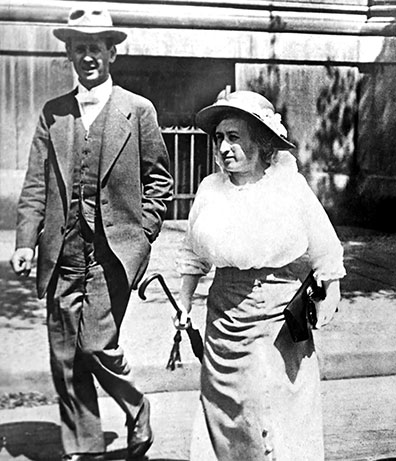 Rosa Luxemburg on her
way to court in 1914 with her lawyer Paul Levi. She was
sentenced to a year in jail on charges of encouraging
public disobedience for her antiwar speeches. After a few
months of freedom she was rearrested in July 1916 and
imprisoned and was only released
Rosa Luxemburg on her
way to court in 1914 with her lawyer Paul Levi. She was
sentenced to a year in jail on charges of encouraging
public disobedience for her antiwar speeches. After a few
months of freedom she was rearrested in July 1916 and
imprisoned and was only releasedin November 1918 with the fall of the monarchy. In January 1919 she was murdered on orders of the Social Democratic government.
(Photo: Granger Historical Picture Archive / Imago)
Nonetheless, Rosa Luxemburg did have an incorrect position, rejecting the Russian Social Democratic Labor Party’s support to the right of self-determination in Poland. Ultimately, it did amount to putting the right of self-determination of oppressed nationalities in question. At one point she said rhetorically, well, if you accept Polish independence, then that raises the question of Ireland, Alsace-Lorraine, and a whole series of places where Bolsheviks did consider the right of self-determination relevant. This position did weaken the struggle of the Polish Social Democrats against Pilsudski. In particular, after 1905 there was a split in the PPS over the question of supporting the Russian Revolution, producing the PPS-Left. One would want to have an orientation to such a leftward moving split, but Rosa insisted that PPS-Left were just nationalists masquerading as socialists. Yet the Polish Communist Party resulted from the fusion between the SDKPiL and PPS-Left in 1918, and it’s quite possible that had she not had this position, there might have been unity much earlier.
The Party Question
The point is that the differences between Luxemburg and Lenin are much narrower on the national question than what is generally understood and that is not the question over which they split. They collaborated closely with each other from 1906 until 1912 and, in general, the SDKPiL and the Bolsheviks fought together against the Mensheviks in the united party. They parted ways when that unity was put into question – namely when Lenin, passing over from being a revolutionary social democrat to a communist, determined to put an end to the “unity” with the conciliators and liquidators once and for all. This struggle came to a head in 1912, and [SDKPiL leader Leo] Jogiches in particular earned Lenin’s ire because he had become a leading “conciliator.”
Later the Stalinists tried to slander Rosa Luxemburg by saying that because she broke late from the SPD [German Social Democratic Party], she was just another garden-variety social democrat. But it was Rosa who, at the turn of the century, fought the rightwing opportunists in the SPD Bernstein & Co. By 1910, even though she may not have taken it to its logical outcome, she launched a fight against the party center of Kautsky and [August] Bebel – the towering lights of “orthodox Marxism” – much earlier than Lenin, and without his support. An upsurge in the class struggle had broken out and Rosa fought for the mass strike, which conjured up fears in the bureaucrats’ minds of the “ghost of 1905.” Rosa was at the head of the insurgent workers movement, fighting for mass action against the ossified trade-union bureaucrats and the Kautsky center who were constantly trying to channel things back into the parliamentary road, talking about the “slow accumulation of forces.” She was the first to realize that the fight in the SPD would not be just with right-wing revisionists like Bernstein, but with the central party leadership.
Rosa tended to see the mass strike as the pressure that would overcome the passivity of the SPD center, as opposed to the need for internal factional struggle in the party. You can see that in her letter to the Dutch left socialist Henriette Roland-Holst:
“Opportunism is in any case a swamp plant, which develops rapidly and luxuriously in the stagnant waters of the movement; in a swiftly running stream it will die of itself. Here in Germany a forward motion is an urgent, burning need! And only the fewest realize it. Some fritter away their energy in petty disputes with the opportunists, others believe that the automatic, mechanical increase in numbers (at elections and in the organizations) is progress in itself!”
–quoted in Carl E. Schorske, German Social Democracy, 1905-1917 (1955)
But to people who later tried to make this into a crude counterposition between Rosa's “spontaneism” and Lenin’s “centralism,” Trotsky wrote that “the most that can be said is that ... preparatory selection of the vanguard in comparison with the mass action fell too short with Rosa.” He labeled as “thoroughly revolutionary and progressive” her fight for the mass strike against Kautsky. And Lenin was the first to admit this, saying:
“Rosa Luxemburg was right when she wrote, long ago, that Kautsky has the ‘subservience of a “theoretician” – servility, in plainer language, servility to the majority of the Party, to opportunism.’”
–Lenin, letter to A. G. Shlapnikov, October 1914, Collected Works, vol. 35.
The Main Enemy Is at Home
It was the imperialist World War I which spelled the bankruptcy of the Second International. August 4, 1914 has gone down in history as a day of infamy: the date that the German Social Democrats – the SPD parliamentary fraction, the biggest fraction in the Reichstag – voted for German war credits. The historic leader of the SPD, August Bebel, had coined the famous slogan, “Not a man, not a penny for this system.” Now this was replaced by the slogan, “We shall not desert the fatherland.” Rosa Luxemburg suffered a nervous collapse. And it is well known that Lenin at first refused to believe it – he thought that the issue of the SPD paper, Vorwärts, containing the news, was a forgery put out by the Kaiser’s agents.
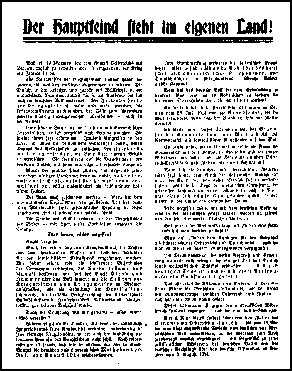
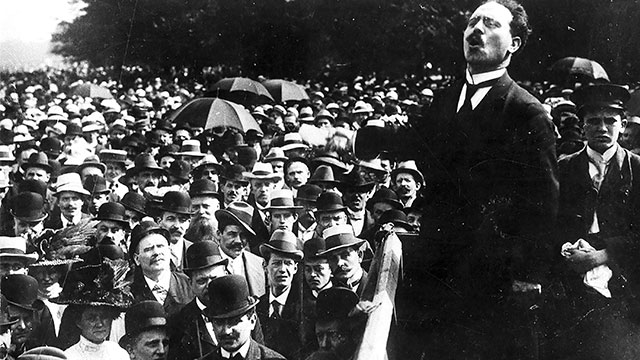 Above: Karl Liebknecht
speaking at antiwar demonstration in 1911. After the
outbreak of imperialist World War I,
Above: Karl Liebknecht
speaking at antiwar demonstration in 1911. After the
outbreak of imperialist World War I, he issued a leaflet (below, left) with his famous slogan, “The Main Enemy Is at Home! (Photo: Ullstein Bild)
August 4, 1914 posed the issue with crystal clarity. Lenin developed his basic policy toward the war in a few weeks; socialists stand for the defeat of “their” bourgeoisie. Turn the imperialist war into civil war! The Second International has been destroyed by chauvinism – long live the Third International!
In Germany, Rosa Luxemburg picked up the task of opposing
the infamous Reichstag vote. But in contrast to Lenin's
Bolsheviks, there were only four leaders in the SPD who
would do so. In September 1914, the first declaration
against the war was signed by Luxemburg, Liebknecht, Franz
Mehring and Clara Zetkin.
They were horribly isolated – a letter Rosa wrote to Clara Zetkin’s son Konstantin captures the quality of how they tried to draw together their tiny opposition forces against the betrayal of the whole of the SPD:
“I want to take the sharpest possible action against the activities of the [Reichstag] delegates. Unfortunately, I get little cooperation from my [collection of] incoherent personalities ... Karl [Liebknecht] can’t ever be got hold of, since he dashes about like a cloud in the sky; Franz [Mehring] has little sympathy for any but literary campaigns; [Clara Zetkin’s] reaction is hysteria and the blackest despair. But in spite of all of this, I intend to try to see what can be achieved.”–J.P. Nettl, Rosa Luxemburg (1966)
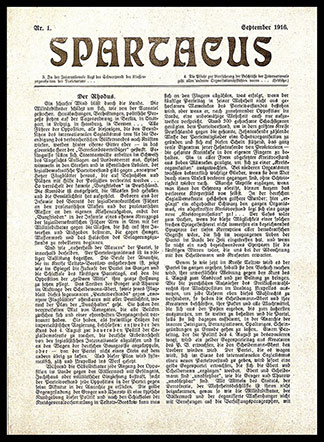
The first issue of Spartacus (September 1916).
Throughout Luxemburg's writings in this period, this sense of isolation and horror at the holocaust to come was to ring through. But as her biographer, J.P. Nettl points out, there was a difference here between Luxemburg and Lenin, who saw the situation not as a tragedy but as a crucial opportunity. For Lenin, the collapse of the Second International represented a new historical epoch – he saw the need for, and was ready for, the complete split with the opportunists and chauvinists. In this, Lenin was making a leap, and a crucial one. Luxemburg and Liebknecht were only to come around to this position much later – throughout the war they were to cling to their oppositional stance within the social democracy.
For the German revolutionists, these were the dog days of 1914 and early 1915, when Germany seemed to be winning the war, and when the whole of the working masses were taken up in chauvinist fever. The SPD leadership under the social imperialists like [Friedrich] Ebert, [Gustav] Noske and [Philipp] Scheidemann gave open support to the Kaiser with the argument that Germany was the most advanced country, the most ripe for socialism, and therefore had to be defended against tsarist reaction. There was also a center group, headed by Kautsky, but also including the old right-wing revisionist [Eduard] Bernstein. They eventually mildly opposed the war on the grounds that it was for imperial expansion, while still insisting they were for the “right of the German nation to defend itself.” The only ones with a clear class opposition were Luxemburg and Liebknecht, whose slogan was “The Main Enemy Is at Home.”
Very quickly repression began to fall on the heads of the antiwar social democrats. On February 18, 1915, Rosa Luxemburg was arrested. Karl Liebknecht enjoyed a few more months of immunity because he was a Reichstag deputy. In November 1914 he became the first SPD deputy to vote against war credits. The Luxemburg-Liebknecht group became known as “Spartacus,” after the name of the underground letters they circulated opposing the war and their “own” bourgeoisie.
On May Day 1916, the Spartakists held a rally in the center of Berlin which drew 10,000 people. When Liebknecht got up to cry, “Down with the Government, Down with the War!” he was immediately arrested. This arrest sparked the first political strike against the war.
From August 4, 1914 to May Day 1916 the mood of the workers had changed dramatically: from four signatures against the Kaiser's war to 10,000-strong demonstrations. Now there were labor strikes against the war and a mass hatred of German militarism which would a year and a half later bring Germany to the point of revolution. A reflection of this sentiment in the working class was the development of the Revolutionary Shop Stewards movement. I want to make the point to young comrades that the consciousness of the working class can shift quickly under the impetus of such mammoth events. The key is leadership – a revolutionary vanguard that can “swim against the stream.”
While she was in Breslau prison in the early months of 1915, Rosa Luxemburg wrote The Junius Pamphlet, exposing the imperialist war in all its gore. She ended the pamphlet decrying the chauvinism which had seized the imperialist countries:
“‘Deutschland, Deutschland über alles,’ ‘long live democracy,’ ‘long live the tsar and slavery,’ ‘ten thousand tent cloths, guaranteed according to specifications,’ ‘hundred thousand pounds of bacon,’ ‘coffee substitute, immediate delivery’ . . . dividends are rising – proletarians falling; and with each one, there falls a fighter of the future, a soldier of the revolution, a savior of humanity from the yoke of capitalism into the grave.”
Lenin called The Junius Pamphlet on the whole, a splendid Marxist work.” But he criticized the author sharply for not mentioning the opportunism of the Kautskyite center. This was crucial. Because the Kautskyites were trying to dismiss August 4 as “an error” whereas revolutionaries had to get to the bottom of the opportunism which had destroyed the Second International. For Lenin, the key question was a split:
“But, first, Junius has not completely rid himself of the ‘environment’ of the German Social Democrats, even the Leftists, who are afraid of a split, who are afraid to follow revolutionary slogans to their logical conclusions. This is a false fear, and the Left Social Democrats of Germany must and will rid themselves of it. They are sure to do so in the course of their struggle against the social chauvinists.”
–Lenin, "The Junius Pamphlet," Collected Works, vol. 22.
That is, in fact, what happened. But the split with the treacherous Kautskyite center came very, very late and only under the pressure of events which were to overwhelm the Spartakusbund.
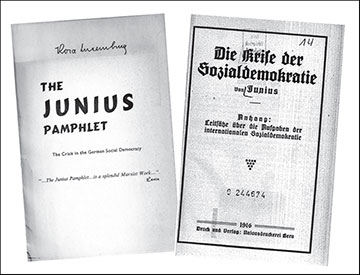 Rosa Luxemburg’s Junius Pamphlet, “The
Crisis of Social Democracy,” was written from jail in
1915.
Rosa Luxemburg’s Junius Pamphlet, “The
Crisis of Social Democracy,” was written from jail in
1915. Lenin commented on the sense of isolation in Junius: “One senses an outsider who like a lone wolf has no comrades linked to him in an illegal organization.” He was careful to point out that it was not a weakness in the author, but a statement about the German left. Here he captured a crucial difference between Lenin and the l.uxemburg group. The Bolsheviks went into the war and the revolutionary situation which grew out of it with a party hardened and tested in struggle; the German lefts only reluctantly and gradually moved toward a break with the official Social Democrats. The Kautsky center group was expelled from the SPD in 1916 and formed the Independent Social Democrats (USPD): the Spartacus group was attached to the USPD until quite late, after the abdication of the Kaiser in November 1918.
Thus, one of the great achievements of the Bolsheviks was to recognize a political split in the working class as a precondition for proletarian revolution. The Bolsheviks had achieved this by August 4, 1914, although they had not generalized it. The German revolutionary left paid with the loss of its leaders, Luxemburg and Liebknecht, and a lost revolution, for the failure to have assimilated this lesson.
“Order Reigns in Berlin”
From the SPD's great betrayal in August 1914, there was a straight line to taking over the reins of the Kaiser’s Imperial Chancellery [in November 1918] in order to save the bourgeoisie from the threat of revolution, and from there, to ordering the murder of Luxemburg and Liebknecht. The Majority Social Democrats drowned the German revolution in blood in the “Spartacus Week” of January 1919 and stabilized the. governments of the Weimar Republic that led, through their impotence, to Hitler’s seizure of power in 1933.
The ultimate weapon of the reformists always is calling upon the capitalist state to do the dirty work for which they can't mobilize mass support. Today, the various reformists and pacifistic doves who want to organize El Salvador protest movements on behalf of the liberal wing of their own bourgeoisie mount physical attacks on the Spartacist League, attempting to seal us off, bringing in the cops.4 Behind their lies, slanders and pathetic daisy chains lie the threat of murderous force. Those who don’t believe that the social democrats are capable of this need only look to the tragic events of Germany of 1918–1919 to see whereof we speak.
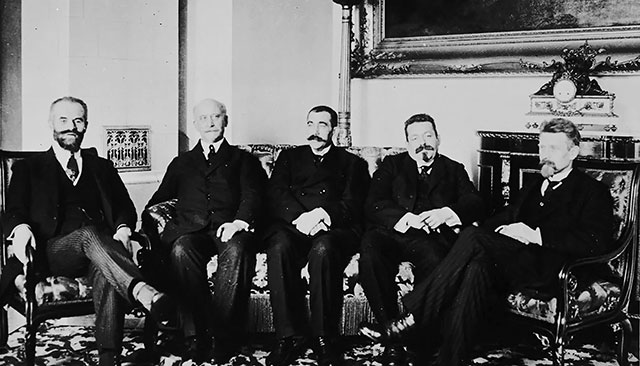 The Social Democratic
Government of Germany after November 1918: Philipp
Schiedemann (left), Gustav Noske (center) and Friedrich
Ebert (to his right). This government of executioners
ordered the murders of Liebknecht and Luxemburg . (Photo: Robert Sennecke / Das
Bundesarchiv)
The Social Democratic
Government of Germany after November 1918: Philipp
Schiedemann (left), Gustav Noske (center) and Friedrich
Ebert (to his right). This government of executioners
ordered the murders of Liebknecht and Luxemburg . (Photo: Robert Sennecke / Das
Bundesarchiv)The treachery of the social democratic leaders was bottomless, The historian Carl Schorske commented on how SPD leader Scheidemann loved the parliamentary junkets to the front where social democrats were wined and dined by high officers. Early in the war, the Majority Socialists actually went and had a meeting with the government, which said, if you guys don’t make trouble, we won’t make trouble for you. You’ll be able to keep your unions (which can be useful in mobilizing the workers for the war), you can keep your press – if you help us out, you’ll get your share. So the labor leaders called off pending strikes, even suspended strike support payments in the name of Burgfrieden (class peace) at home, But it didn’t work out the way they thought it would because Germany was losing the war. The ravages of the war, and the resulting social crisis in Germany, was turning the masses violently against the Kaiser, against militarism and on to revolution.
By 1917, early 1918, the mortality rate for children was up to 50 percent. The average adult calorie intake was 1,000 calories a day – starvation was everywhere. There were strikes and food riots on the part of the Berlin munitions workers. The army was crumbling – Spartacus letters were reaching the trenches hidden in sandbags. After February 1917 and the overthrow of the Russian tsar, the Independents and the Spartakists got a big boost. Then came the October Revolution and the Bolsheviks, as genuine internationalists, did everything they could to further the German revolution.
In his “Farewell Letter to the Swiss Workers” written in January 1917, Lenin had stated flatly, “The revolution will not stop at Russia – the German proletariat is the most faithful and reliable ally of the Russian and worldwide revolution.” Upon arriving at the Finland Station he went out of his way to say, “The hour is not far off when, at the summons of our comrade, Karl Liebknecht, the people will turn their weapons against the capitalist exploiters.” Lenin was prepared to undergo any sacrifice. He told Trotsky, “If it were necessary for us to go under to assure the success of the German revolution, we should have to do it.” And in March 1918, Lenin spoke at the Russian party conference declaring, “It is an absolute truth that we shall go under without the German revolution ... [but] Liebknecht will rescue us from this.”
The possibility and necessity of a German revolution was key to Lenin’s acceptance of the Brest-Litovsk accord.5 It gave the Soviet revolution a breathing space – and an embassy in Berlin. From April 1918, the Soviet Embassy became a headquarters for the promotion of the German revolution. Lenin sent in Adolf Yoffe with an enormous staff: more than 300 persons. Over the embassy, Yoffe hoisted an enormous red banner on which was written, “Workers of All Countries Unite.” From this building he sent out streams of agitators – money was distributed liberally, tons of diplomatically immune revolutionary literature were imported from Russia for distribution in war-torn Germany. Almost every night Yoffe conferred with German revolutionaries on the most detailed tactical questions. (Tell that to the Stalinists who unfortunately aren’t lying when they forswear arms to El Salvador!)
By the autumn of 1918, time had run out for the German Empire. The military government of [German commander General Eric von] Ludendorff wanted to resign so somebody else would take the rap for Germany’s defeat. But they couldn’t find anybody willing to take over the government – except the Social Democrats who rushed in to save the sinking ship of the imperial Kaiser's government. Germany was about to explode. In what might be called the first day of the German revolution, the sailors in the Baltic seaport of Kiel mutinied on November 3, 1918. They had refused to ship out in what was whispered to be a final “death ride” against the British navy, and filled the streets instead. Workers and sailors councils were formed. The Internationale was sung. Red flags flew from every vessel in Kiel. The Berlin government dispatched Majority Socialist Gustav Noske, who would soon be known as “the bloodhound,” to try to cool things down. But within a week general strikes were spreading across Germany. The prison gates were flung open – Rosa Luxemburg was released from prison in Breslau to cheering crowds.
About two weeks earlier, Karl Liebknecht had been released from jail and went straight to the Soviet Embassy for consultations. There was full agreement – the call would be “All Power to the Soviets.” When news of Liebknecht’s release reached Russia, the factories closed down for a holiday. Lenin’s government sent a telegram, “The release from prison of the representatives of the revolutionary workers of Germany is a visible sign of the new epoch – the epoch of triumph of socialism now being revealed for Germany and the whole world.”
On November 9, the Kaiser finally abdicated. Friedrich Ebert, the head of the Majority Socialists, told the Chancellor that their only chance to save capitalism was to get rid of the Kaiser: “If the Kaiser does not abdicate, the social revolution is inevitable. I do not want it – in fact I hate it like sin.” The Kaiser finally bailed out – after they appealed to his higher sense of duty to his class. The Majority Socialists also acted in the higher interests of these same class masters. Friedrich Ebert became president of an Empire that no longer existed.
But Where Was the Party?
The form of the German revolution had come pretty much as Rosa Luxemburg had predicted – mass actions and mass strikes, largely spontaneous in character. But there was a central difference between what happened in Russia and in Germany. There was no party. Lacking was the central leadership which could coordinate and concentrate the revolutionary forces to focus on one single aim: the seizure of power.
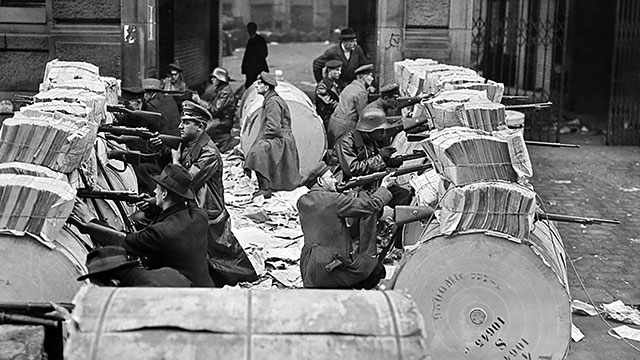 On 4 January 1919, over
100,000 Berlin workers protested the government’s
repressive crackdown including occupying the printing
plant of the Social Democrats’ newspaper Vorwärts.
On 4 January 1919, over
100,000 Berlin workers protested the government’s
repressive crackdown including occupying the printing
plant of the Social Democrats’ newspaper Vorwärts.
(Photo: Bildarchiv Preußischer Kulturbesitz / SMB)
The revolutionary leaders, Rosa Luxemburg, Karl Liebknecht, the other Spartakists were there, and they had tremendous prestige. But at this point they were still part of the Independent Social Democrats. And when they put forward a motion in USPD for “All Power to the Soviets” and for boycotting the constituent assembly, they were voted down. Only afterwards was the decision made to set up an independent organization, to form a Communist party in Germany. As a result of this excruciating delay, for example, in the elections to the all-German Congress of Workers Councils, not a single Spartakist candidate was presented. And the Spartakists had never independently penetrated the trade unions. The mass of the workers were concentrated in SPD and USPD.
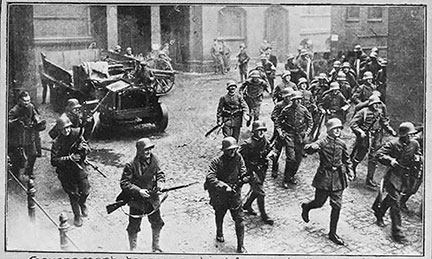 Government forces,
including former Guards Corps troops, restore “order” in
Berlin on 10 January 1919 by assaulting revolutionary
workers and drowning their uprising in blood.. Their
leaders, Rosa and Karl, were murdered five days later. (Photo: PA Pictures)
Government forces,
including former Guards Corps troops, restore “order” in
Berlin on 10 January 1919 by assaulting revolutionary
workers and drowning their uprising in blood.. Their
leaders, Rosa and Karl, were murdered five days later. (Photo: PA Pictures)Finally, on December 30, 1918, the Communist Party of Germany (KPD) was founded. Rosa Luxemburg wrote the draft program. But by this time, she and Karl Liebknecht had only two weeks to live. Already the rabid calls of the bourgeoisie and their trained dogs, the Majority Socialists, were escalating. Every tactic was used to crush the revolutionary rising – provocation, set-ups, assassinations. Every crime was put down to Spartakist. Paul Frölich, Rosa Luxemburg’s comrade, and later biographer, told how the “Anti-Bolshevik League” of the time – well supplied with government money – kept inventing new monstrosities which screamed out from posters on the walls, from leaflets. “Bolshevism Nationalizes Women” was one typical cry. Spies and provocateurs were everywhere. The Majority Socialists made a secret agreement with General [Wilhelm] Groener – the army would not make a coup against the Social Democratic cabinet, if the Social Democrats would agree to fight the Spartakists.
They brought Noske back from Kiel and made him Minister of Defense. He had a single task – round up, sniff out and destroy Spartakist. Noske accepted, saying, “Someone has to be the bloodhound.” More attacks: the head of the Berlin police force – a popular left Independent – was sacked. The printing offices of the KPD’s Rote Fahne (Red Flag) were attacked. Anonymous social-democratic leaflets circulated reading, “Strike the Spartakist leaders dead – Kill Liebknecht.”
And that was what they did. The army was unreliable, so they brought in the Freikorps.6 On January 13, the SPD paper Vorwärts printed a poem – an open call for the deaths of Karl Liebknecht and Rosa Luxemburg. And two days later they were rounded up by Noske’s soldiers. Rosa was shot in the head and her body thrown in the Landwehr Canal; Karl Liebknecht was pushed out of a car and then shot in the head – “shot while trying to escape,” they said.
We recently reprinted the Vorwärts poem in Workers Vanguard, in the article “The Main Enemy Was the Spartacist League” [WV No. 303, 16 April 1982] reporting on the massive police presence combined with social-democratic goon squads arrayed against us at the March 27 (1982) El Salvador demonstration in Washington. You’ll recognize the tone – “the Spartacists are a violence-prone minority,” etc.:
“Many hundred corpses in a row, proletarians!
“Powder, iron and lead don’t ask if to the right or left it’s a Spartakist, proletarians ....
“Who sent force into the streets, proletarians?
“Who first took weapons to hand and burned for a showdown? Spartakus!
“Many hundred corpses in a row, proletarians ....
“Karl, Rosa, Radek & Co.,
“Not one of them is there, not one of them is there, proletarians.”
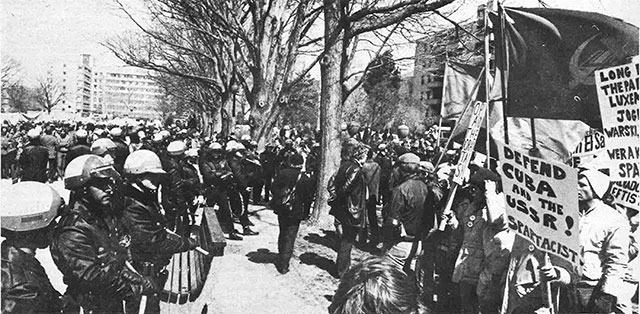 During the El Salvador civil war,
the Spartacist League called for military victory to the
leftist insurgents. Different reformist groups formed lines
(“daisy chains”) and called on police to attempt to seal off
the revolutionaries. Above: Washington, D.C., 27 March
1982. (Photo: Workers
Vanguard)
During the El Salvador civil war,
the Spartacist League called for military victory to the
leftist insurgents. Different reformist groups formed lines
(“daisy chains”) and called on police to attempt to seal off
the revolutionaries. Above: Washington, D.C., 27 March
1982. (Photo: Workers
Vanguard)Well, pretty soon there were Spartakist cadavers in the street. Anybody who thinks that all of these slanders presently going around about the Spartacist League today are only something written on paper or said over the radio should look at what happened in Germany – it set them up for the kill.
The German reformists did everything in their power to crush the revolution. Our reformists today are only the water-boys and advisers of Teddy Kennedy. But one should not expect that they are the only ones. As we said, forces far greater than these reformists had to have been in play for the kind of police mobilization brought out against us on March 27.
After the Spartakist “rising” had been defeated – and two days before her death – Rosa Luxemburg wrote her last article in Rote Fahne, attacking the murderous social democrats who would crush the insurrection to preserve “order” for the capitalist class. Their call for “law and order” always reminds me of the [Socialist Workers Party’s] call to keep things “peaceful, legal.” Rosa’s article, called “Order Reigns in Berlin,” ended this way: “You stupid lackeys. Your ‘order’ is built on sand. The revolution will raise itself up again clashing and to your horror, it will proclaim to the sound of trumpets, ‘I was, I am, I shall be’.”
It wasn’t long after the defeat of the first German revolution that the revisionists of all stripes started to exploit Rosa Luxemburg's writings and started inventing “Luxemburgism,” either as a dogma to give themselves a left cover and still be anti-Leninist; or as the Stalinists did, to create a “Luxemburgism” in order to destroy her internationalist legacy.
As we have seen, this is a complete falsification. There was no Luxemburgism separated from Leninism. Luxemburg and Lenin, although in different countries and different situations, were generally political allies. On a number of issues, they had disagreements. But they were together two of the leaders of the revolutionary wing of pre-World War I social democracy.
Now, through the bullets unleashed by the social democrats, Rosa Luxemburg was ripped away at a crucial point in history, and we cannot say what would have become of her. The program of Lenin, you see, was able to bring together the best elements of the left wings of the socialist parties, and others – for example the revolutionary syndicalists – under the banner of the Third International. Certainly, at every key point in her life, Rosa took the revolutionary side; she founded the KPD just before her death.
Nonetheless, one of the first to try to exploit her differences with Lenin was Paul Levi. Levi had been Rosa’s lawyer and comrade and took over the leadership of the KPD after Jogiches, Luxemburg, Liebknecht, [Eugen] Leviné and most of the central Spartakist leaders had been killed. But Levi didn’t last much longer in the communist movement. On his way back to the Second International Levi published Rosa’s 1917 writings, written in Breslau prison, wherein she was sharply critical of the Bolshevik Revolution. (By the way, Rosa never published these writings in her lifetime – indeed, Levi, after discussions with Leviné, had gone to Breslau at the time to tell her she was disoriented and should wait until she got out of jail and understood more of what was going on in Russia before going into print with her differences. She did later retract much of what she had written in jail at that time.) But now Levi, obscenely trying to reclaim Luxemburg for the social democrats who had murdered her, published these writings.
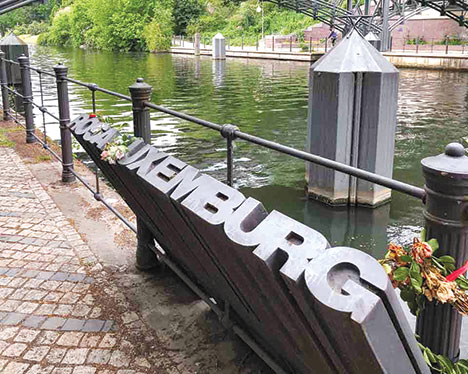 A marker of where Rosa’s body
was pulled out of Berlin’s Landwehrkanal a month after she
was dumped in the canal by her murderers.
A marker of where Rosa’s body
was pulled out of Berlin’s Landwehrkanal a month after she
was dumped in the canal by her murderers. (Photo: FRTC Blog)
Lenin replied with his defense of Luxemburg:
“Paul Levi wants to get into the good graces of the bourgeoisie – and, consequently, of its agents, the Second and the Two-and-a-Half Internationals – by republishing precisely those writings of Rosa Luxemburg in which she was wrong. We shall reply to this by quoting two lines from a good old Russian fable: ‘Eagles may at times fly lower than hens, but hens can never rise to the height of eagles.’ ...
“But in spite of her mistakes she was – and remains for us – an eagle .... ‘Since August 4, 1914, German social democracy has been a stinking corpse’ – this statement will make Rosa Luxemburg’s name famous in the history of the international working-class movement. And, of course, in the backyard of the working-class movement, among the dung heaps, hens like Paul Levi, Scheidemann, Kautsky, and all that fraternity will cackle over the mistakes committed by the great Communist. To every man his own.”
–Lenin, Collected Works, vol. 33.
And Trotsky, on numerous occasions took up the cudgels for Rosa against Stalin’s slanders and those of the social democrats. I’d like to end by just quoting from one, from “Luxemburg and the Fourth International” (24 June 1935):
“Put aside the incidentals which developments have overcome, and we can, with full justification, place our work for the Fourth International under the sign of the ‘Three L’s,’ that is, under the sign not only of Lenin, but also of Luxemburg and Liebknecht.”
- 1. At a pro-Solidarność rally in February 1982, the liberal writer Sontag equated communism with fascism.
- 2. In 1949 a collection of anti-communist essays titled The God That Failed was published with the secret support, financing and distribution by the CIA and Britain’s MI6, as part of the anti-Soviet Cold War.
- 3. After seizing power in a coup d’état in 1926, Marshall Józef Pilsudski ruled as a Bonapartist strong man until his death in 1935.
- 4. Only weeks before this talk, on 20 February 1982, at a New York City protest over the U.S. war on El Salvador, the reformists of the Committee in Solidarity with the People of El Salvador (CISPES) and the SWP, tried to exclude the Spartacist contingent, even getting the police to put up barricades to keep the SL out. The reformists were appealing to liberal Democrats, and were mortally afraid of being “contaminated” by the revolutionaries calling for military victory to the leftist insurgents. See Workers Vanguard No. 300, 5 March 1982. The same happened in Washington, D.C. on March 27 when reformists again called on the cops to keep out the Spartacists.
- 5. In March 1918, the young Soviet republic (which had taken power less than four months before) signed an armistice with the German Imperial Army. Trotsky had opposed a ceasefire, calling for “no war – no peace” and as Commissar for Foreign Affairs went to Brest-Litovsk, where the negotiations were being held, in order to stall for time. But as the military situation of the Soviets worsened, Lenin insisted that a “robbers peace” had to be signed “in order to save the world revolution.”
- 6. After the overthrow of the imperial monarchy in November 1918 and Germany’s capitulation in World War I, volunteer corps were set up that enrolled thousands of the army veterans who blamed their defeat on a “stab in the back” by Communists and Jews. The Freikorps, the largest of these paramilitary groups, quickly became the shock troops to put down a potential workers revolutionary uprising.