
February 2009
Intervention in the Unions
One
group that falsely lays claim to the
heritage of
Trotskyism, the Spartacist League (SL),
recently published an article,
“Why
Marxists Support the EFCA” (Workers
Vanguard, 30 January). Without
saying so directly, this “corrects”
the SL’s
previous position against the “card check”
bill (see WV,
8 December 2006). It also revisits an
article in Workers
Vanguard (8 October 1976), back when it stood on
the program of
revolutionary Marxism. That article noted
that in 1935 when Congress
passed the
National Labor Relations Act (NLRA),
“Trotskyists opposed the Wagner
Act as a
threat to labor’s ability to strike.”
According to today’s
“post-Trotskyist” WV, “In
fact, as far as we know, the
Trotskyists neither explicitly supported
nor opposed the Wagner Act.”
This is
so much horse manure.
In
the first place, the 1976 Workers
Vanguard
article extensively quoted from the
Trotskyists’ New Militant
(6 July 1935), which wrote:
“Under this bill
a National Labor Relations
Board [NLRB]
is to be set up to ‘enforce’ collective
bargaining, etc. Thus the way
is paved
for eventual greater control of government
over the unions.... [T]he
basic
concern of these government agencies is
never that of enforcing the
rights of the
workers, but that of maintaining
‘industrial peace,’ in other words,
preventing
strikes or if they break out somehow,
‘settling’ them, getting the
workers back
to work as quickly as possible.
“Thus these
government boards become in
effect
strike-breaking agencies even under the
best conditions. The workers
will not
get salvation from the Wagner bill. They
must now as ever fight the
entire
system for which it stands. They will get
nothing except that which
they can
take by their organized strength and
militancy.”
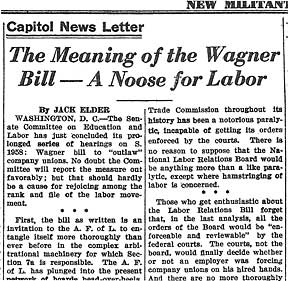 Trotskyists in the
1930s didn't oppose the Wagner Act? See
for yourself. Article from the New
Militant (4
May 1935).
Trotskyists in the
1930s didn't oppose the Wagner Act? See
for yourself. Article from the New
Militant (4
May 1935).
The 1976 WV
article also pointed out that in 1935, the
“even the Communist Party
came out
against the Wagner Act.” It quoted the
CP’s Daily
Worker (6 July 1935) saying:
“The Wagner Bill
does NOT guarantee (except
in words)
the right to organize.... On the contrary,
the bill sets up compulsory
arbitration machinery that can be used to
prevent and break strikes and
to tie
labor hand and foot.”
And if the
editors of WV had
bothered to check, they would have found
another article in
the New Militant (4 May
1935), titled
“The Meaning of the Wagner Bill – A Noose
for Labor.”
While
opposing the Wagner bill, the
Trotskyists did
say that its passage could give the
impression “that unionization will
get
government support and so to stimulate
organizing campaigns and
strikes.” In
that case “militants will take advantage
of the situation” so that
workers can
“learn the true nature and function of all
capitalist governments.”
Genuine
Marxists (i.e., Trotskyists) oppose any
mechanisms of government
control of labor,
whether by card check or NLRB-supervised
“elections.” A real union
organizing
drive would rest on mobilizing the
workers’ strength in action,
including
possible strike action. Given the balance
of forces and the need for
unions to
function in the capitalist legal
framework, it may be necessary to make
use of
or participate in such procedures. But the
tactical issue of how to
deal with
mechanisms for government certification
once they are law is very
different
from calling for passing a law that
slightly modifies but maintains
those
mechanisms.
The
latter-day Spartacist League now says
that while
supporting the EFCA, it opposes the
compulsory arbitration provisions,
which
provide for an initial two-year contract
imposed by the government if
the union
and employer cannot agree. However, in
order to pretend that this is
not such a
big deal, the SL claims that “there are no
legal prohibitions in the
EFCA to
prevent strike action during this
four-month period” of negotiations
leading up
to the binding arbitration. This ignores
legal precedent that will
surely be
used against the workers. The Supreme
Court has ruled (in Gateway
Coal Co. v. UMW, 414 US 368 [1974])
“that the arbitration
clause created an implied no-strike
clause,” and thus a strike was not
legally
protected and could be ruled an unfair
labor practice. And even if the
union
could legally strike, under the EFCA the
outcome would still be subject
to
arbitration!
The
SL’s argument is just eyewash to hide the
fact
that it is supporting a bill to modify,
but still retain, a key element
of
state control of the unions under the
NLRA. Since one can assume that
in
hard-fought cases the employers will not
agree to a contract, in
practice this
means that, while pretending to oppose
binding arbitration, these
pseudo-Trotskyists
favor a system that will result in two
years of government-dictated
contracts.
It
is telling that while the latest WV article quotes from
Trotsky’s 1940
essay on “Trade Unions in the Epoch of
Imperialist Decay,” it doesn’t
mention
the demand that he considered key, for “complete
and unconditional independence of the
trade unions in relation to the
capitalist state.” This is no
academic matter. The most militant
major
labor struggle under U.S. jurisdiction in
recent years, the strike by
the
Puerto Rican Teachers Federation (FMPR) in
February-March of last year,
was
precisely against the colonial
government’s Law 45, which bans strikes
by
public employees. The SEIU then sought to
oust the FMPR using the union
certification procedures of that law
similar to those of the NLRA (see
“Puerto
Rican Teachers: Unbought and Unbowed,” The
Internationalist No. 27, May-June
2008). The militant teachers
union was
decertified, but the ranks were able
defeat the government-back SEIU
affiliate
in the subsequent election because they
were prepared to defy
this anti-labor law.
If
the “card check” bill is passed (and the
new
administration has not been pushing this),
it may make union organizing
somewhat easier. However, many companies
unionized under this procedure
in
recent years have been offered sweetheart
deals by the unions in
exchange,
particularly by the SEIU. It is also
possible that the election of
Barack Obama
with his vague talk of “change” could
encourage some labor activists to
struggle. This played a role in the recent
Republic Windows and Doors
plant
occupation in Chicago (see “Chicago Plant
Occupation Electrifies
Labor,” The Internationalist
supplement, 15
December 2008). But any effort to wage
serious labor struggle in key
sectors –
such as the auto plants slated to be
closed and the undermining of the
health
and pension fund being demanded of the UAW
– will require a leadership
built on
a program of hard class struggle that is
prepared to oppose
the Obama government down the line. And
that means ousting
the present sellout labor bureaucracy
whose entire policy is to chain
the
unions to the bourgeois Democratic Party
and the capitalist state. ■
See
also: Obama
Presidency:
U.S. Imperialism Tries a Makeover
(23
February 2009) 
The
“Obama
Socialists”
(23
February 2009)
Not a
“New New Deal,” But a
Transitional Program for Socialist
Revolution
(23
February 2009)
Barack
Obama
vs. Black Liberation
(23
February 2009)
To contact the Internationalist Group and the League for the Fourth International, send e-mail to: internationalistgroup@msn.com