
February 2009
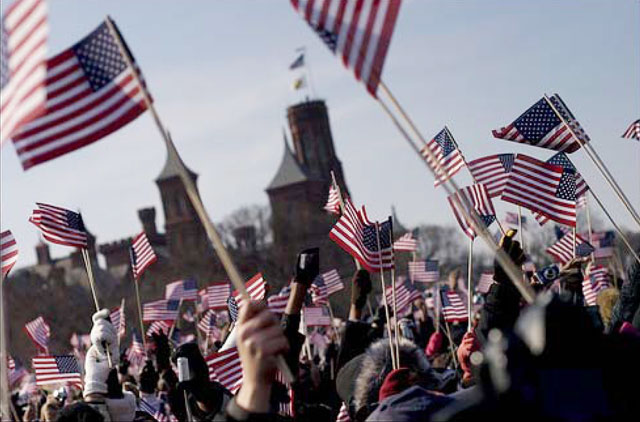
Ruling class used flag-waving inaugural for new imperialist chief Obama to claim that racism has
been overcome in U.S. But racial oppression is in DNA of American capitalism. (Photo: Lydia Bullock/Flickr)
For Black Liberation Through Socialist Revolution!
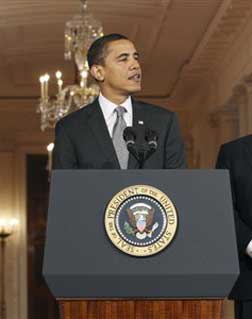 Barack
Obama, the new commander in chief of
U.S. imperialism.
Barack
Obama, the new commander in chief of
U.S. imperialism. (Photo: Pablo Martínez Monsiváis/AP)
The election of Barack Obama as president of the United States was widely hailed as the culmination of the Civil Rights movement. On election night in Harlem, New York’s first (and so far only) black mayor, David Dinkins, declared, “We’re all drinking out of the same fountain now,” as if segregation were a thing of the past. But racist discrimination and oppression are woven into the fabric of American capitalism. Black equality is a dream that is far from being realized while schools around the country are as racially segregated as ever – and in New York City, more so. Racist police brutality is ever-present: witness the New Year’s cop execution of Oscar Grant in a rapid transit station in Oakland, California before scores of witnesses. Obama’s campaign was based on the illusion that the United States had moved “beyond race.” In his inaugural address, he never mentioned race, integration, civil rights, Abraham Lincoln or Martin Luther King. The day before, January 19, was MLK Day, a holiday that was bitterly opposed by racists. Yet the president-elect ostentatiously did nothing that recalled the struggle for civil rights, instead highlighting “service” and support for the military.
Although
Washington, D.C. has had a black
majority for
decades (part of the reason it has no votes
in Congress), the center of
power
stretching from Capitol Hill to the White
House and State Department is
the
preserve of white politicians and their
retinues. On January 20,
however,
hundreds of thousands of black people
flooded into the area, joining
with
whites in celebrating Obama’s swearing-in as
president. Veterans of the
Civil
Rights movement and black teenagers shared a
feeling of pride and
accomplishment. Many felt the last color bar
had been broken. Older
Washingtonians recalled the separate
drinking fountains and lavatories,
the
“whites only” swimming pools, the segregated
schools – and now there’s
a black
president in the White House. Along with all
the Obama kitsch, there
were
ubiquitous photos of the First Family to be
hung in homes around the
country.
But what was jarring was how the ruling
class used the occasion
to claim
that this proves that racism in the United
States has been overcome.
Don’t
believe it. It goes far deeper than legal
discrimination – racial
oppression is inscribed in the DNA of
American capitalism.
It will take a revolution to do away with
this scourge.
The
election of Barack Obama was proclaimed
“historic”
and even “transformative” by virtually the
entire American political
spectrum,
suggesting that it would fundamentally alter
the shape of U.S.
politics. Liberals
and conservatives, as well as
self-proclaimed socialists and outright
reactionaries sang from the same hymnal. The
Wall Street
Journal (5 November 2008) headlined:
“Obama Sweeps to
Historic Victory; Nation Elects Its First
African-American President
Amid
Record Turnout.” John McCain, the defeated
Republican, chimed in: “This
is a
historic election, and I recognize the
significance it has for
African-Americans and for the special pride
that must be theirs
tonight,” he
said, adding that “we have come a long way
from the injustices that
once
stained our nation’s reputation.” There were
only scattered boos from
unreconstructed racists in the crowd. The
same tone of
self-congratulation
marked the inauguration. Yet the injustices
are not only a matter of
past
history. The white racist vote was strong as
ever in its redoubts, and
there
were a number of racist threats and attacks
during and after the
election,
which were largely hushed up by the media.
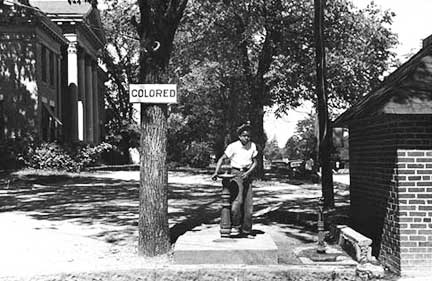 Segregated
drinking fountain outside county
courthouse, Halifax, North Carolina,
1938. (Photo:
Library of Congress)
Segregated
drinking fountain outside county
courthouse, Halifax, North Carolina,
1938. (Photo:
Library of Congress)
There
were blatant appeals to racism both in
the
primary and general elections. Hillary
Clinton’s appeal for votes on
the
grounds that “Senator Obama’s support among
working, hard-working
Americans,
white Americans, is weakening,” was
unmistakable. At rallies of the
Republican
McCain/Palin ticket, Obama was called Arab,
Muslim, traitor, terrorist,
friend
of terrorists, not a real American or more
generally, “not one of us.”
In the
coded language of racism, when speakers
labeled him “elitist,” they
were saying
“uppity.” In the weeks before the
presidential vote, many blacks
worried that
their votes would not be counted.
Ultimately, Obama got a higher
percentage of
white votes nationally than either of the
previous two Democratic
candidates (John
Kerry and Al Gore), but the Democrats have
not won a majority among
whites
since Lyndon Johnson signed the Voting
Rights Act in 1965. The
Republicans
picked up the Dixiecrats with Nixon’s
“Southern strategy.” And while
Obama took
North Carolina and Virginia, the Bible Belt,
that hard core of Southern
white
racism, went more heavily
Republican
than in 2004. In Mississippi and Alabama, 88
percent of whites voted
Republican.
Then
there were the racist attacks and
threats. The
one case that was widely reported was that
of two young Nazi skinheads
in
Tennessee who were arrested by federal
agents a week before the
election. They
had plans for a killing spree to single out
black school children,
“killing 88
people and beheading 14 African-Americans”
before assassinating Obama,
according to the feds’ affidavit. Following
the election, authorities
said
Obama received more threats than any other
president-elect. The
Southern
Poverty Law Center reported “hundreds” of
racist incidents. There were
graffiti
at North Carolina State University calling
to “shoot that ... in the
head,”
elementary students on a school bus in Idaho
chanting “assassinate
Obama,”
swastikas, racial slurs and “Go back to
Africa” spray-painted on
sidewalks,
houses and cars in the Los Angeles area,
crosses burned in yards of
Obama
supporters in New Jersey and Pennsylvania.
In Maine a general store
held an
“Osama Obama Shotgun Pool” where customers
could bet a dollar on the
date he
would be killed, saying “stabbing, shooting,
roadside bombs, they all
count,”
and adding: “Let’s hope someone wins” (AP
dispatch, 16 November 2008).
 Nazi skinhead
arrested in Tennessee last
October in plot to assassinate Barack
Obama and kill black school
children. (Photo:
Associated Press)
Nazi skinhead
arrested in Tennessee last
October in plot to assassinate Barack
Obama and kill black school
children. (Photo:
Associated Press)
These
incidents didn’t just take place in
Southern
backwaters or rural areas where “white
power” fascists prowl. In the
town of
Mastic on Long Island, New York, two dozen
cars were sprayed with
messages
against the president-elect, including “Kill
Obama.” On the day before
the
election, Ku Klux Klan literature was
distributed in neighborhoods in
Islip,
L.I. And in nearby Patchogue, three days
after the election, Marcelo
Lucero, an
Ecuadorian immigrant, was murdered by a
lynch mob. Moreover, on Staten
Island
in New York City, on election night a racist
gang went cruising through
a black
neighborhood, using a pipe and police baton
to beat a black man, send a
black
teenager to a hospital, threaten a Hispanic
man and a group of blacks
celebrating Obama’s victory, and ram a white
man with their car
thinking he was
black. This was silenced in the major media
until two months later,
when the
police made arrests in the case. The brutal
fact is that virulent
racism is
present all over the United States. The
issue is: what will it take to
put an
end to it?
Black
struggle in the 1950s and early ‘60s
focused on
demands for legal rights, and then led to
upheavals in the northern
ghettos
where the black poor were just as oppressed
as they were before the
Civil Rights
movement. Racist police brutality was
rampant, black struggles for
school
integration and open housing were met with
mob violence. In Chicago,
where
outright fascists mounted violent attacks on
a 1966 march led by Martin
Luther
King against segregation in Cicero, it was
axiomatic that “urban
renewal means
Negro removal.” Today, “school reform,”
designed by leading Chicago
corporations and administered by Obama’s
education secretary Arne
Duncan, goes hand-in-hand
with “gentrification” as whites move into
formerly black neighborhoods.
In New
York, police murder African immigrant Amadou
Diallo in a hail of 41
shots in
1999; in 2006, a young black man, Sean Bell,
is cut down by 50 NYPD
bullets. In
both cases, the killer cops walk. Now Obama
tells blacks they must
“respect”
the verdict of the racist, capitalist court.
Is this “change we can
believe
in”? Hardly. A “post-racial” America? No
way.
Obama’s “Color-Blind”
Campaign Conciliates
Racists
The
message of Obama and the Democratic Party
political operatives who shaped his election
campaign was to ignore
wherever
possible and downplay the issue of race, and
above all to stay away
from any
mention of struggle against
racism.
Hillary Clinton and the Republicans latched
onto statements by Obama’s
pastor,
Rev. Jeremiah Wright, whose cardinal sin was
to say that the U.S.
itself
practiced and supported terrorism. In a
sermon after the 11 September
2001 attack
on the World Trade Center and the Pentagon,
Wright told his
congregation:
“We bombed
Hiroshima, we bombed Nagasaki,
and we
nuked far more than the thousands in New
York and the Pentagon, and we
never
batted an eye.... We have supported state
terrorism against the
Palestinians
and black South Africans, and now we are
indignant because the stuff we
have
done overseas is now brought right back to
our own front yards.
America’s
chickens are coming home to roost.”
What Rev. Wright
said is the plain truth, and
his
“chickens coming home to roost” is exactly
what Malcolm X said about
the John
F. Kennedy assassination. (Not long after,
Malcolm himself was
assassinated.)
But under fire from the racists, Barack
Obama denounced his former
pastor,
calling his remarks “divisive,” in a March
18 speech in Philadelphia on
the
issue of race that was widely hailed in the
bourgeois media. Obama’s
appeal for
“reconciliation over rancor,” as one
commentator put it, in fact
conciliated
the racists.
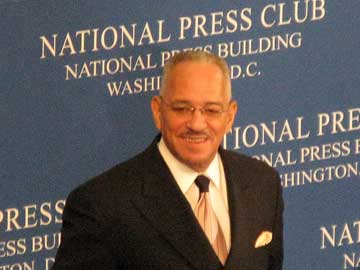 Obama
repudiated Rev. Jeremiah Wright for
telling it like it is. Speaking
here at National Press Club, 28 April
2008. (Photo:
talkradionews)
Obama
repudiated Rev. Jeremiah Wright for
telling it like it is. Speaking
here at National Press Club, 28 April
2008. (Photo:
talkradionews)
The
Democratic candidate said that Rev.
Wright’s
statements “expressed a profoundly distorted
view of this country – a
view that
sees white racism as endemic, and that
elevates what is wrong with
America
above all that we know is right with
America; a view that sees the
conflicts in
the Middle East as rooted primarily in the
actions of stalwart allies
like
Israel, instead of emanating from the
perverse and hateful ideologies
of
radical Islam.” Obama’s statement here was
nothing less than a loyalty
oath to
U.S. imperialism and support for its wars to
terrorize the world into
submission. He also showed “understanding”
for the racist fears of
whites “when
they are told to bus their children to a
school across town; when they
hear
that an African American is getting an
advantage in landing a good job
or a
spot in a good college because of an
injustice that they themselves
never
committed; when they’re told that their
fears about crime in urban
neighborhoods
are somehow prejudiced....” But white
opposition to school integration
through
busing, to affirmative action in response to
centuries of exclusion,
and white hysteria
over “urban crime” are in fact expressions
of
deep-rooted prejudice that must be rooted
out.
The
fact that Obama would not touch issues of
racial
oppression with a ten-foot pole did not go
unnoticed by blacks or
whites. It
goes so far that he is reticent to even
pronounce Martin Luther King’s
name on
a national stage (some hoped for a mention
in the inaugural address,
but were
disappointed). Clearly, he and his political
advisors have made a
decision to
stay away from any hint of black struggle in
order to raise the
“comfort level”
with white voters. Obama explains this by
saying he “stands on the
shoulders”
of those who marched for civil rights, whom
he and others have taken to
calling
the “Moses generation,” that stood up to the
Pharoah and led their
people out
of bondage. Now, they say, the torch has
passed to the “Joshua
generation” who
will lead their people into the promised
land. Having supposedly
arrived there,
blacks are being told to be patient. Popular
radio and TV talk-show
host
Michael Baisden has been telling his
listeners to rein in their wish
lists.
Allison Samuels wrote in Newsweek
(2
February):
“Now that President
Obama is a reality, we
have to
confront a whole new kind of calculus....
Obama faces two international
wars
and the deepest economic crisis since the
Great Depression, with job
losses
that soar by the week. With desperation,
Americans of all races and
backgrounds
are counting on him to solve their problems.
Depending on our
expectations,
African-Americans may be in for a stinging
reality check.
“Though Obama never
promised us anything
specific, we
just assumed that because he’s
African-American, he will put our
interests near
the top of his agenda.... We all understand
that Obama can’t change the
world
in the first day—or even the first 100. We
can be patient.”
Yet
patience will not bring freedom any
closer, not
for black people nor any other sector of the
oppressed. Frederick
Douglas’
saying still holds true today, “Power
concedes nothing without demand.
It never
has and it never will.” Gains won through
struggle can also be taken
back so
long as social, economic and political power
remains in the hands of
capital.
Moreover, the democratic rights won by the
Civil Rights movement never
addressed the situation of black people in
the Northern ghettos, whose
oppression is rooted not in legal
discrimination but in the capitalist
economy,
where they have historically been “last
hired and first fired,” where
housing
discrimination was through “red-lining” by
real estate interests, where
school
segregation was based on residence not legal
prohibitions. “Racial
profiling”
and racist police brutality against blacks
has not changed a bit even
though
over the last three decades there have been
black mayors of just about
every
large city in the U.S. and there are tens of
thousands of black and
Latino
cops. It is the system that
produces
black oppression, not the personnel.
Beginning
in the late 1960s, there has been a
considerable increase in the number of black
elected officials: from
under
1,500 in 1970, it grew to over 9,500 in
2006, with 40 members of
Congress. But installing
black officials won’t change the racist
nature of American capitalism,
any more
than having Colin Powell as chairman of the
Joint Chiefs of Staff or
Powell and then Condoleezza Rice as
secretary
of state under Bush made the U.S. any less
imperialist. As Mumia
Abu-Jamal, the
former Black Panther and renowned radical
journalist on Pennsylvania’s
death
row for the last quarter century, noted
(“The Perils of Black Political
Power,”
16 August 2008), when black Democrat Carl
Stokes was elected mayor of
Cleveland
in 1967, one of his first acts was to hire
black general Benjamin O.
Davis,
just back from Vietnam, as director of
public safety. Davis ordered
30,000
dum-dum (hollow point) bullets and cracked
down on the Black Panther
Party.
Mumia’s conclusion: “Black faces in high
places does not freedom make.”
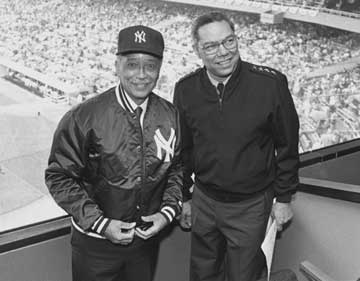 NYC Mayor David Dinkins
(“they’ll
take it from me”), left,
with Gen. Colin Powell at Yankee
Stadium, 15 April 1991, shortly after
Persian Gulf War. Under Powell's
command, U.S. troops buried Iraqis
alive. (Photo:
New York City)
NYC Mayor David Dinkins
(“they’ll
take it from me”), left,
with Gen. Colin Powell at Yankee
Stadium, 15 April 1991, shortly after
Persian Gulf War. Under Powell's
command, U.S. troops buried Iraqis
alive. (Photo:
New York City)
In
fact, black mayors have often been brought
in just
when the rulers decided to impose
anti-working class austerity measures
on the
poor, black and working-class population.
When David Dinkins was
running for
NYC mayor in the fall of 1989, he told his
big money backers, “it may
well be
that I’ll have to tell some of my friends
they cannot have all the
things they
want. But they’ll take it from me.” A year
later he ordered $1 billion
in
cutbacks in city services and threatened up
to 15,000 layoffs. Today a
big
factor contributing to Obama’s victory was
the economic and financial
crisis. Many
workers (even “Rednecks for Obama”) voted
for the Democrat because they
figured
he would better defend their pocketbook. The
crisis especially affects
black
workers, whose official unemployment rate is
almost double that of
whites (12.6
percent compared to 6.9 percent in January).
In particular, some 20,000
black auto
workers have lost their jobs since the
beginning of the crisis, a 14
percent
fall in black employment in the industry,
more than three times the
overall
decline for manufacturing workers (New
York Times, 30 December 2008). And
Obama is the one who will tell
them
they’ll just have to take it.
Ruling Class
Substitutes “Diversity” for
Equality
In a
country built on the myth that “any
child can
grow up to be president,” Barack Obama’s
election is seen as an example
of
individual achievement. He is being promoted
as a role model for black
youth,
to encourage teenagers that it’s “cool” to
study hard – you can still
shoot
hoops. There is even an academic study
purporting to show an “Obama
effect”
among black students taking standardized
tests, with scores going up
after his
nomination and election victory. But for all
his personal qualities,
the future
president did not go from Hawaii’s most
exclusive college preparatory
school to
Occidental College, Columbia University and
Harvard Law School on the
basis of
diligence and intelligence alone. Nor are
decisions about who gets
access to
the elite private educational institutions
of U.S. capitalism made by
some
lowly admissions officer sitting in a
cubicle looking over test scores.
Although
political competition sometimes results in a
real dud at the helm of
the imperialist
ship of state, the more far-sighted sections
of the ruling class take
care in
selecting and grooming their future leaders.
The
commanders-in-chief of U.S. imperialism
are also
supplied with a governing apparatus. True,
Richard Nixon convincingly
pretended
to be a madman, Ronald Reagan notoriously
fell asleep during cabinet
meetings
and George W. Bush seemed unable to utter a
sentence without mangling
the
language. Yet their administrations carried
out their reactionary
programs
fairly efficiently. The failed military
adventures, torture, scandals
(Watergate, Iran-contra, “WMD”) and economic
disaster were not due to incompetence
but the result of policy
and the capitalist system.
So after eight years of
Bush,
the American ruling class was ready to turn
to the Democrats, who pride
themselves on being the “responsible”
administrators of U.S.
imperialism, as
opposed to the Republican “cowboys.” After
Obama grabbed attention with
his
speech at the 2004 Democratic convention,
some key Democratic money men
placed
their bets on him in the fall of 2007 and
Wall Street firms financed a
well-oiled
campaign machine. Once elected, the
president was provided with a
“team” to run
the government which – surprise! – turns out
to be the same as the
previous
Clinton administrations, plus some holdovers
from the Bush regime.
Having
a black president does not represent
black
power, or even “empowerment,” in Jesse
Jackson’s ambiguous phrase.
Obama in the
White House, built by slave labor, will not
overcome the legacy of
slavery and
bring about the “promise” of racial
equality. Instead, in the 1970s, in
response to the unrest in the northern
ghettos, the ruling class
embarked on a
conscious policy of diverting black anger by
promoting a privileged
layer of
black petty-bourgeois, and recruiting
particular individuals from this
pool
into the bourgeoisie itself. By 2001, you
had a number of black CEOs at
the
head of Fortune 500 companies (Stanley
O’Neal at Merrill Lynch, Richard
Parsons
at Time Warner, Franklin Raines at Fannie
Mae, Kenneth Chenault at
American
Express). But having a more diverse
selection of capitalist “decision
makers,”
also including a few women, in no way
indicates a move toward social
equality.
The opposite is the case: relative incomes
of black families have fallen
over the last three decades, from
64 percent of whites’ in 1974 to only 58
percent in 2004. The gap in
wealth is
considerably wider. “Diversity” is being
promoted as an alternative
to equality, which
capitalism cannot provide.
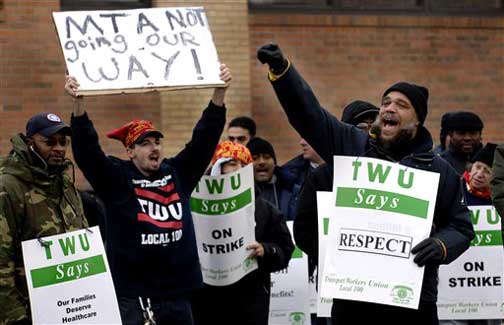 Black workers
power: Blacks are an integral
and strategic part of the multiethnic
working class. Transit workers
struck in December 2005, tieing up New
York City, center of
international finance capita.
Black workers
power: Blacks are an integral
and strategic part of the multiethnic
working class. Transit workers
struck in December 2005, tieing up New
York City, center of
international finance capita.
(Photo: Jason DeCrow/AP)
Developments
since the end of the Civil
Rights
movement have made certain changes in the
condition of black America.
Sections
of the black middle class have moved out of
the ghettos and into the
suburbs.
There are more opportunities and often
higher incomes for black
university
graduates. There was a surge of black home
ownership in the late 1990s.
Yet the
workings of capitalism constantly reproduce
black inequality, as we are
now
seeing. Unemployment in inner city
neighborhoods remains at Depression
levels.
The numbers of black men in college have
been sharply falling,
foreclosures
disproportionately affect middle-class black
families, while layoffs
are
hitting black industrial workers
particularly hard. Black
people in capitalist
America are still today a race-color
caste segregated at the bottom of
U.S.
capitalist society.
At
the same time black workers are an
integral and
strategic part of a multiethnic proletariat.
While the rulers conspire
to keep
black and white divided, the experience of
class struggle can unite
black
workers with their white, Latino and Asian
brothers and sisters,
immigrant and
U.S.-born, against their common capitalist
enemy. And although legal
equality
is a bourgeois-democratic demand – a
watchword of the French Revolution
of
1789, which proclaimed “freedom, equality,
fraternity” – genuine
freedom and actual
social, economic and political equality
for blacks in America, whose
oppression
has always been central to the
preservation of the capitalist order,
can only
come about through a socialist
revolution.
Lessons of the Second
American Revolution
To
understand why this is so, one need only
consider
the outcome and legacy of the first two
American revolutions. The
first, the
War for Independence from Great Britain, was
solely a political
revolution to
throw off colonial rule. Although the
Declaration of Independence had
ringing
proclamations of democratic ideals, such as
“all men are created
equal,” the
practice was far different. The Constitution
was based on compromise
between
Southern planters and Northern merchants,
manufacturers and bankers in
order to
preserve the interests of capitalist
property and ward off the threat
of social
revolution. Voting was limited to men of
property and human bondage was
enshrined by counting three-fifths of the
slave population in
calculating
representation in Congress. The Atlantic
slave trade was legally
permitted for
20 years (and continued unabated right up to
the Civil War). But while
plantation
agriculture flourished (the number of slaves
increased from 700,000 to
4
million) and the slaveholders dominated
national politics, slavery
increasingly
divided the country. The Haitian Revolution
inspired slave revolts
– notably those led by Gabriel
Prosser
(1800), Denmark Vesey (1822) and Nat Turner
(1831). The 1845 annexation
of
Texas and 1848 war on Mexico were fueled by
a drive to extend the
number of
slave states, and Abolitionist agitation and
border wars led to
political
polarization.
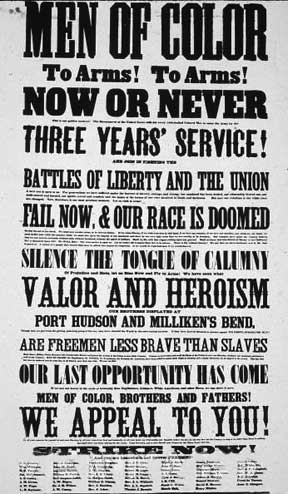 Recruiting poster
calling on blacks to join
the Union Army in the Civil War. Appeal
was signed by Frederick
Douglass, among others.
Recruiting poster
calling on blacks to join
the Union Army in the Civil War. Appeal
was signed by Frederick
Douglass, among others.
In
1858, Abraham Lincoln declared, “I believe
this
government cannot endure permanently half
slave and half free.” The
future
Republican president made clear his
intention was not to abolish
slavery, only
to limit its extension. However, immediately
after Lincoln’s 1860
election the
South began preparing secession. When
fighting broke out, some Northern
and
British capitalists treated it as simply a
war over tariffs. But the
Southern
planters were determined to defend the fount
of their wealth, and the
Confederate
Constitution explicitly endorsed slavery.
After the April 1861 attack
on Fort
Sumter, South Carolina ended efforts at
compromise, Frederick Douglass,
the
former slave and great Abolitionist,
observed:
“The American
people and the Government in
Washington
may refuse to recognize it for a time, but
the ‘inexorable logic of
events’
will force it upon them in the end: that the
war now being waged in
this land
is a war for and against slavery; and that
it can never be effectively
put down
till one or the other of these vital forces
is completely destroyed.”
–Douglass’
Monthly, May 1861, cited in James M.
McPherson, The
Negro’s Civil War (1965)
Across the sea in
London, Karl Marx arrived
at the
same conclusion. In November 1861, the
founder of modern communism
wrote:
“The present
struggle between the South and
North is,
therefore, nothing but a struggle between
two social systems, the
system of
slavery and the system of free labour. The
struggle has broken out
because the
two systems can no longer live peacefully
side by side on the North
American
continent. It can only be ended by the
victory of one system or the
other.”
Today
some self-proclaimed Marxists who
refuse to
understand that the struggle against black
oppression is key to workers
revolution in the U.S. say they wouldn’t
take sides in the Civil War,
dismissing it as a squabble between two sets
of bosses. Not
surprisingly, using
the same rationale they also refuse to
defend Iraq and Afghanistan
against U.S.
imperialist attack. Yet a century and a half
ago, Marx, Douglass and
hundreds
of thousands of free blacks and slaves could
see further. Black men
rushed to
enlist in the Union Army, understanding that
its victory by the force
of their
arms was the only guarantee of emancipation
from the bonds of servitude.
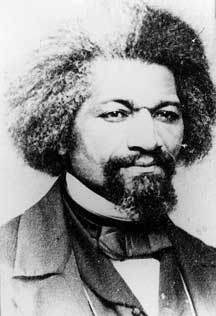 Frederick Douglass
The
destruction of slavery in the Civil War,
in which
some 180,000 black men fought in the Union
Army and 40,000 died,
constituted
the Second American Revolution. It ushered
in the only really
democratic chapter
of American history: Reconstruction. It
brought legal freedom for 4
million
slaves, decreed in the Emancipation
Proclamation and codified in the
13th
Amendment to the Constitution. It extended
citizenship to all born in
the
United States – except Native Americans and
women! – in the 14th
Amendment, and
outlawed discrimination in voting rights on
the basis of race or color
in the 15th
Amendment. Despite resistance, not only from
the defeated Southern
planters but
also from “moderate” capitalist politicians
from the victorious North
and
border states (including Lincoln’s successor
Andrew Johnson),
Reconstruction
governments in the militarily occupied South
for the first time brought
black
men to political office. Over 600 blacks
served as state legislators,
as well
as 15 U.S. Representatives and two black
Senators. Prior to the Civil
War
education for slaves was a crime, during
Reconstruction networks of
public
schools for blacks arose across the South,
although segregated.
Conditions
were laid for a deeper social
transformation: the first halting steps
toward racial equality were
made and
workers began building labor unions in the
fight for the eight-hour
day. But
from the beginning this was undercut and
ultimately reversed by the
failure to
provide the freedmen and women with economic
conditions that would
enable them
to exercise their formal democratic rights.
The former slaves did not
receive “40
acres and a mule” General William Sherman
promised in his famous Field
Order
No. 15 to the tens of thousands of black
refugees who joined his army
as it
marched across Georgia to Savannah.
President Andrew Johnson revoked
Sherman’s
order and ordered confiscated lands returned
to their former owners.
Lacking
capital and land, blacks found themselves
forced by economic necessity
back
onto the plantation to which they were bound
by the sharecropping
system. From
chattel slaves they had become landless
peasants and tenant farmers.
Almost
immediately, the remnants of the Confederate
Army began terrorizing
blacks
through the hooded nightriders of the Ku
Klux Klan, seeking to
intimidate the
former slaves from exercising their newly
won and tenuous rights.
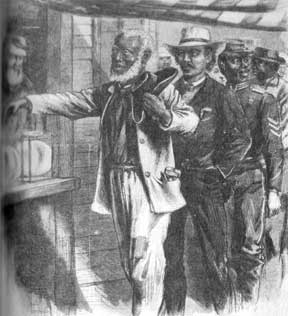 “The First
Vote,” from cover of
Harper’s Weekly,
16 November 1867. (Sketch by A.R. Waud)
“The First
Vote,” from cover of
Harper’s Weekly,
16 November 1867. (Sketch by A.R. Waud)
But
meanwhile, black workers had begun to
organize. In
1865, there were an estimated 100,000 black
mechanics in the South. In
1867
there was a wave of strikes, including on
the levee in Mobile, Alabama
and on
the docks in Charleston, South Carolina
where the Longshoremen’s
Protective
Union Association won higher wages. William
Sylvis, head of the
National Labor
Union founded in 1866, reported from the
former Confederacy that he was
convinced that “a vigorous campaign will
unite the whole laboring
population of
the South, white and black, upon our
platform,” and “we will have a
power in
this part of the country that will shake
Wall Street out of its boots.”
However,
although a plan to organize black workers
was approved, many local
unions in
the North refused to admit black members. In
1870 a National Colored
Labor
Union was formed that affiliated with the
NLU. The latter issued a call
for a
labor party, saying that “inasmuch as both
the present political
parties are
dominated by the non-producing classes, the
highest interest of our
colored
fellow-citizens is with the workingmen, who,
like themselves, are
slaves of
capital and the politicians.”
These
first steps toward working-class racial
unity
soon halted. The National Labor Union
ignored calls for a campaign to
gain full
legal equality for blacks, engaged in
chauvinist agitation against
Chinese
laborers, and was soon swallowed up in a
populist crusade (the
greenback
movement) against the return to the gold
standard. The NCLU, in turn,
became
effectively an appendage of the Republican
Party and ignored struggles
of black
workers, such as the Baltimore
Longshoremen’s Association strike in
1871. Then
in September 1873 the failure of a leading
New York banking house
touched off
the first Great Depression, throwing
millions out of work. Unions were
decimated. In the South, reaction was on the
march, as pressure built
to put an
end to Reconstruction. This was accomplished
in the infamous Compromise
of
1877, following the contested election of
1876. Republican Rutherford
Hayes was
awarded the White House in exchange for the
withdrawal to their
barracks of the
remaining federal troops in the former
Confederate states. White
supremacy was
reestablished and over the next decades “Jim
Crow” segregation was
instituted,
more rigid even than under slavery.
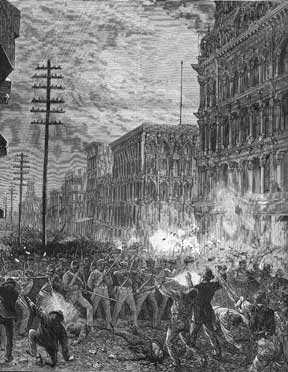 The Great Railroad
Strike of 1877: National Guard troops
shoot down strikers in Baltimore.
Engraving from cover of Harper’s Weekly,
11 August 1877.
The Great Railroad
Strike of 1877: National Guard troops
shoot down strikers in Baltimore.
Engraving from cover of Harper’s Weekly,
11 August 1877.
Once
the initial shock of the 1873 panic wore
off,
workers’ struggles picked up again. A bitter
1875 strike over wage
reductions
in the northeastern Pennsylvania coalfields
was crushed and the miners’
union
destroyed. The mine owners with their Coal
and Iron Police and
Pinkerton labor
spies spread terror by arresting, hanging
and assassinating labor
militants
accused of being members of a secret
“terrorist” society, the Molly
Maguires.
Yet only two years later, the Great Railroad
Strike of 1877 broke out
in West
Virginia, spreading to Maryland and
Pennsylvania, and on to Illinois.
The
bosses’ press blamed “the hands of men
dominated by the devilish spirit
of
Communism.” This strike, too, was broken by
a series of massacres as
federal
troops and militias shot down 40 strike
supporters in Pittsburgh and
scores
more elsewhere (see “1876,” in The
Internationalist No. 9,
January-February 2001). But the outcome
could have
been very different. The destruction of
Black Reconstruction in the
South
emboldened the federal government in sending
soldiers to slaughter
Northern
strikers. Indeed, Thomas Scott of the
Pennsylvania Railroad, one of the
original robber barons, engineered the
Compromise of 1877. Hayes
dispatching
troops to massacre strikers was the payback.
It
was perhaps too early for a workers
revolution: even
in the midst of a Depression, American
capitalism was in its phase of
expansion. But the development of the class
struggle could have been
very
different had the former slaves had the
economic wherewithal to fight
back
against the plantocracy and their KKK terror
squads, and if black and
white
workers had been able to forge real bonds of
class unity. The potential
for
this was indicated as poor blacks and whites
joined in the Populist
movement in
the 1880s. But the racist rulers responded
with lynching and
disenfranchising
blacks through poll taxes, literacy tests
and other subterfuges. The
workers
movement would have been tremendously
strengthened if not divided by
race and
poisoned with racism. Black people could
have been spared 90 years of
hideous
segregation, denial of basic democratic
rights and outright terror.
Because the
destruction of slavery was not accompanied
by the social and economic
emancipation of the slaves, the democratic
rights won in the bloodiest
war in
American history were largely reversed. The
legacy of the defeat
of the struggle for full equality and
freedom following the
Civil War meant that the “American dream”
was a nightmare
for blacks.
Accommodation,
Separatism or Revolutionary
Integrationism
The
post-Civil War Reconstruction of the
South marked
the high point of the struggle for black
freedom in the United States.
It was
also the limit to what can be achieved
without going beyond democratic
rights
to attack the underlying economic structure
of black oppression. The
smashing
of Reconstruction, the suppression of the
black vote and the imposition
of
rigid race segregation, consecrated by the
Compromise of 1877 between
the
different factions of the capitalist ruling
class, North and South,
ushered in
a lengthy period of defeat. The Civil Rights
struggles of the 1950s and
‘60s
were largely to regain rights that had been
written into the U.S.
Constitution
but were denied in reality. And even those
gains are at risk. The
Voting Rights
Act of 1965 has been brazenly undermined by
intimidating blacks from
voting and
simply annulling black votes. In Duval
County, Florida alone, 26,000
votes from
the black communities around Jacksonville
were thrown out on
“irregularities”
in the 2000 election.
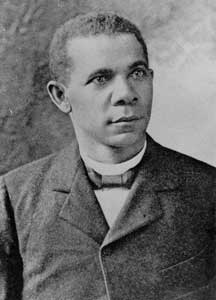 Booker T. Washington,
president of Tuskegee Institute.
Booker T. Washington,
president of Tuskegee Institute.
The
reestablishment of white supremacy after
1877
produced a change in black leadership.
Rather than Frederick Douglass
in the
forefront of the Abolitionist movement,
Booker T. Washington became the
spokesman for an accommodationist policy
that accepted Jim Crow. In his
1895
“Atlanta Compromise” speech, Washington
declared, “In all things that
are
purely social we can be as separate as the
fingers, yet one as the hand
in all
things essential to mutual progress.” This
speech laid the basis for
accepting
the 1896 Supreme Court decision in Plessy
v. Ferguson that established the
“separate but equal” doctrine
justifying
segregation in public facilities.
Washington’s program was self-help
(“it is at
the bottom of life we must begin, and not at
the top”) while pledging
to be
loyal, responsible citizens (“in our humble
way, we shall stand by you
with a
devotion that no foreigner can approach”).
Soothing Southern
aristocrats and
Northern investors, he called for
“interlacing our industrial,
commercial,
civil, and religious life with yours in a
way that shall make the
interests of
both races one.” Waxing
poetic, he said,
“The laws of changeless justice bind
Oppressor with oppressed ... We
march to
fate abreast.”
Barack
Obama today is no successor to Martin
Luther
King, Jr. While occasionally paying
lip-service to the leader of the
liberal
Civil Rights movement, Obama’s position is
that the time for fighting
for black
rights is past. Or as his adviser Valerie
Jarrett put it, “You do not
need to
have demonstrations in front of the White
House” about how “there is a
disparate impact in the African-American
community around issues such
as health
care and education. He’s got that.” With his
talk of personal
responsibility
and self-help, Obama is sounding the same
themes as Booker T.
Washington. In
his Philadelphia speech on race, Obama
declares that “working together
we can
move beyond some of our old racial wounds,”
and while “continuing to
insist on
a full measure of justice,” this also “means
taking full responsibility
for own
lives.” Obama embraced “this
quintessentially American – and yes,
conservative
– notion of self-help.” Where Washington
said not to “permit our
grievances to
overshadow our opportunities,” Obama
criticized the “mistake” of his
former
pastor Rev. Wright in his “offending sermons
about America – to
simplify and
stereotype and amplify the negative.”
Obviously,
the situations are different – for
all his
warm and financially rewarding relations
with Northern capitalists like
Andrew
Carnegie, Booker T. Washington would never
have been elected to any
office, much
less the presidency – but the themes are
similar. Rather than
Washington’s
image of the oppressed and oppressor
harmoniously marching forward to
face fate
– or in the Obama version “working together
we can move beyond some of
our old
racial wounds” – we prefer the words from
Byron with which W.E.B.
DuBois began
his 1903 essay, “On Mr. Booker T. Washington
and Others”: “Hereditary
bondsmen!
Know ye not, Who would be free themselves
must strike the blow?”
Since
the abolition of slavery, there have
been sharply
different programs in the struggle for black
freedom. In periods of
defeat, the
views of compromisers like Booker T.
Washington gain force, along with
separatists like Marcus Garvey who despair
of any positive resolution
in the
U.S. Whether preaching submission or escape,
both seek accommodation
with the
capitalist rulers. This is also true of
currents such as the Nation of
Islam
under Elijah Mohammed and Louis Farrakhan.
In periods of advancing
social
struggle, on the other hand, the fight for
integration predominates.
Those
struggles have generally been led by
bourgeois liberals such as the
NAACP
(National Association for the Advancement of
Colored People), CORE
(Congress
for Racial Equality) in its early years, or
King’s Southern Christian
Leadership
Conference (SCLC). When the liberal
integrationists reached a dead end
following the passage of the ’60s Civil
Rights laws, many young black
radicals
turned toward the advocates of “black power”
who rejected King’s
turn-the-other-cheek pacifism. But the Black
Panthers and other radical
nationalists were destroyed by the
combination of racist state
repression and
internal discord.
Historically,
most of the left in the U.S.
has
supported the liberal integrationists,
particularly since the mid-1930s
when the
Stalinists embraced the “popular front,”
joining social-democratic
reformists
in tailing after liberal Democrat Franklin
D. Roosevelt. Sometimes
these
leftists hold up the picture of Malcolm X as
an icon, as they do with
the image
of Che Guevara, to give a radical allure.
But politically they are
solidly in
the Martin Luther King camp, and today
either openly or with a fig leaf
of
independence they want to profit from
Obama’s popularity. As opposed to
conservative accommodation and liberal
integrationism, we Trotskyists
fight for
a program of revolutionary
integrationism.
We stress that the fight for
black freedom and equality in capitalist
America can only succeed by
overturning the economic foundations of
black oppression. We recognize
the
radical impulse of many black nationalists
who were breaking from the
liberal
preachers, but emphasize that the oppressed
black poor and working
people can
only achieve power through common struggle
together with their class
sisters
and brothers of all races. We stand for black
liberation through socialist
revolution.
A Revolutionary Workers
Party as a Tribune of
the
People
Today
black liberals and reformists support
Barack
Obama, in line with their overall
popular-front politics (many
supported
Democrat John Kerry as well). After an
initial complaint about Obama
being a
no-show at a “Covenant for Black America”
conference, Cornell
West (honorary chairman of Democratic
Socialists of
America) signed up. Manning
Marable
(DSA, former co-chairperson of Committees of
Correspondence, chairman
of
Movement for a Democratic Society, Inc.)
likewise. The cultural
nationalist and
Democratic Party politician Charles
Barron enlisted early on, saying Obama
would not only break the
white, male
monopoly on the presidency but would be best
placed to “put forth a
black
agenda,” which he has hardly done. Another
right-wing nationalist,
Prof. Leonard Jeffries, who
made headlines in
1990 with his crackpot “ice people”/“sun
people” racial theories and
anti-Semitism (blaming Jews for the slave
trade), bizarrely claimed
that the
election of Obama marked “the moment that
the capitalist system
collapsed.” “No
matter what Obama does in office,” he added,
“Mumia Abu-Jamal ... even
if he
goes to his reward he’s got to celebrate the
fact that he was here” at
Obama’s
election.
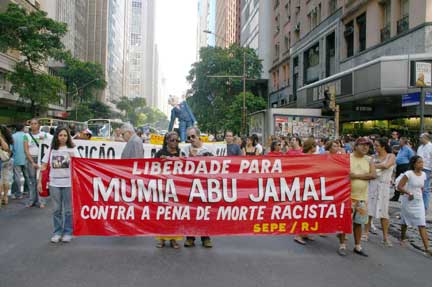 Teachers
union (SEPE) of Rio de Janeiro,
Brazil, April 2008, in its second
state-wide work stoppage demanding
"Freedom for Mumia Abu-Jamal! Down with
the Racist Death Penalty!"
Teachers
union (SEPE) of Rio de Janeiro,
Brazil, April 2008, in its second
state-wide work stoppage demanding
"Freedom for Mumia Abu-Jamal! Down with
the Racist Death Penalty!"
(Photo: Vanguarda
Operária)
It is
characteristic of the range of those
who
supported Barack Obama that it went from
supporters of Mumia to
right-wing
Philadelphia talk radio hack Michael
Smerconish, who has for years been
in the
forefront of the cop vendetta to execute
former Black Panther Jamal for
a crime
he didn’t commit. Smerconish, who was a
master of ceremonies for Bush
in 2004
and has endorsed the U.S.’ use of
“waterboarding” and other forms of
torture, hosted
Obama on his show and came out for the
Democratic candidate last
October. Now
he will try to cash in on that support,
hoping at least for Obama’s
acquiescence
in the face of the legal lynch mob. Those
who looked to the election of
a black
president to save Mumia could be cruelly
awakened from their illusions.
The
Internationalist Group and the League for
the Fourth International
(LFI) fight
to mobilize the working class to free Mumia
Abu-Jamal. Our comrades of
the
Brazilian section of the LFI initiated the
first strike action for
Mumia’s, a
statewide work stoppage by teachers in Rio
de Janeiro, in April 1999,
in conjunction
with the U.S. longshore union, ILWU, which
closed the West Coast ports
for ten
hours demanding his freedom.
While
many liberals and reformists have been
caught up
in what’s being called “Obamania,” some
left-wing black intellectuals
and
political activists have not fallen prey to
the all-round cheering for
Democrat
Obama. Interestingly, former Communist Party
vice-presidential
candidate Angela
Davis said in an interview with the London Guardian
(8 November 2008) shortly after the
election, “when the inclusion of
black
people into the machine of oppression is
designed to make that machine
work
more efficiently, then it does not represent
progress at all.” Davis
added that
Obama “is being consumed as the embodiment
of colour blindness. It’s
the notion
that we have moved beyond racism by not
taking race into account.” Glen
Ford of
the Black Agenda Report was even sharper. In
a December 14 Harlem
debate with
Obama supporters Barron, Jeffries, Viola
Plummer (December 12 Movement)
and
Malik Shabazz (New Black Panther Party),
Ford declared forthrightly:
“What we wound up
with is a president-elect
whose
Cabinet to-date is mostly a Clinton Cabinet
– and worse.
“Obama’s military
portfolio is in the hands
of a
Reagan/Bush-1/Bush-2 war criminal, Robert
Gates, whose crimes go back
to Iran
Contra and the mining of Nicaragua’s
harbors.
“Obama’s economic
mechanisms will be in the
hands of
the very same robber baron bankers that set
the stage for catastrophic
meltdown
through their actions under both Bill
Clinton and George Bush....
“Barack Obama has
chosen of his own free will
to put
his face at the head of an administration
whose most powerful
portfolios – War
and the Economy – are manned by the worst
thieves and warmongers
available.”
–Black
Agenda
Report, 17 December 2008
While
voicing criticisms of the Democratic
candidate,
the “lesser-evil” logic of American
bourgeois politics is so ingrained
that
very few left groups, socialists and black
activists would flatly call
for no vote for Obama, as
the Internationalist
Group did. Using a sliding scale of who is
the more “progressive,” they
either
wash their hands of the whole matter, or end
up supporting to one
degree or
another the new commander-in-chief of U.S.
imperialism. Today their
candidate is
laying waste to Afghanistan and Iraq,
launching missiles in Pakistan,
bailing
out Wall Street banks, opposing caps to the
multi-million-dollar
salaries of
all but a tiny number of bankers, bailing
out the auto companies by
slashing
auto workers’ jobs and imposing a no-strike
clause to boot. Genuine
communists
and fighters for black liberation instead
take a class
stand in political opposition to all bourgeois
politicians and
parties. Rather than beseeching the
representative of capital to be a
“friend
of the people,” we seek to form
a revolutionary
workers party that champions the
cause of, and seeks to
mobilize, all
those exploited and oppressed by capital.
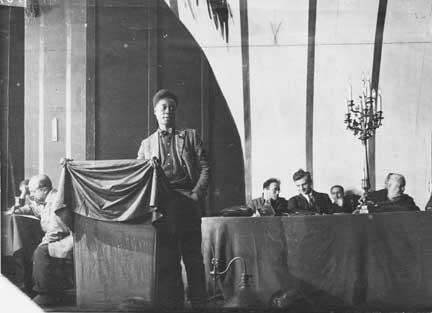 Claude McKay
addressing the Third Congress
of the Communist International, Moscow,
1923.
Claude McKay
addressing the Third Congress
of the Communist International, Moscow,
1923.
(Photo: Beinecke Rare Book
Library/Yale
University)
At
the turn of the last century, American
socialists
were at best oblivious to the oppression of
blacks. Their “color-blind”
policy
was summed up in the expression of Eugene V.
Debs, that “we have
nothing
special to offer the Negro.... The Socialist
Party is the party of the
whole
working class, regardless of color.” Other
socialists such as Victor
Berger
were open racists. It was the Communists,
basing themselves on the
experience
of the Russian October Revolution, who
insisted that blacks were doubly
exploited second-class citizens, and that a
program of special demands
was
needed to address black oppression. The
early Communist International
paid
particular attention to this issue, with
reports on the “Negro
question” from
John Reed, Otto Huiswoud (J. Billings) and
Claude McKay at the Second
and Third
Congresses of the Comintern (see the
Internationalist pamphlet, The
Communist International and Black
Liberation). Leon Trotsky asked McKay
to elaborate, which he did in
a
report on Blacks in America.
American
Trotskyist leader James P. Cannon later
wrote:
“Everything new on
the Negro question came
from Moscow
– after the Russian Revolution began to
thunder its demand throughout
the world
for freedom and equality for all national
minorities, all subject
peoples and
all races – for all the despised and
rejected of the earth.”
It
was the Communists’ worldwide campaign for
the “Scottsboro
Boys” that saved them from the hangman’s
noose in the early 1930s. But
Stalin,
having ditched Lenin and Trotsky’s program
of world social revolution,
ordered the
Communist Party in the U.S. to ally with
liberal Democrat FDR, whose
New Deal
program rested on the support of Southern
Dixiecrats in Congress. The
CP sought
to put the lid on black struggle, and
thousands of black Communists
drifted
away in disillusionment. The Trotskyists
continued to fight for black
rights,
and during WWII their leaders were jailed
for opposing the imperialist
war. In
the late 1950s, as the Civil Rights movement
was getting under way,
Cannon
wrote: “There has been a big change in the
outlook and demands of the
Negroes’
movement since the days of Booker T.
Washington, but no fundamental
change in
their social condition.” He added: “An
honest workers party of the new
generation will recognize this revolutionary
potential of the Negro
struggle,
and call for a fighting alliance of the
Negro people and the labor
movement in
a common revolutionary struggle against the
present social system”
(James P.
Cannon, The Russian Revolution
and the
American Negro Movement [1959],
available as an Internationalist
pamphlet).
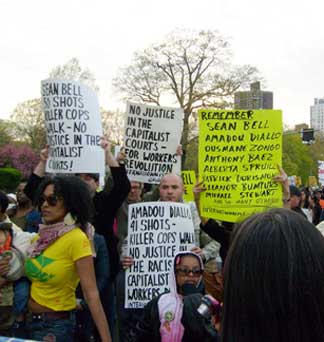 Internationalist
Group at April 2008
protest against court verdict letting
killer cops who gunned down Sean
Bell go free. Yellow sign lists some of
many victims of racist police
terror in New York City.
Internationalist
Group at April 2008
protest against court verdict letting
killer cops who gunned down Sean
Bell go free. Yellow sign lists some of
many victims of racist police
terror in New York City.
(Photo: The Internationalist)
We
continue to fight against segregation of
schools
even as many liberals have abandoned the
fight for school integration
through
busing. Today that means opposing schemes
for “school choice” and
selective
elite schools and programs, favored by Obama
and conservatives like
McCain,
which only increase race and class
segregation. But where the liberals
appealed
to the capitalist state, in the form of
federal troops and courts, we
look to
the working class, such as the black
longshoremen in Norfolk, Virginia
who
mobilized to defend busing in the late
1970s. When the cops who
murdered Sean
Bell in New York went free last year, Obama
told black youth to respect
the verdict
of the (bourgeois) courts. In protests
against the recent police
execution of Oscar
Grant in Oakland, California, some have
called on Obama’s Justice
Department to
open an investigation, to no avail. In
contrast, we
warn against illusions in the capitalist
government and call to bring the working
class into the streets against
it.
The
Trotskyists fight for basic democratic
demands,
such as an end to the denial of
voting
rights for former prisoners, which
amounts to permanent
disenfranchisement
of a whole section of the black population.
We demand cops
out of the schools and an end to the
brutalization of students
by the uniformed enforcers of racist,
capitalist “law and order.” We
demand an end to “racial
profiling” and random “stop
and frisk” orders by police who
last year searched more than 500,000 people,
82 percent of them black
and
Latino, without cause. We oppose the
ruling-class drive to a police
state and
criminalization of black youth. At the same
time, black people are
among the
hardest-hit by the capitalist crisis, and
therefore will be in the
forefront of
class struggle against the effects of that
crisis. We demand an immediate
moratorium on all foreclosures and
call for the workers movement to mobilize to
block
evictions as it did during the 1930s.
And as hundreds of
thousands of black workers are fired we call
for plant
occupations and broader strike
action
against layoffs, to impose a shorter
workweek with no loss in pay.
But
such demands are not magical words on
paper. They
must be taken up by militant black, white,
Latino and Asian workers, by
immigrants,
women and youth, united in class struggle.
That struggle will
inevitably go up
against the government of Democrat Obama.
And that struggle urgently
requires
the leadership of a revolutionary workers
party that is not afraid to
tell the
truth, a party that acts, as Lenin expressed
it, as a tribune
of the people, the champion of all the
oppressed, that will
achieve genuine equality for blacks and all
the oppressed by the only means
possible – sweeping away
bankrupt, racist American capitalism through
international socialist
revolution. ■
See
also: Obama
Presidency:
U.S. Imperialism Tries a Makeover
(23
February 2009) 
Why
Marxists Oppose All Government
Intervention in the Unions
(23
February 2009)
The
“Obama
Socialists”
(23
February 2009)
Not a “New
New Deal,” But a
Transitional Program for Socialist
Revolution
(23
February 2009)
To contact the Internationalist Group and the League for the Fourth International, send e-mail to: internationalistgroup@msn.com