
February 2009
Transitional Program for Socialist Revolution
What
the entire gamut of liberals and
reformists is
seeking is for Obama to launch a “New
Deal” like that of Roosevelt in
the
1930s. Following the November election,
this was all the rage in the
bourgeois
media. The New York Times
(8 November
2008) ran a piece on Obama’s stimulus
package titled, “75 Years Later,
a Nation
Hopes for Another F.D.R.” Liberal
economist Paul Krugman wrote on his
blog the
same day, “Everybody’s talking new New
Deal these days.” Before
the election, Nation
editor
Katrina vanden Heuvel and Eric Schlosser
wrote an
article for the Wall Street
Journal
(27 September 2008) calling for exactly
that: “What we really need is a
new New
Deal: a systematic approach to the
financial and economic problems of
the
United States. Firstly, we need relief for
ordinary Americans.” More
recently,
the Monthly Review
(February 2009), a
non-denominational organ of Stalinist
reformism, ran an article by John
Bellamy
Foster and Robert McChesney, “A New New
Deal under Obama?” saying, “The
possibility of a new New Deal is to be
welcomed by all of those on the
left, as
promising some relief to a hard-pressed
working population.”
The
social-democratic reformists of the
International
Socialist Organization is singing from the
same hymnal. In an article,
“Who
Made the New Deal?” in Socialist
Worker
(19 November 2008), SW
editor Lance
Selfa “recounts the history of an era that
is still remembered for the
important changes that benefited the
working majority.” That is, of
course, how
the liberals remember it,
and
obscures the fact that FDR’s purpose was
quite different. So Selfa
adds: “The
New Deal was, first and foremost, a
program to save a U.S. economy in
crisis.”
But it’s not just “the economy” in generic
terms, as Daniel Gross wrote
in
piece on “The New ‘New Deal’” (Newsweek,
25 March 2008), “In the 1930s Franklin
Delano Roosevelt saved American
capitalism from its own self-inflicted
wounds.” And FDR himself wrote,
“I am
the best friend the profit system ever
had.” The ISO tries to get
around this
by saying: “That American workers made
gains was the result of huge
struggles
that gave a radical content to that
program.” Yet the content of the
New Deal
was hardly radical, and the workers’
struggles were often waged in the
face of
efforts by the Roosevelt administration to
call them off.
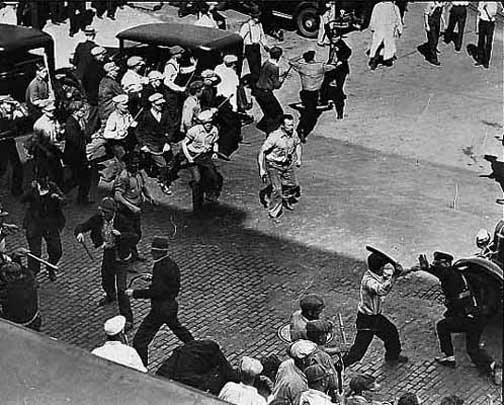 Battle of
the Market during 1934
Minneapolis Teamsters strike led by
Trotskyists. Pickets disperse
attack on strike by police and bosses'
vigilantes. (Photo:
Minnesota Historical Society)
Battle of
the Market during 1934
Minneapolis Teamsters strike led by
Trotskyists. Pickets disperse
attack on strike by police and bosses'
vigilantes. (Photo:
Minnesota Historical Society)
The
New Deal was a program to save
capitalism. It
didn’t even end the Depression – it took
World War II to do that. To
the extent
the New Deal offered anything to the
working class, it was in an effort
to keep
it under control and stave off the spectre
of “red revolution.” It was
the
leaders of the conservative AFL unions who
preached reliance on
Roosevelt, not
“the left,” and certainly not the
revolutionaries. The issue came to a
head in
a series of strikes in 1934, in Toledo
(auto parts), San Francisco
(maritime),
Minneapolis (truckers) and a national
textile walkout. Trotskyist
leader James
P. Cannon wrote, “Now, as in the labor
upsurge of last year, the
attitude of
the workers toward the NRA [National
Recovery Administration] occupies
a
central place.” Compared to the walkouts
of 1933, there “has been a
heavy shift
in emphasis from faith in the NRA to
reliance on their own strength.”
Workers
dubbed the NRA the “National Run Around.”
But leadership was key. Only
in
Minneapolis, where the Trotskyists led the
strikes, was there a
clear-cut
victory. Cannon compared the outcome there
with the other strikes:
“In most of the
other strikes the leaders
blunted the
edge of the fight – where they could not
head it off altogether, as in
the case
of the auto workers – and preached
reliance on the NRA, on General
Johnson, or
the president. In Minneapolis the leaders
taught the workers to fight
for their
rights and fought with them.”1
–James P. Cannon,
“Minneapolis and Its
Meaning,” New International,
July 1934
The
key question, in the 1930s and today, is
revolutionary leadership. Now as then, the
opportunists look to the
capitalist
government, taking their cue from
presidents Roosevelt and Obama. Thus
the
leadership of the largest “antiwar
coalition,” United for Peace and
Justice
(UFPJ), essentially called off national
antiwar mobilizations for the
duration
of the election campaign, in order not to
embarrass the Democratic
Party
candidate. Subsequently it has resisted
calling for immediate
withdrawal from
Afghanistan (although reluctantly ceding
on this) or directly
confronting the
Obama administration. So it will call a
demonstration on April 4 in New
York
City, not Washington, on the slogan “Yes
We Can ... End the War.” Sound
familiar? Yet the UFPJ is just more
up-front in its opportunism. The
fact is
that all the reformists
have sought
to build a class-collaborationist “antiwar
movement” geared to what is
acceptable to Democrats. Now that the
Democratic Party, with their aid,
controls the executive and both houses of
Congress, the bankruptcy of
this
policy is starkly revealed: the war in
Iraq goes on, and in Afghanistan
and
Pakistan it is escalating under Obama,
while the U.S. backs the Israeli
slaughter
of Palestinians in Gaza.
In
contrast, the Internationalist Group,
section of
the League for the Fourth International,
calls for defense
of the Afghan, Iraqi and Palestinian
peoples and the defeat
of U.S. imperialism and Zionism,
for workers strikes against
the war,
for transportation unions to hot
cargo
war materiel, for mobilizing the
power of the international
proletariat
rather than appealing to the capitalist
Democrats. The first-ever
workers
strike in the United States against a U.S.
imperialist war, the walkout
last
May 1 by the International Longshore and
Warehouse Union that shut down
all 27
ports on the West Coast, was a step in
this direction. The union ranks,
fed up
with the Democrats’ failure to stop the
war, carried out this action
over
repeated attempts by the union leadership
to sabotage and distort it.
The IG
fought for and helped build and publicize
this action.
Currently,
labor officialdom and the
reformist left
are concentrating on building support for
the Employee Free Choice Act,
since
Obama and the Democrats have endorsed
this. Meanwhile, the new
administration
is shoving a “stimulus” bill down the
throat of auto workers which will
eliminate their right to strike, slash
billions of dollars of company
contributions to their health and pension
funds, close at least 15
additional
auto plants and lay off 50,000 auto
workers, just from the Detroit 3,
while
giving $39 billion to their bosses. The
UAW leadership is going along
with this
devastating plan. What should the response
of labor militants be? In a
December
17 statement, the CPUSA calls to “get
behind President-Elect Barack
Obama's
economic stimulus and public works jobs
program,” and suggests “public
ownership of the domestic auto industry.”
How? Simple. “The United
States government
could buy all the common shares of stock
in General Motors.” This
takeover
could even be temporary, these
“communists” suggest. The ISO likewise
calls, in
a November 10 article, for
“nationalization” of auto, while urging
that
“the
Obama government should insist on a
moratorium on layoffs and
guarantees of job
security.”
Such
calls build dangerous illusions. The
Obama
administration is committed to slashing
auto jobs wholesale in order to
make
the industry “competitive.” If it does go
for a temporary de facto
nationalization, it would only be to hold
onto a key industry for
“national
security,” and auto companies would still
be subject to the dictates of
the
capitalist market. Instead of calls on the
capitalist government to
save the
workers, in the face of the threat of a
wholesale shutdown of
productive
capacity, with auto plants across the
country laying idle,
class-struggle
unionists should call for workers action
to occupy
the plants, not only those
threatened with closing but of the
entire chains,
and impose workers control.
Audacious? Certainly. Impossible?
Certainly not, as demonstrated by the
recent
occupation of Republic Windows and Doors
in Chicago and the
enthusiastic
response it received from workers around
the country. Militant workers
should
raise demands for 30 hours
work for 40
hours pay, form workers
committees to
open the books of the auto companies,
demand full socialized
medicine (not just “single payer”
health insurance) as
well as a massive program of
public works
at union-scale wages and under union
control.
Under
those conditions, demands for expropriation
of the bankrupt auto
manufacturers (not compensated
nationalization), whose discredited
management has run the industry into the
ground, would have a very
different
content. They would point directly to the
need for a socialist planned economy,
which would produce to fill
human
needs rather than for profit, and to the
only way to achieve this:
through workers revolution.
As Leon Trotsky
wrote in the founding program of the
Fourth International, written in
the
depths of the last Great Depression, with
special attention to the
struggles of
American workers:
“It is necessary
to help the masses in the
process of
the daily struggle to find the bridge
between present demand and the
socialist
program of the revolution. This bridge
should include a system of
transitional
demands, stemming from today’s conditions
and from today’s
consciousness of
wide layers of the working class and
unalterably leading to one final
conclusion: the conquest of power by the
proletariat.”
–The
Death Agony
of Capitalism and the Tasks of the
Fourth International (The
Transitional
Program)
1 In the Toledo Auto-Lite strike, the AFL leadership accepted the findings of an FDR-appointed federal mediation board, which included recognition of a company union, but the ranks rose up against it. In San Francisco, the AFL tops managed to seize control from the militant maritime workers, led by the Stalinist CP, and sold out a general strike. In the national textile strike, which marked the peak of the strike wave, even as victory was in the their grasp the workers were stabbed in the back by the AFL tops who, fearing that the power of the mass struggle could unseat them, accepted a mediation board “settlement” pushed by Roosevelt that gave the strikers nothing. Of the textile strike, Cannon wrote:
“This was the
greatest strike in American labor
history
in point of numbers, and the equal of
any in militancy. Called into
being by
the pressure of the rank and file at
the convention against the
resistance of
the leadership, it was frankly aimed
at the NRA and the whole devilish
circle
of governmental machination, trickery
and fraud. The workers, the
majority of
them new to the trade union movement,
fought like lions, only to see
the fruits
of their struggle snatched from their
hands, leaving them bewildered,
demoralized, and defeated – they knew
not how....
“The
mainspring of the new
left wing can only be a revolutionary
Marxian party. Its creation is
our
foremost task.”
–James P.
Cannon, “The
Strike Wave and the Left Wing,” New
International, September-October
1934
General
Hugh Johnson
was a top official of the NRA who
saw Mussolini’s fascist Italy as a
model.
See
also: Obama
Presidency:
U.S. Imperialism Tries a
Makeover
(23
February 2009) 
Why
Marxists
Oppose All Government
Intervention in the Unions
(23
February 2009)
The
“Obama
Socialists”
(23
February 2009)
Barack
Obama
vs. Black Liberation
(23
February 2009)
To contact the Internationalist Group and the League for the Fourth International, send e-mail to: internationalistgroup@msn.com