Showdown on West Coast Docks: The Battle of Longview
(November 2011).
click on photo for article

Chicago Plant Occupation Electrifies Labor
(December 2008).
click on photo for article
May Day Strike Against the War Shuts Down
U.S. West Coast Ports
(May 2008)
click on photo for article

February 2026
Overcrowded Classes,
Underfunded Schools, Underpaid Teachers,
Students Targeted by ICE
For a California
Statewide
Educators Strike
Break with the
Democrats – For a Class-Struggle Workers Party
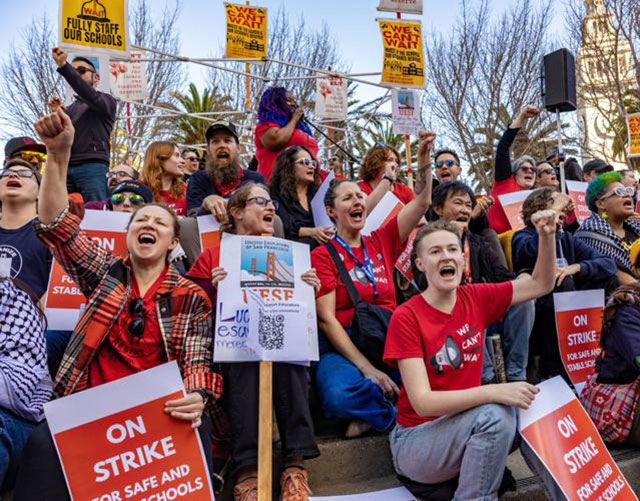
United Educators of San Francisco at a rally at Embarcadero Plaza February 12, 2026.
(Photo: Craig Lee / San Francisco Examiner)
Across California, teacher unions have been stalled for months in negotiations with their school districts since their contracts ended in June 2025. The affected districts employ over 80,000 education workers statewide. Several have already led strikes to demand better conditions for education. First was the United Teachers of Richmond (UTR) in December, then the United Educators of San Francisco (UESF) in February, both for four days. Coming up are contract battles in Oakland, Berkeley, Los Angeles and elsewhere. Meanwhile, the Immigration and Customs Enforcement (ICE) and other federal agents have been threatening students and parents, particularly in the L.A. area. The California Teachers Association (CTA) launched a “We Can’t Wait” campaign for 32 of these districts, underlining that educators face common conditions of overcrowded classes and underfunded schools. But although these conditions require statewide action, teachers are bargaining on a district-by-district basis, undercutting their power.
While education unions have historically seen themselves as “professionals,” the education workers involved range from teachers, counselors, nurses and social workers to custodians, bus drivers and aides. This came to the fore in the December strike in Richmond (West Contra Costa School District), the first in the history of the UTR and of Teamsters Local 856 that represents auxiliary and classified staff. The strikers, including many young teachers, were enthusiastic. The district hired scabs, security guards and a high-paid strikebreaking lawyer. Yet two days into the strike, the Teamsters accepted a deal and the leadership ordered members to cross UTR’s picket line, which many did. This break in union solidarity is a prime example of the role of the labor bureaucracy, sabotaging workers’ struggles on behalf of the capitalist bosses. Weakened by this betrayal, the teachers nevertheless won some gains, including fully funded health care. The 8% raise spread over two years will, at best, barely keep pace with inflation.
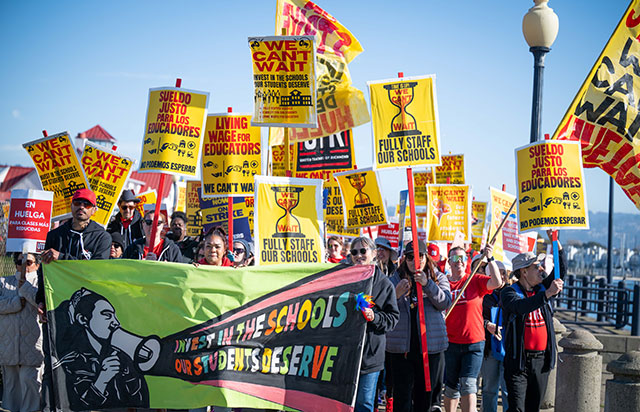
Richmond teachers strike in December 2025. (Photo: Brooke Anderson)
Next were the 6,500 UESF teachers across the Bay who began their strike on February 9, the first San Francisco teachers strike since 1979. This time the administrators’ union declared a sympathy strike and 1,000 custodial and food service workers in SEIU (Service Employees International Union) Local 1021 also walked out, forcing the district to close most schools. Superintendent Maria Su shed crocodile tears at a press conference before the strike and absented herself from the bargaining on one day. United Educators mobilized rallies and marches every day of the strike: in the Civic Center, Dolores Park, in front of the school district headquarters and at Embarcadero Plaza. The upwards of 15,000 demonstrators, including many students, far outnumbered the strikers, underscoring the wide public support for the strike. Working people in SF, one of the most expensive cities of the country, connected with the teachers’ lament that their salaries didn’t cover their living costs.
Over the four days of the UESF strike, members of the Revolutionary Internationalist Youth and the Internationalist Group participated in the daily picket lines and mass strike rallies with signs calling for students, teachers and all workers to unite in this crucial struggle. While the overwhelming majority of the 100+ schools in SFUSD were closed, a handful of facilities were open to scabs. At one of these, John O’Connell Technical High School, Internationalists joined several dozen striking teachers, SEIU members and high school students on the picket line with our signs saying “Picket Lines Mean Don’t Cross.” With thousands of members on the street, the strike leadership could have easily shut all the schools with mass pickets that no one dare cross.
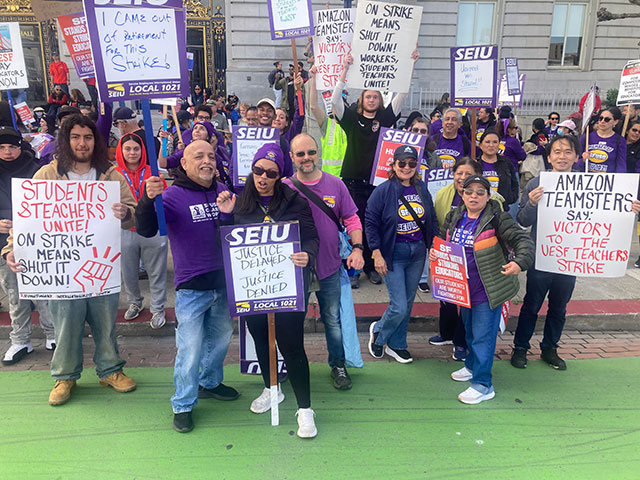
Internationalists and members of SEIU local 1021 at rally at Civic center, February 9 2026. (Internationalist Photo)
The UESF and the district reached a tentative agreement in the early morning of February 13, including fully employer-funded health care for teachers’ dependents. This is an important gain: while individual teachers were already covered, premiums for families were $1,200 a month, and slated to rise to $1,500, eating up a huge portion of paychecks. The union leadership said it had won “sanctuary protections for students and teachers,” which mainly consisted of putting in the contract the existing city and school district policies, under which ICE agents must show a judicial warrant signed by a federal judge or magistrate to enter school grounds. But California is already a “sanctuary state,” and that hasn’t stopped ICE and Border Patrol from deporting at least 8,250 people in the first nine months of 2025.1 SF teachers should form immigrant defense committees to see that la migra does not enter or lurk around schools at all, and to use labor’s power to drive out the feds’ masked paramilitary snatch squads that are a danger to all.
The Tentative Agreement also includes some relief for overworked special education educators. But the salary “raise” is another matter. The overall increase, of 5% over two years is way less than the 14% that the union originally demanded, and actually amounts to a pay cut, as inflation in San Francisco is running at 3% annually. The fact that classified (school staff) employees got a higher pay hike (8.5%) is important, as they are lower-paid. In the previous (2023-25) contract, SF teachers got $9,000 across the board, plus 15% over two years, appreciably raising salaries. But with the district screaming “deficit,” the new agreement has teachers essentially paying for much of the increased health coverage by accepting sub-inflation pay. This is hardly a “historic contract victory,” much less a “transformational victory,” as claimed by Liberation (13 February), the online newspaper of the Party of Socialism and Liberation (PSL), which has several supporters in the UESF leadership.
Now, barely a week after the strike ended, the school district announced “preliminary” layoff notices for several dozen employees, citing falling attendance and saying that even those cuts will not resolve the district’s financial crisis (San Francisco Standard, 21 February).
Mobilize Teachers and Unions Across California
The outcome of the San Francisco teachers strike underscores how bargaining on a district-by-district basis is an obstacle to winning a real victory. This will soon come up in Oakland, where a strike is pending. The demands put forward by the Oakland Education Association (OEA) are similar demands to those raised by the UESF, notably protections for immigrant students and a 14% raise. Oakland teachers are still some of the lowest-paid in the region, which part of the reason why nearly 400 educators leave the Oakland Unified School District (OUSD) every year. The OUSD is balking at the union’s demands, citing a $50 million deficit. Teachers and parents worry that fixing the deficit will be at the cost of the students, the majority of whom are black, immigrant and working class. In a district with a sordid history of billionaires buying a school board majority, two decades of state receivership and a sold-out strike in 2019, Oakland educators are in for an intense struggle to win the demands they and their students deserve.
In particular, Oakland has 38 charter schools, 27 of them under OUSD. The high proportion of charter schools in Oakland is part of the assault on public education by capitalists who are out to commoditize a democratic right. The insidious profit-making scheme of privately managed schools financed with state funds (along with funding from real estate speculators and private equity investors) has been promoted by many Democrats around the U.S., including by Barack Obama at the national level. Locally in Oakland, leading capitalists such as Michael Bloomberg and their instruments including the Gates Foundation (Microsoft) and the Walton Foundation (Walmart) pumped hundreds of thousands of dollars into political action committees (PACs) to finance pro-charter school board candidates. By 2020 five out of the seven directors on the OUSD board backed charter schools. With the support of Democratic politicians, they turned the district into a guinea pig for privatization of public schools.
Meanwhile, Oakland schools have been under the thumb of state control since 2003, when facing bankruptcy, the state offered a $100 million loan in exchange for complete control over the district’s financial and administrative functioning. In the first four years of the receivership the number of charter schools more than doubled, from 16 to 33. Many large schools were broken up, with up to ten schools on one campus at the height of the small schools craze.2 Then the board sought to close many small schools in African American and Latino neighborhoods to replace them with charters. In 22 years of forced servitude, ever-changing state administrators cut the adult education program, forced a 4% pay cut for teachers and drained millions of dollars from the OUSD budget to feed the parasitic charters. In a 2018 report analyzing the financial impacts of charter schools, University of Oregon economist Gordon Lafer found that by 2016-2017 charter school development cost the Oakland school district $57.3 million yearly.3
The balance of power began to change with the gains of the OEA’s 2023 strike that in addition to a 15.5% raise over three years won reduced class size and measures to aid homeless students and their families. In the 2024 school board elections, only a couple of pro-charter PACs were active and four union-endorsed directors (a majority) were elected. In July 2025, California school superintendent Tony Thurmond announced that the conservatorship was over (and right-wing “education reform” media and organizations immediately began denouncing union power). But some 27 schools, many of them with majority black enrollment are still at risk of closing, and Oakland educators’ pay is still third from the lowest of 101 districts in the Bay Area. The OEA is calling for vacant district buildings to be converted into affordable housing. Even with a union-backed majority, the OUSD board is still the representative of the capitalist bosses, and the stringent budget constraints cannot be undone solely on a local basis.
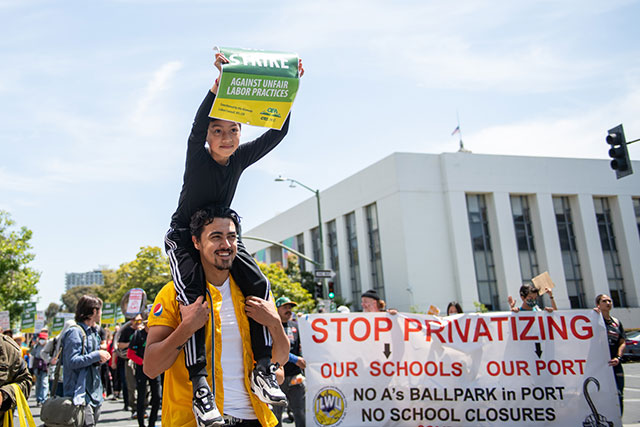
Oakland teachers march with ILWU against privatization in 2022. Mobilize the powerhouses of labor to win California teachers strikes! (Photo: KQED)
Meanwhile, the United Teachers of Los Angeles (UTLA) has also voted to authorize a strike against the Los Angeles United School District (LAUSD), the largest public school district in the California and second largest in the nation, with 390,000 students, many of them immigrants. UTLA is calling for a 16% increase in starting salaries, a restructuring of the salary steps to increase pay, with lower-paid employees getting a 3.25% increase immediately, and a 3% raise for all in 2027. Again, this is at or below the rate of inflation. And, as in San Francisco, the LAUSD is threatening layoffs, but on a much larger scale. Last week, the school board voted (by 4 to 3) to issue 3,200 preliminary layoff notices, intending to cut at least 657 jobs, almost all from the classified staff. The stated reason is, again, a “structural deficit” due to falling enrollment and the end of COVID pandemic payments. Yet those cuts would only “save” $150 million out of an $18.8 billion budget, and the district has $5 billion in reserve funds.
Above all, L.A. is ground zero for the militarized immigration raids that the Trump administration launched last June. Some schools introduced remote instruction as families were too afraid to send their children to school, and some posted lookouts for ICE agents to ensure that immigrants could safely attend graduation ceremonies. Last August, UTLA marched on the district headquarters demanding greater protection for immigrants. Now, on February 10, a right-wing website posted a series of notes and documents witch-hunting UTLA for its school safety plans on how to respond to an incursion of ICE or other immigration agents. Although presented in a sensationalist fashion, claiming that the materials “appear to advocate for the use of school and district resources,” it only shows that teachers are seeking to protect their students from the masked paramilitary kidnappers.
According to the notes and documents, the preparations call for patrolling school sites, using encrypted apps to alert people of the presence of migra agents; for school lockdowns if ICE should attempt an incursion; and for the union to notify the Los Angeles Rapid Response Network, to “surround the school with supporters” and alert the media – all prudent steps to defend immigrant students (and staff). But beyond these basic measures, the union should join with all labor in mass strike action to drive ICE out.
Recently there has been a wave of high school and middle school walkouts and marches to the Municipal Detention Center and City Hall in downtown Los Angeles involving hundreds and sometimes several thousand students protesting ICE raids. There is a long history of such actions in L.A. going back to the 1968 East L.A. walkouts of tens of thousands of students that touched off the Chicano movement. In March 2006, 40,000 students walked out against the infamous Sensenbrenner “border control” bill that called for draconian sentences for “illegal aliens.” The bill never passed Congress, but what really killed it was the massive strike by immigrant workers on May Day 2006, in which millions stopped work across the country. This underscores the need for the organized workers movement to bring its power to bear, to back up the students and shut down the ICE Gestapo.
Who’s Responsible for Underfunding? Prop 13 and the Democratic Party
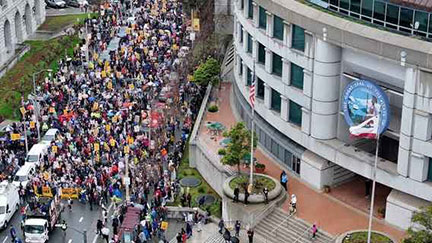 Teachers march past
California state building at SF Civic Center for a
statewide teachers strike. (Photo: Getty Images)
Teachers march past
California state building at SF Civic Center for a
statewide teachers strike. (Photo: Getty Images)The “We Can’t Wait” campaign and numerous initiatives by public education advocates, such as a 2020 report by the Policy Analysis for California Education research center on the chronic underfunding of education have emphasized that California has the fifth largest economy in the world and is the richest state in the United States, with a median annual income $10,000 above the U.S. average. Yet even before the COVID-19 pandemic, school funding was – and continues to be – woefully inadequate. California has the largest class sizes in the country, some (in Los Angeles) of as many as 35-44 students, with almost double the number of students per instructional employee (22) compared to New York (12). Last year California spent barely $18,000 per public school K-12 student, compared to $26,500 in New Jersey and over $33,000 in New York state. Currently it is 33rd in the U.S. in per pupil spending. But it wasn’t always that way. In the 1960s and ’70s, California was in the top ten states in education spending.
All across California school districts, teacher union demands mirror each other: a livable wage increase in the face of California’s sky-high and ever-rising cost of living; adequate resources for special education students; filling hundreds of vacant classified staff positions; size caps for overflowing classrooms; more support for homeless students and their families (which in California number about 250,000 students); protections for immigrant students in the face of the violent onslaught by ICE nationwide; and, fully funded healthcare. Add it up and teachers are fighting to save the public school education system under attack from privatizers, charterizers and immigrant kidnappers. One district alone cannot defeat this assault – what’s needed is to bring out the power of labor across the state. Above all it requires breaking from the parties of capital, particularly the Democratic Party which controls every aspect of education in California.
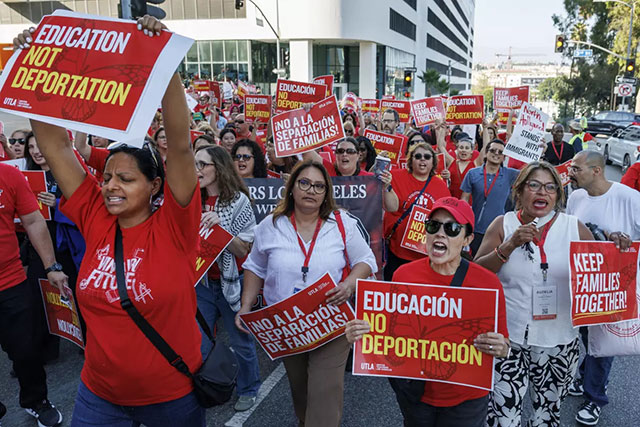
UTLA workers march on LAUSD headquarters demanding protection for students and staff against ICE.
(Photo: Gina Ferazzi / Los Angeles Times)
We can trace the heart of the underfunding of California education back to Proposition 13, passed in 1978, which devastated California public education. Prop 13 limited local property taxes, which traditionally funded the bulk of public education, to 1% of the assessed value of the property, and limited increases to 2% a year. This was ostensibly driven by a “taxpayer revolt” of small homeowners, although the lower taxes overwhelmingly benefitted the superrich. But it went hand-in-hand with a racist reaction to providing public education for the children of the growing number of Mexican immigrants. Following passage of Prop 13, property tax revenue was cut in half, spending on education fell sharply and only crept back up at a rate below almost all other state and local expenditures. State funding of education could counteract inequality of funding between richer and poorer districts, but Prop 13 “equalized” education spending by underfunding all districts. That is the main reason for the deficits of almost all districts today.
In 1978, Proposition 13 was passed by an overwhelming majority of Democrats and Republicans alike. In the 48 years since then, not a single Democratic governor has touched this pillar of California public policy. Measures like Prop 98 (1988) and the Local Control Funding Formula (2013) have barely improved financial conditions for schools. Meanwhile, the Democrat-backed drive to reap profit from public education (led by outfits like Democrats for Education Reform who backed Obama) encouraged charter school developers. Today, three members of the state Board of Education appointed by Democratic governor Gavin Newsom have interests in charter schools, and California has the largest number of charter schools – 1,300 – in the U.S. Yet for decades, the California Teachers Association (CTA) and the smaller California Federation of Teachers (CFT) have been major funders of the Democratic Party.4
In 2025, the CTA spent $4 million on Proposition 50, a purely partisan measure allowing the Democratic-controlled legislature to gerrymander Congressional districts to match Republican gerrymandering in Texas. In his January 2026 budget review, Governor Newsom shifted $5.6 billion from this year’s education budget to the 2026-27 school year – funding that schools need now, among other things to pay for the cost of contract gains. (The San Diego school district says it can’t pay for raises agreed to in negotiations unless the state releases that money.5) Yet in 2018 the CTA contributed a cool $1 million to Newsom’s campaign for governor. In that same election it contributed $8 million to the campaign of Tony Thurmond for state superintendent who pushed the OEA leadership to sell out the members in the 2019 strike, and who presided over the state receivership of Oakland schools for eight of its 22 years.
The insidious policies of the phony “friend of labor” Democrats and of the “labor lieutenants of capital” leading the unions stand in the way of an all-out fight against the destruction wrought by decaying capitalism. Unlike New York, where public employees are hamstrung by the “no-strike” Taylor Law (which the union bureaucrats hide behind), California teachers regularly exercise their right to strike. While the “We Can’t Wait” campaign shines light on the common problems facing educators across California, it does not provide what is desperately needed: a class-struggle program of militant common struggle to overcome those threats. The CTA misleaders prefer to wheel and deal behind closed doors in Sacramento as an unofficial “fourth branch of government” (as a former state Senate leader put it), leaving teachers and students to scramble for crumbs.
Nationally, Democrats built up the immigration machine that Trump is now using to expel immigrant coworkers and neighbors. In the Middle East, Democrats not only funded but delivered the bombs and planes to carry out the Zionist genocide against the Palestinians. The Democrats are responsible for the destroyed schools of Gaza. When students across the U.S., including in the University of California and California State University, protested this abominable crime, Democratic president Joe Biden denounced them and Democrats from university presidents to big city mayors took the lead in violently repressing them. It was Democrats who have been closing schools with African American and Latino students. From Minneapolis to the Bay Area, Democrats were and are the bosses of the racist killer cops.
In California, every “decision maker” on public education – from the governor to state schools superintendent to both houses of the state legislature to the mayors of big cities and the leaders of the teachers unions – are all members of the capitalist Democratic Party. Union leaders often argue that this gives them extra “clout” and an “in” with the power brokers in Sacramento. In reality, the labor bureaucrats’ ties to the Democrats chain union members to the bosses. Whether it is fighting for smaller class sizes or resisting the assault by immigration cops, neither the union tops nor school administrators challenge the power of capital. Against this unholy alliance, Class Struggle Education Workers, a union opposition tendency fraternally allied with the Internationalist Group, calls to unchain the power of the unions from the death grip of the Democrats and to forge a workers party fighting for a workers government.
Today, the assault on public schools, on immigrants and on the democratic rights of all cannot be defeated by allying with the Democrats in an “anti-Trump” alliance – a “popular front” of class collaboration. To defeat the developing police state requires mobilizing the power of the organized workers movement in defense of all the oppressed against the oppressors. The Revolutionary Internationalist Youth join the CSEW in calling for democratic control of the schools by educator-led councils of teachers, students, parents and workers. Today, as educators across California are stiff-armed by the education bosses, the fight to defend public education should begin with a statewide teachers strike, with mass pickets including students and parents, backed up by the powerhouse dockworkers (ILWU) and transit (ATU) unions, by statewide unions like the SEIU and federations like the SF Labor Council and the L.A. Fed. ■
- 1. “ICE deportations in California surged in the thousands as 2025 went on,” Sacramento Bee, 12 January. Figure based on a report by the Deportation Data Project at the University of California Berkeley Law School.
- 2.“The Small Schools Movement Remade Oakland Education. Is This the End?” Oaklandside, 11 December 2024.
- 3.“Report: The Cost of Charter Schools for Public School Districts,” In the Public Interest, 8 May 2018.
- 4.“California Teachers Assn. a powerful force in Sacramento,” Los Angeles Times, 18 August 2012.
- 5.“San Diego teachers cancel strike as deadline neared,” CalMatters, 18 February.