

November 2026
For a Real
General Strike to Win Students’ and Workers’
Demands!
French Youth in Revolt: School
Protests Brave Massive Repression
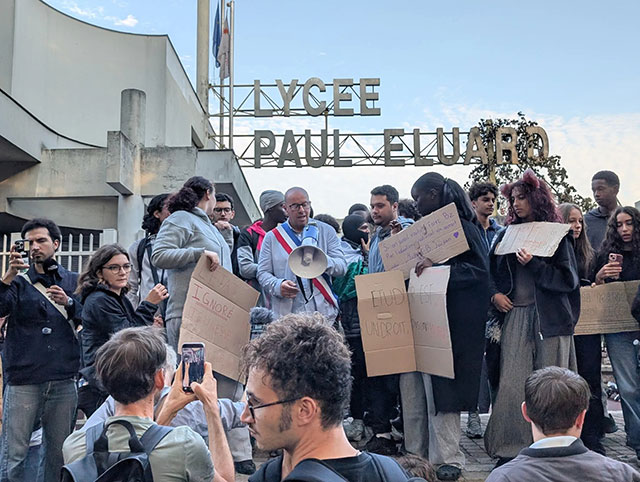
Blockade outside the Lycée Paul Éluard in Seine-Saint-Denis, a heavily immigrant working-class suburban area outside Paris, September 29. (Photo: Luc Auffret / Anadolu)
Imperialist
War Drive and Capital Markets Block Funds for Education
NOVEMBER 13 – For three weeks this fall, starting in the late September, up to 1,000 high schools (lycées) across France were blocked and shut down by students protesting abysmal conditions in the schools. They were hit with vicious police attacks on young protesters, but also joined by repeated mass protests of hundreds of thousands of students along with parents and workers supporting the students. Then, after a two-week fall school vacation, the blockades started up again. By November 5, 1,000 schools were blocked, or shut down by administrations, coinciding with a strike by all the major union federations. Over 1.5 million people marched in cities across France. The student protests have crystallized widespread anger about falling living standards, hard-hit public services and cop brutality. But as the “center-right” government tries to wear protesters down, revolutionary leadership is urgently needed to actually win the struggle.
Decaying school facilities, classes without teachers and overcrowding are among the top complaints of students, and their teachers. The fact that the conditions they are protesting are intolerable is universally recognized and the basic demands to remedy them are straightforward. However, the response from the government has been to unleash riot cops – particularly the notorious CRS (Republican Security Squads) and other paramilitary police – on teenagers in the streets and outside their schools. After a high school in Créteil (a suburb outside Paris) was blocked on September 18 by striking teachers, supported by students, a student protest movement took shape. The massive repression sparked outrage among parents and workers, and on October 6, hundreds of thousands of protesters took to the streets across the country. As our correspondent reported from the march in Paris:
“The high-school and university students were joined by large contingents of workers in their union vests accompanied by floats from the largest union federations. The show of solidarity by the organized working class with the student struggle was impressive. People came out from all over the place according to the locations listed on their [union] flags. Aside from education unions there were some industrial sectors of labor there, notably the CGT (General Confederation of Labor, associated with the Communist Party) and railroad workers, some in their work uniforms. The rail workers at one point formed a human chain across Boulevard Voltaire as a defensive tactic as we marched towards Place de la Nation.”
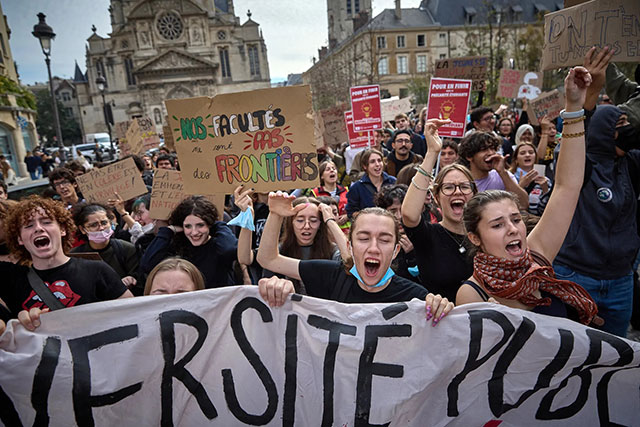
High-school students march on October 6 in Paris, when half a million protested nationwide, including many workers, in support of the students’ demands. (Photo : Kiran Ridley / Agence France-Presse)
It’s important to understand how dire conditions are in the lycées that French students are revolting against, probably worse than most American high-schoolers have experienced. Overcrowded classes, overflowing toilets, widespread rat infestations, crumbling buildings, scheduled classes with no teachers, classrooms freezing in the winter and dangerously hot in the summer, and an oppressive schedule lasting from 8 a.m. to 6 p.m. The length of the school day is the result of a major school reorganization, the “Blanquer reform” instituted by French president Emmanuel Macron in 2018 in his first administration. Under the guise of increased “flexibility,” turning three educational tracks into 13 “specializations,” schedules resulted in big gaps between classes, making students spend as much as 50 hours a week at school.1 And on top of everything else, there are the arbitrary university admissions.
The lack of teachers is notorious, as school administrations often take months to fill teaching positions.2 In some cases, students spend half a year without any instructor, forcing them to prepare for their baccalaureate exam (the national exam at the end of high school in France) on their own. Also, the heat wave that roasted Europe this last summer (in France there were more than 7,200 heat-related deaths) was particularly brutal in the schools. In late June, with several 100° days and no air conditioning in the classrooms, it was suffocating for students. This also intersected social issues. One student’s sign at an October 2 protest in Paris read, “Banning the Abaya Won’t Lower Temperatures in the Classrooms.” This referred to the exclusionary ban on the loose-fitting Islamic dress in schools.3 It also highlights the racist effect of austerity measures which hit hardest in the working-class suburbs where most immigrants in the Paris region live.
A key component of the Blanquer “reforms” that has enraged students and teachers alike was the introduction of the “Parcoursup” program of selection of students for higher education.4 Following the 1968 student/worker revolt, the French government considerably expanded higher education. But particularly since the 2007-08 global capitalist financial crisis, it has tried to cut back enrollment. Under the 2018 reform, potential post-secondary students are assigned to different institutions and programs by an obscure mathematical formula. This severely limits their options. Plus, at present 126,500 students, one-fifth of all high-school graduates, have not been offered any option of a school to attend. They are being excluded from higher education by an algorithm! The main student unions are demanding 250,000 additional university slots. But “more” is not enough. As Revolutionary Trotskyists, we call for “No selection – Open admissions!”
In recent weeks, mass student/youth protests have spread to Belgium, Germany, Italy and other European countries. These are often referred to as “Gen Z revolts.” But in France the students are by no means alone. The participation of unions in marches, bringing out hundreds of thousands of workers in solidarity with students (and parents) in the recent protests, can be a critical factor for the student struggle to succeed. The common platform put forward by the Union Étudiante for university students, Union Syndicale Lycéenne for high-schoolers, calls for 10 emergency measures to fix the schools that would cost 10 billion euros (€). In short, “10 mesures, 10 milliards.” But last year’s national budget slashed 4,000 teaching positions, and the 2027 budget now in the Senate calls for eliminating another 1,588, as well as cutting 1 billion € from education overall.5 The government of Macron’s prime minister Sebastien Lecornu would surely let itself be brought down in a vote of confidence rather than add 10 billion €.
In any case, capital markets would veto it. France is teetering on the edge of a catastrophic debt crisis. Public debt is 3.6 trillion €, 120% of the entire Gross Domestic Product.6 Piling on more debt would lead international credit rating agencies to lower France’s rating, thus raising interest. Yet the Macron government, like all European NATO (North Atlantic Treaty Organization) imperialists, is now ramping up war against Russia over Ukraine. In the 2027 budget, the French military is slated to gain an additional 6 billion € (11% more than last year). Increased militarization means cuts to social services, but the classic reformist program of “butter not guns” will not solve this crisis of education. Imperialist war is not a matter of budget priorities, but a product of decaying capitalism. Although the students’ demands are simple, to win them requires a struggle to defeat the war drive and take on the capitalist system itself.
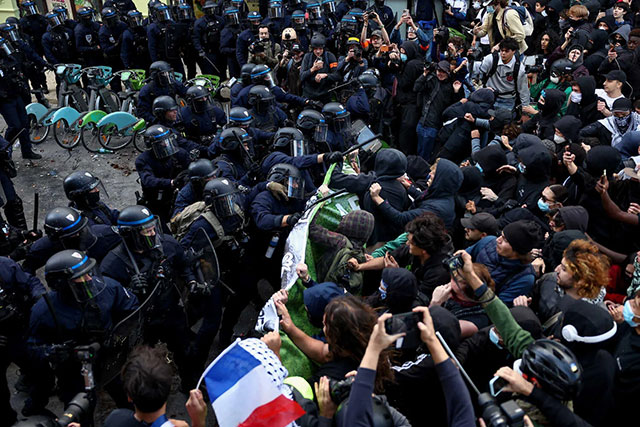
Squads of paramilitary riot police (left) attack high-school student march in Paris on October 8. Viciousness of cop violence against teenagers shocked France, infuriating parents and worker. (Photo : Abdul Saboor / Reuters)
At this moment, with students, parents and workers ready to fight and a new day of action on November 17, it’s not enough to call to “block everything” (bloquons tout), as protesters did a year ago, bringing down Macron’s seventh (!) prime minister, François Bayrou. Nor will a one- or two-day “general strike” suffice. The unions should all strike together and stay out until the students’ demands are met, as well as to demand full indexation of wages and pensions against inflation, and to bury Macron’s “permission to kill law” (see below) giving police the “presumption of impunity.” Otherwise, all the blockages and marches risk being mere episodes on the way to next year’s presidential elections, after which the markets will impose their dictates, no matter which capitalist politician wins.
As recent French history has repeatedly proven – from May 1968 to struggles in 2006, 2010 and 2023 – it is possible to bring out masses of workers and students in common struggle. But only by fighting for a transitional program on the road to socialist revolution can real victories be achieved.
The Government Responds with Crazed Repression
The walkouts and blockades of high schools that swept mainland France actually began in French colonies (officially designated “Overseas Territories”). The first was in Mayotte, an island in the Indian Ocean off Madagascar, where on August 31 students, parents and teachers blockaded the Lycée du Nord with an enrollment of 1,400 students over capacity. A week later, on September 7, students in Guyane (the former French Guiana, in northern South America) blockaded Lycée Félix-Éboué in Cayenne, the capital, protesting the lack of funding and resources in their schools. After the September 18 walkout in Créteil, southeast of Paris, blockades quickly spread through the working-class, heavily immigrant suburbs (the banlieue) in Seine-Saint-Denis, northeast of the capital. Unlike the usual pattern in the U.S., the well-to-do middle class inhabits the center of Paris while the bulk of the workers live on the outskirts.
Because the mass revolt in metropolitan France first took root in the Paris suburbs, where schools are in worse shape, it has faced anti-immigrant racist reaction. This was the line of the fascist Rassemblement National (RN, National Rally), whose leader Marine Le Pen denounced the mass mobilization of October 17, when brutal police charges led to tumult, as an “alliance between groups of politically motivated rioters and delinquents from the suburbs” (Libération, 19 October). The same story from U.S. president Donald Trump, who on his Truth Social (6 October) channel blamed protests in France on “out of control mass migration.” But the protests over school conditions and cop violence have extended throughout the country. In Dijon signs on garbage cans blocking the elite center-city Lycée Carnot read: “1 prof pour 35 élèves, 5 CRS pour un élève” (one teacher for 35 students, five CRS riot cops per student).7
While abject conditions in the schools are what prompted students to walk out in the first place, the ferocious police repression that youths were met with turned the blockades into a massive upheaval of lycéens (high-schoolers) joined by their teachers, their parents, college students and workers. From the end of September to mid-October, the police arrested more than 8,000 high-school students. It is widely understood in France that police readily charge into mass protests, riot batons waving. But the sight of the CRS, the BAC (Anti-Crime Brigades) and the Paris motorcycle cops of Brav-M (Brigade for Repression of Violent Action) firing rubber bullets and stun grenades at teenagers shocked the nation. And this was no random occurrence. In addition to students at peaceful protests being gassed and beaten by police:
– On September 28, in Saint-Ouen-l’Aumône (Val-d’Oise), a 14 year-old student was shot in the face at point blank range with a tear-gas grenade by a cop outside his school. The impact broke his jaw and knocked all the teeth in the front of his mouth out of his face.
– On September 30, a 16-year-old student in Tours (Indre-et-Loire) was shot in the right eye with a 40mm rubber bullet from a riot gun (LBD, a supposedly “less lethal” weapon).
– On October 1, another 16-year-old was shot with an LBD, which shattered the bones in his face and, despite surgery, he may not recover vision in one eye.
– On October 2, a 15-year-old student was almost drowned by a cop in Bélfort, who reportedly held the teen’s head under water in a river near his school.
– Then on October 5, in Lens (Pas-de-Calais), a 15-year-old student was shot with a stun grenade, tearing off his left hand, so that his arm had to be amputated below the elbow, and he required multiple skin grafts on his right hand and torso.
Afterwards, an investigation was opened which prompted the minister of the interior, the sinister Laurent Nuñez, to temporarily “suspend” the use of stun grenades – but only for “student protests.” In reality, the cops are still using them. When demonstrators known as the Yellow Vests (gilets jaunes) militantly protested high fuel prices in 2018-19, Nuñez was notorious for escalating repression against them “employing less-lethal weapons, widespread use of arrests and detention to disrupt protests, and the almost systematic banning of marches” (Libération, 4 November).8 Now he is using the same tactics on teenagers, but even more aggressively. “They forget that we’re just kids,” said a 10th-grader. “Is this the image the government wants to convey to us – the adults of tomorrow?” asked a 16-year-old. Clearly, the answer is “yes.”
Protests Generalize Into an “Autumn of Anger”
Enraged by the rabid state repression, many parents joined protests to protect their children. And not only parents. On October 6, in the Paris march called by the Union Étudiante which brought out 100,000 people in the capital and almost half a million across the country, we saw contingents of all the major labor federations, including the CGT and the SNES-FSU education union, who work together; the CFDT (French Democratic Confederation of Labor) and Force Ouvrière (Workers Force), representing two wings of social democracy; the more left-wing Solidaires federation, with its affiliates SUD-Education, SUD-Rail, as well as tens of thousands of education workers, railroad workers, firefighters and others, all to support students’ demands. In Le Havre, the main port city in the north, the CGT came out explicitly to defend the students, as they did on October 1 and 2 after police gassed students blocking a lycée.9
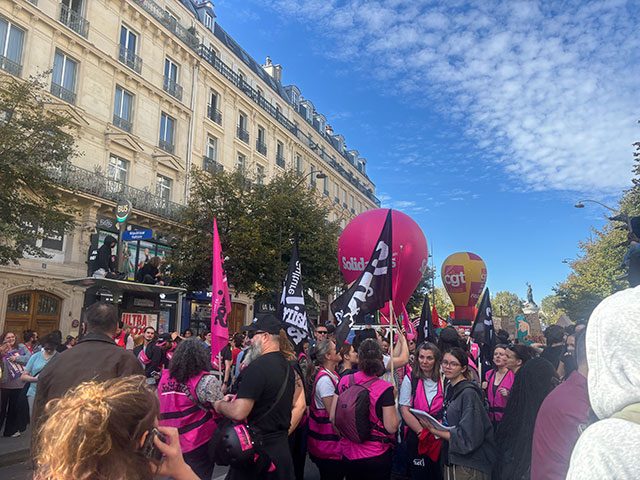
Union contingents at October 6 student march in Paris. What’s needed is for all to strike together until demands are won. (Photo : The Internationalist)
On October 8, the education unions in Seine-Saint-Denis (Département 93) went on strike for the day. At the Lycée Professionnel Frédéric Bartholdi, represented by CGT 93 Éducation, a teacher said to the students “we’re really on strike for you guys, only a little for us.” From there it was on to Lycée Paul Elouard, a protest stronghold, and then to the march in the center of Paris. After marching from République, protesters arrived a Place de la Bastille, where the prison was located that was stormed on 14 July 1789, setting off the French Revolution. Overall, there were an estimated 25,000 people, overwhelmingly high-school students. They were kettled in the plaza at Bastille for hours by the National Police and Gendarmes, gassed with tear-gas grenades, sprayed by water cannon and beaten. And, of course, there were the supposedly banned stun grenades. After three solid hours, the police finally let people filter out slowly.
Chants were not about the specific student demands but “Macron dégage” (Macron get out), “À bas l’état, les flics et les fachos” (Down with the state, the cops and the fascists), and so on. This reflects in part the fact that the marches have expanded beyond the original high-school protests to encompass wide sections of the working people in an “autumn of anger,” protesting against a decade of macronie, of the detested Macron government, that has brought falling standards, slashed social services and increased repression. There is a feeling of generalized “ras-le-bol” (people fed up). So on October 9, an Interfaculty Coordination of university students met and on October 10 a National Lycée Coordination, agreeing to unite in a march on October 13. This time unions counted 480,000 participants across France, with the Union Étudiante reporting that 90% of the 70 universities were blocked or closed.
On Saturday, October 17, demonstrations against the high cost of living had been announced weeks beforehand on social media (TikTok), and seconded by the Yellow Vests as well as by the student unions and the CGT and Solidaires labor federations. The government was counting on high-schoolers’ demos running out of steam with the start of a two-week fall vacation, expecting 140,000-160,000 demonstrators nationwide. At the same time, it feared a convergence of “jeunes et jaunes” (youth and Yellow Vests). Seeking to put an end to the social unrest with a “firm hand,” hardline interior minister Nuñez announced the day before that, due to “the risk of serious urban violence … all types of intermediate weapons can be used” by the police.10 More than a serious miscalculation, this was a provocation, which led to the random outbreaks that followed.
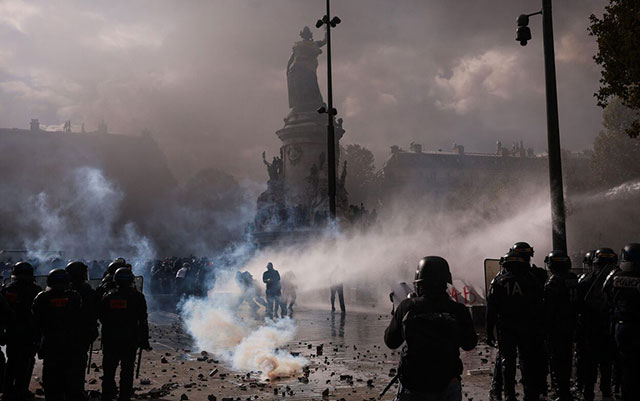
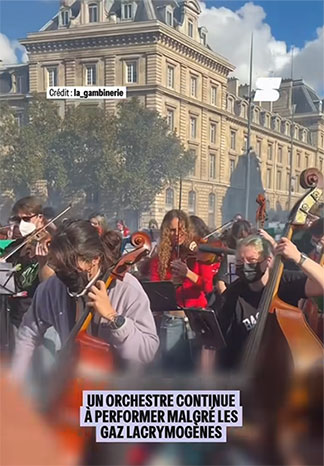
On October 17, when 800,000 marchers came out to support students, riot cops attacked demonstrators as they were gathering, splintering them into multiple large groups. Above, Place de la République in Paris, where police tear-gassed the Orchestre du Nouveau Monde as they were performing (below), pushing demonstrators out of the square. (Photos: Kiran Ridley / AFP; La Gambnerie)
The October 17 mobilizations brought out 800,000 people across France according to the student organizations, and even 550,000 according to the (as usual understated) police count – i.e., more than triple what the authorities expected. And the cops’ heavy-handed tactics backfired, big-time. That evening and in following days the media broadcast non-stop images of smashed windows, burning barricades and the city hall of Limoges aflame, as the government and right-wing politicians called in unison for a crackdown on “ultra-leftists” and “opportunistic rioters” from the immigrant suburbs. In reality, the disturbances were provoked by the police, who used tear gas, water cannon and rubber bullets on the crowds even before they were set to step off, in Paris and elsewhere. The police charges split the crowds into smaller groups, and tens of thousands of enraged protesters then roamed through the cities.
These were the largest protests since May Day 2023, when huge numbers marched in France (including tens of thousands of high-schoolers), against Macron’s pension “reform” raising the retirement age. October 17 was also historic for another reason that is hardly mentioned: on that date in 1961, the French state unleashed murderous terror against a march for the independence of Algeria. Paris police chief Maurice Papon’s cops killed as many as 200 Algerian demonstrators and dumped their bodies in the Seine River. That monstrous massacre didn’t stop the struggle for Algerian independence, and the police provocations on this October 17 haven’t stopped the protests. On October 24, even though Paris police pushed the marche to the city limits, 250,000 came out in the French capital and again 800,000 nationwide, according to the unions. And on October 31, 500,000, mainly youth, marched on Halloween (Toussaint).
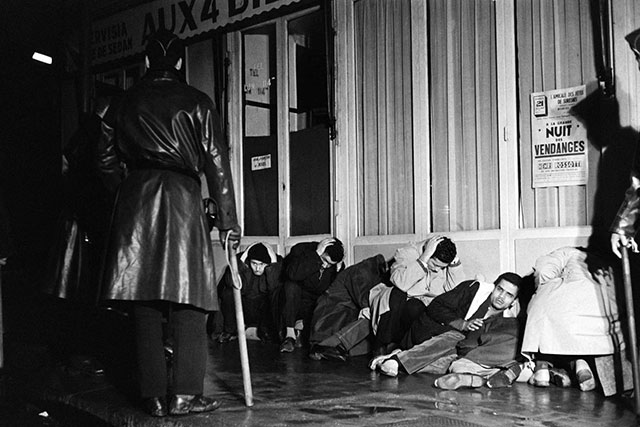
17 October 1961: Paris police murdered a many as 200 Algerians in pro-independence march, dumping their bodies in the Seine River. That didn’t stop the independence fight, and cop brutality today hasn’t stopped high school revolt. (Photo : Fernand Parizot / AFP)
Thursday, November 5 was to be the big day, with demonstrations called by all the major union federations (CGT, CFDT, FO, CFE-CGC, CFTC, Unsa, Solidaires, FSU), as well as the student unions. And it was big, 1.6 million marchers according to the unions, double their expectations. The unions’ focus was on the high cost of living (la vie chère). Since the stick of escalating repression did not seem to be working, Macron tried a little carrot, offering to increase the minimum wage – but only by 1.6%, or 25 € a month, to the utterly inadequate total of 1,502 € (US$1,660) monthly. For the students, he offered to “reform” – not eliminate – the hated Parcoursup university-admissions-by-algorithm platform … in 2028. But that ploy didn’t work either, and on November 7, 250,000 students marched with Yellow Vests, again. The movement isn’t stopping. But where is it going?
Meanwhile, the repression continues. Now the government is demanding that school officials hand over enrollment cards with pictures of students so they can be identified from police videos of protests and school blockages. The ministry of education is threatening not to pay teachers who refuse to hold class remotely during blockages or shutdowns. Now Macron has introduced a bill in the Senate (“casseur – payeur”) to supposedly make those accused of rioting or looting pay for damages.11 This is absurd: if they could prove it, prosecutors would demand jail. And the “permission to kill” act would make any shot fired by a police officer presumptively legal unless proven otherwise, while any proof would have to come from the victim, not the state. This law is up for a vote by the Senate on November 17.
Not a Sideshow for the Presidential Election, But a Fight Against Imperialist Militarism
From the outset, the Macron government has called the high-school student blockades and marches an electoral ploy by the bourgeois populist party, La France Insoumise (France Unbowed, or LFI), whose leader, Jean-Luc Mélenchon is a leading candidate for next year’s French presidential elections (first round of voting, April 18). In addition, the mayor of Saint-Denis, Bally Bagayoko,12 a member of LFI, has been the subject of a smear campaign because of his defense of student protesters (in some instances physically defending them against the police and being tear-gassed for it). As a Muslim of African origin (his parents immigrated from the former French colony of Mali), he has faced vile racist attacks.
Certainly, many of the demonstrators support Mélenchon, who launched his campaign at a stadium in Saint-Denis and just held a convention of his LFI in the nearby Le Bourget Exposition Center with thousands of young people of immigrant origin from the working-class suburbs. But the aim of Mélenchon (and Bagayoko) has always to keep the protests within institutional limits. The claim that the ongoing blockades of hundreds of high schools, strongly backed by teachers, parents and workers, and the protests of hundreds of thousands of people are simply an election stunt is belied by their scope and duration. But as the struggles drag on without a solution, and encompass a panoply of issues, there is a danger that the high-school students’ demands will effectively be subsumed as one more issue in the 2027 elections. That appears to be what Macron is aiming at, and that would be a defeat. It can be stopped by mobilizing workers’ power.
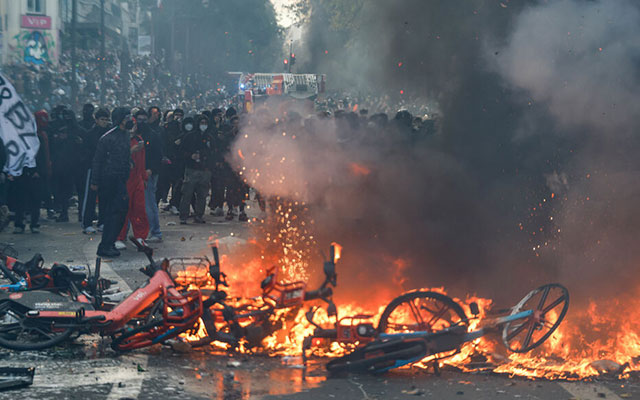
After paramilitary police broke up crowds at the starting point, thousands of frustrated protesters roamed through Paris streets. Some made barricades out of burning rental bicycles. (Photo : Olivier Corsan / Le Parisien)
Clearly the continuing blockades by French students and the mass mobilization of youth across Europe go a lot deeper than a demand for “ten measures for ten billion euros,” as the high-school and university student unions call for. Inspired by the French walkouts, in Italy on October 16, tens of thousands of students protested in major cities demanding “Money for Schools, Not for War.” In Spain, thousands marched in Madrid on October 24 against skyrocketing housing costs. In Germany on October 31, amid the third weekend of protests in France, “Generation Z” protests were held in 30 cities calling for more funds for higher education and opposition to military conscription. More generally, youth across the capitalist world face a daunting future, with difficulty getting (and in the U.S., paying for) an education,13 facing high unemployment now compounded by the eruption of job-killing artificial intelligence.
Obviously, behind talk of “Gen Z revolutions” there is a lot of hype, as social revolutions are not made by age groups but by social classes. This rubric has frequently served as a mask for takeovers by reactionary forces (such as in Nepal) hiding behind a youthful façade. But there is a common origin to many of these struggles, and that is the growing militarization of European imperialist countries. Even the very modest initial demands of the French high-school protests are running up against a brick wall, as France has seen the interest charges on its debt surge from 0% in 2022 to 5% today. There was an almost 2% jump in 2026 alone, due to the oil crisis set off by the U.S./Israel war on Iran and the decision by European members of the NATO military alliance to escalate their military commitments to the puppet regime in Kiev in the imperialist proxy war against Russia, as they prepare to wage war against Russia itself.
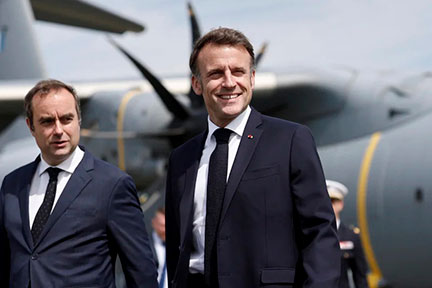
“Jupiterian” French president Emmanuel Macron (right) with his defense minister (now prime minister) Sebastian Lecornu, June 2025. Much of French left joins Macron in demanding Russian troops out of Ukraine. The League for the Fourth International calls to defend Russia against NATO imperialist proxy war. (Photo : Benoit Tessier / AFP)
Emmanuel Macron, who fancies himself a “jupiterien” (Jupiter-like) president, defends French imperialism. He has doubled the military budget in his decade in office, from 32 billion euros to 64 billion, while his education budget has barely risen (5.6%, adjusted for inflation). Over half of the 20% jump in military spending in 2026-27 is for drone warfare, including 10,000 cheap drones. For use where? Clearly this is aimed at Russia. On October 6, Macron observed a test of a new submarine-based nuclear-capable missile. And right now, France is one of the two co-leaders (along with the UK) of war games by a “coalition of the willing” in Poland near Ukraine.
The “Far Left” Capitulates to Fearmongering Against “Rioters”
To fight against militarization, you have to fight against the war that it serves. The reformist and centrist left seeks to sidestep that, because on the war over Ukraine, most groups are in step with Macron in condemning Russia, although many try to hide behind a fig-leaf of criticism of the Western powers. The various pseudo-Trotskyists of the Nouveau Parti Anticapitaliste (NPA, New Anti-Capitalist Party), NPA-Revolutionnaires and Révolution Permanente (RP, internationally affiliated to the Current for Permanent Revolution) all call for Russian troops out of Ukraine. Against these stooges for imperialism, the League for the Fourth International calls to defeat the NATO proxy war and the fascist-infested Ukrainian military, and for the international working class to defend Russia, an intermediate capitalist power, against the united imperialist onslaught. We call for workers action against the war drive that is ultimately aimed at counterrevolution in China (and World War III).
Meanwhile, the high-school students’ struggle is going up against a broad offensive seeking to dismantle the “welfare state” social programs. These were put in place by capitalist governments in Western Europe and elsewhere at the onset of the post-WWII anti-Soviet Cold War, in order to stave off the “threat” of red revolution. Ever since the counterrevolutionary destruction of the Soviet Union and the East European bureaucratically deformed workers states in 1989-92, “neoliberal” proponents of “free market” capitalism have been hacking away at these social programs, from pension plans to health insurance to education. The union tops and reformist leftists call to dump neoliberalism, but with the falling rate of profit and general capitalist decay, that is not an option. To defeat the attack on education and other vital social services requires fighting on a transitional program leading to the overthrow of capitalism.
That is not what the left and labor leaderships are putting forward today. The union leaders emphasize that they have come out in solidarity, not more. A CGT 76 (Seine-Maritime) official told TV, “We are for self-determination of the youth. It is their movement, their choice. We are here to support them, and if they need to be protected, we are here.” The various not-so-far leftists, aside from supporting the demands of the lycéens, are mainly focusing on integrating them into broader anti-Macron “popular-front” protests of labor and the left together with Mélenchon’s bourgeois populist LFI. With little presence in the high schools, the “far left” groups have been consumed with organizational squabbling – notably between the NPA-R and Le Poing Levé (LPL, The Raised Fist, the university youth group of Révolution Permanente), with competing regional coordinating bodies.14
It is striking how much of the pseudo-Trotskyist left is sensitive to, and capitulates to, the smear propaganda by the government, the bourgeois media and the fascist RN against casseurs (window-breakers), code for rioters. After October 17, Lecornu declared “either one is on the side of the Republic, and thus of the forces of order, … or one is on the side of the casseurs.”15 A week later, Révolution Permanente (25 October) published a bizarre imagined conversation in which the government urges society to take a position on the rioters, “for or against.” RP’s response: “‘Resolutely against, Mr. Commissioner,’ all the leftists in the country – whether they are ultra-lefts, far-lefts, radicals, union members, strikers or ordinary protesters – should say with one voice. Regardless of our organizational affiliations.” To make sure there is no ambiguity, a paragraph later it repeats “On October 17, we took a stand very clearly against the rioters.”
In a similar vein, the Ligue Trotskyste de France (LTF, section of the International Communist League) writes that “We must avoid a repeat of the 17th at all costs, because the balance of power would be entirely different and would further isolate the movement.” This is exactly the wrong response, playing into the hands of the racist right-wing. It must be said instead that this “rioter”-baiting goes back to Georges Pompidou, de Gaulle’s prime minister in May 1968, who at the start of his presidency in 1970 passed the infamous “anti-rioter law” (loi anti-casseur). It should also be said that the government’s hardline “tout répressif” policy on October 17, attacking demonstrators as they were gathering, even gassing the Orchestre du Nouveau Monde as it was playing in Place de la République, led directly to large groups of frustrated protesters roaming around the capital. The same happened in the provinces.
Even though RP goes on to ironize about “reformulating” Lecornu’s question, to take a stand, “for or against,” hands being torn off, protesters having their eyes blinded, etc., and saying only on that basis can one discuss “the appropriateness of the ways in which some of the marches or groups of protesters may have attacked property, businesses, or public facilities, whether in self-defense or in retaliation” – this falls into the government’s trap. The anarchists, on the other hand, are rhapsodic over scenes from October 17. “It’s the Revolution, we’re taking the Bastille,” some shouted as they briefly broke into Marseille city hall. “October 17: Day of Insurrection,” the anarchist Contre-Attaque headlined its summary of events. And the media go apoplectic over a barricade on the Boulevard de Sébastopol (a pile of rent-a-bikes set alight) and on Champs-Élysée (using police equipment) “less than 500 meters from the presidential palace” (gasp).
Fight to Win Worker/Student Demands – Fight for Socialist Revolution
This kind of imaginary “revolution”-mongering is the reverse side of the regime’s fear-mongering, by people for whom revolution is an affair of fantasy. And one has to ask: which revolution are we talking about, 1917 or 1789? There are very few red flags and hammers-and-sickles in the protests, and most of those are held by various left groups or isolated individuals. On the other hand, the flags at blockades and draped on the statue of Marianne (the symbol of the French Republic) in the Place de la République are the French tri-color (and sometimes the Palestinian flag). The Marseillaise (the French national anthem) can be heard more often than the Internationale (the workers anthem), and quotes from Victor Hugo in Les Misérables are far more frequent than from Lenin in What Is to Be Done? Many protesters today are moved by the contradiction between the realities they face and the ideals of “liberté, fraternité et égalité” of the French Revolution.
In this struggle, begun by young people in the colonies and immigrant neighborhoods, the fight against racist reaction is fundamental. Not only are there the xenophobic outbursts from Donald Trump and from the mouths of many police, the fascist Rassemblement National is at the door, with 43% of preferences in opinion polls (and 67% among police). After October 17, RN president Jordan Bardella spewed out a tirade of racist filth on CNews (18 October), saying:
“There is a deadly, fatal alliance between the far left – specifically, the far-left rioters on one side, whose goal is the destruction of the state – and, on the other, the predators of the suburbs, hordes of rootless savages who live on the other side of the Paris beltway and who come into the major metropolitan areas and cities to loot and to vent their feelings of revenge against France.”
This toxic language is not just verbal abuse, it is incitement to violence. Sure enough, five days later a RN supporter went on a deadly rampage in the Paris suburb of Trappes, murdering a 26-year-old French citizen of Congolese origin, Pengo Bossio Wangi, and wounding seven others. The killer said he picked his victims by the color of their skin, and Bardella has repeatedly singled out Trappes for his Islamophobic diatribes, calling it a “miniature Islamic republic.”
While the present demands of the struggle are primarily economic and democratic, the League for the Fourth International insists that key to winning them is to fight on a program pointing to socialist revolution. The call for a general strike is certainly on the order of the day – not the usual work stoppage and parade, but a real general strike which shuts down production and transport until strikers’ demands to fix the schools and adjust for inflation are met. As many high-school protesters see themselves as heirs of 1968, a deep-going worker/student uprising could lead toward the formation of workers councils. And faced with brutal police charges, racist attacks and the threat of fascists in power, it is high time to form worker/immigrant defense committees. Above all, in the face of Mélenchon’s bourgeois populism, it is urgent to build the nucleus of a genuinely Trotskyist, revolutionary workers party. ■
Parcosup: University Admissions by Algorithm
French
Education Crisis:
No to “Selection” – For Open Admissions!
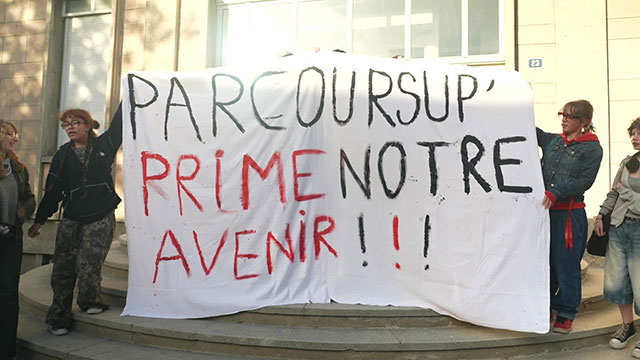
“Parcoursup Suppresses Our Future.” High-scholers in Normandy protest the digital app which decides their options for higher education based on an algorithm. This year one-fifth of high school graduates received no options at all. Trotskyists call for open admissions. (Photo : France 3 Normandie)
Underlying the deteriorating conditions in French education that high school students (lycéens) are revolting against is the educational “reform” packet instituted in 2018 under French president Emmanuel Macron’s first administration. Macron’s prime minister at the time, Édouard Philippe, as well as the minister of education Jean-Michel Blanquer, together put together a series of reforms in the high schools and to the baccalaureate exam, le bac, which every student takes at the end of high school. This effectively lengthened the school day (with big gaps) to the present endurance test, potentially lasting as long as 8 a.m. to 6 p.m. But the axis of the reforms was the introduction of the web portal Parcoursup (a contraction of parcours and supérieure, i.e., pathway to higher education), as the obligatory national admissions platform for post-baccalaureate education.
Getting rid of Parcoursup, the object of much hatred by the high-school students and teachers alike, is a key demand of the present protests, while the government at most talks of “replacing” the platform with another selection mechanism. The Blanquer reforms as a whole were sold as “freedom of choice” and a “streamlining” of high-school education and of the baccalaureate exam, replacing the three tracks, or filières (scientific, social-economic, and literature), with 13 “specializations.” This traps students in an increasingly constricted education early in high school, exacerbating the inequalities already present in the French education system. For one thing, not every school has the capacity to provide every track to their students; wealthier schools give students more options and can prepare them more effectively for the exams compared to schools with less resources and offerings.
Also, in addition to the exam itself, 40% of the grade now comes from ongoing assessment, which better-off schools provide but those with less resources not so much, limiting chances for their students. Students in poorer schools often simply do not have teachers available to complete their courses. So hiring more teachers is a key demand of the protests. When students graduate and are looking to go on to higher education, they must enroll via Parcoursup, which uses an opaque algorithm to sort students according to various criteria including their educational track in high school, where they’re from, whether they attended public or private schools, family income, etc., in order to determine what university programs they are eligible to apply for. That is, if they’re given any options at all. Of the 660,399 students who graduated high school in the summer of 2026 and applied via Parcoursup, 126,500 received no placement offer to a higher education program.16
Moreover, in recent years, the numbers of students who did not receive an offer for post-secondary education has grown. In all, teachers report (on the government web site Vie Public) that the reforms to the bac and the schools generally created “students who are ‘highly stressed’ by ongoing assessment and increasingly guided by strategic considerations regarding their future education (a sentiment echoed by guidance counselors, educational assistants, and school psychologists within the national education system).”17 In 2018, teachers unions spoke out against the Blanquer reforms, criticizing how they targeted students coming from lower income areas, like the banlieues (working-class and immigrant suburbs) of Paris. SUD-Éducation wrote that the reforms made students “the ‘entrepreneurs’ of their own education, increasingly responsible, on their own, for their choices, their ‘successes,’ or their ‘failures.’”18
Because of this, Parcoursup has been labeled a “social sorting” algorithm. In the blockades and demonstrations, students’ signs called to ditch the program entirely: “Sorting Is for the Trash, Not for Our Students, Fuck Parcoursup” and “Parcoursup Decides Our Future, But Our Future Belongs to Us. Put a Stop to the Selective Admissions and Stress!” Or simply, “À bas la sélection!” (Down with selection).
Down with Selection: For Higher Education Open to All
With hundreds of thousands of students in the streets of French cities, now joined by huge numbers of workers, many protesters (and media commentators) are making references to the May 1968 struggles in France, when a student revolt in the universities exploded into a general strike as workers joined the students’ barricades. The global situation is very different, of course. May ’68 was part of a worldwide youth radicalization, particularly over the Vietnam War, whereas the current revolt is defensive, over increasing cuts in education, social services and incomes, and started with a series of basic money demands. But the bourgeoisie, under orders from the capital markets, is not about to grant those demands, while brutal police repression, far from intimidating the protesters, is radicalizing many. When masses of students and workers join their struggles in the streets, week after week, things can get explosive. What’s key is program and leadership.
Still, there is a more direct connection to ’68. Before then, passing the bac in high school was the ticket to getting a spot in a university. In 1966, President Charles de Gaulle’s education minister, Christian Fouchet, attempted to implement selective entry to higher education with his university reform bill. The bill tried to introduce, among other things, increasing specialization of educational tracks and selection in university admissions (as exists today). The student protests of 1968 forcefully opposed the Fouchet Reforms, and sought to defeat the selection proposal – which they did. The Union National des Étudiants de France (UNEF, National Union of French Students) in May 1968 published a leaflet at the peak of the protests stating: “No selection upon admission or during higher education. Given that a complete overhaul of the education system is an absolute prerequisite, we reject any form of selection whatsoever.”19
Instead of the Fouchet Reform, after the worker-student struggles were sold out in the Grenelle Accords by the Communist Party and CGT union leadership, four months later the Faure Law was passed, conceding some of the demands of the students during the struggle in May. Some student representation in decision-making was instituted and in particular a number of new universities were created with a greater degree of financial, pedagogical and administrative autonomy to accommodate a growing student population. In addition to the Sorbonne, which had long been a prestigious and internationally famous institution, they created, among others, Université Paris X at Nanterre, which became a leftist stronghold, and Paris VIII in Vincennes (now relocated to Saint-Denis), which boasts of being the only university in France which admits students with no baccalaureate exam). But the students and workers didn’t make a revolution; the (significant) educational reforms were a consolation prize.
Almost two decades later, in 1986, the government again attempted to institute selective measures on university admissions, resulting in another wave of student protests. This time, it was the Devaquet Law under the popular-front government of Socialist president François Mitterrand and his conservative prime minister, Jacques Chirac. The protests were huge: on 4 December 1986, one million students marched through the streets of Paris. And so was the repression: on the night of December 5, police beat a student from an Algerian family to death. What was key was when rail workers threatened to strike in support of the demands of the national student strike. Two days later, Chirac backed down and the Devaquet Law was indefinitely shelved.20 Not until the implementation of Parcoursup by Macron in 2018 was selective admission introduced nationally. To bury it, it’s necessary to fight for revolution.
In the United States, as well, there have been significant struggles against selective admissions to universities, notably at City College in New York (CCNY) – now part of the City University of New York (CUNY) – in 1969, when an occupation by black and Latino students won open admissions.21 But as in 1968 and 1986 in France, these gains only came about through huge struggles, in which bringing the power of the workers movement to bear was vital. And subsequent experience in the U.S. (where free tuition at CUNY was eliminated in the 1975 NYC fiscal crisis, while open admissions was undone in 1999) and France (with the 2018 Blanquer reforms), such gains can always be rolled back, so long as capitalism remains. As the revolutionary French Trotskyists wrote in 1986, it is necessary to forge a genuine Bolshevik party, part of an authentic Fourth International, world party of socialist revolution, to fight for “a May ’68 that goes all the way.” ■
- 1. Sofiane Orus-Boudjema, “On passe dix heures au lycée pour rien» : derrière la revendication des emplois du temps, la question de l’efficacité du modèle scolaire français,” Le Temps, 9 October.
- 2. An article by the main high-school teachers union, SNES-FSU, “Rentrée 2026: Toujours la pénurie!” (Back to School 2026: Shortages Continue) reported that 53% of French schools have classes lacking teachers. According to government statistics, 9.8% of scheduled teaching hours in public high schools were not delivered in the 2024-25 school year.
- 3. In line with French laws on secularity (laicité) in the schools, in 2023 France’s highest administrative court ruled that the abaya is a conspicuously religious symbol. The hijab, or Islamic scarf, was already banned in French public schools since 2004. As Trotskyists we vigilantly defend secular public education, particularly against attempts to introduce religion in the schools (such as reading the Christian bible, as is now being done in some U.S. states). However, we oppose bans on the abaya and hijab, which would exclude religiously observant Muslim girls and young women from public education, as well as deepening prevalent racist and Islamophobic reaction.
- 4. See “French Education Crisis: No to Selection – For Open Admissions!” here.
- 5. Romain David. “Mobilisation de lycéens et des étudiants : ce que prévoit le budget 2027 sur l’Éducation,” Public Sénat, 2 October.
- 6. “A ‘Doom Loop’ Threatens France as Populism Confronts Markets,” New York Times, 20 October.
- 7. France 3, 5 October. The channel also reported that “CGT union activists joined the rally to hand out masks and saline solution” to wash tear gas from student protesters’ eyes.
- 8. “France: ‘Yellow Vest’ Revolt and the Struggle for Socialist Revolution,” The Internationalist No. 56, May-June 2019. In January 2019, Yellow Vests reportedly took out the entrance to the building housing the offices of the government spokesman with a bulldozer. They also reportedly knocked out 60% of all speed cameras in France.
- 9. “In Le Havre, the CGT supports high-school students for their third day of action,” France 43 Normandie (6 October).
- 10. “17 octobre : comment le gouvernement a perdu le contrôle,” L’Humanité, 18 October.
- 11. A similar measure has already been introduced in Albania (“Albania imposes $6,000 fine for demonstrators present at a protest that turns violent,” Guardian 29 October).
- 12. See “The 53 Year-Old in a Suit Who’s the Face of France’s Youth Protests,” The New York Times, 17 October.
- 13. In France, as in much of Western Europe, higher education in public universities is tuition-free.
- 14. See “Interfac ou Coordination régionale étudiante : débat dans le mouvement étudiant en Ile-de-France,” Révolution Permanente, 4 November. RP/LPL, which leads the CRE, accuses the AG Interfac, led by the NPA-R, of being self-appointed and too readily acceding to the government determining march routes. But our correspondent was present at a meeting that erupted in protest against LPL seeking to impose itself as a leadership, supposedly elected at a meeting where many in the assembly had not been present.
- 15. See “17 octobre : le bilan d’une journée où la colère a explosé,” L’ Humanité, 18 October.
- 16. Laurence Albert, “Parcoursup : encore 126.500 candidats sans affectation dans l’enseignement supérieur,” Les Échos, 11 July 2026.
- 17. “Réforme des lycées 2018 : des ressentis différents entre chefs d'établissement, professeurs et élèves,” Vie Public, 6 September 2026.
- 18. SUD Éducation Paris, “Rentrée 2018: Refusons l’école du tri social, combattons les réformes Blanquer” (Back to School 2018: Reject Schools That Promote Social Segregation and Fight the Blanquer Reforms).
- 19. “L’UNEF propose…” National Bureau of the UNEF, May 1968.
- 20. “French Student Revolt,” Workers Vanguard No. 418, 18 December 1986. At the time, WV was an organ of revolutionary Trotskyism.
- 21. For more, see “How Open Admissions Was Won in 1969,” Revolution No. 6, April 2009.