

July 2026
Urgently Needed: International Workers Action to Break the Energy Blockade!
Cuba Alert! Zero Hour
to Defend the Revolution
The 176
Measures: Threat of Capitalist Restoration
Oppose Privatization! Workers Control, Now!
The
Bureaucracy Is Bowing to Imperialist Pressure
What’s Key: Build a Genuine Communist Opposition
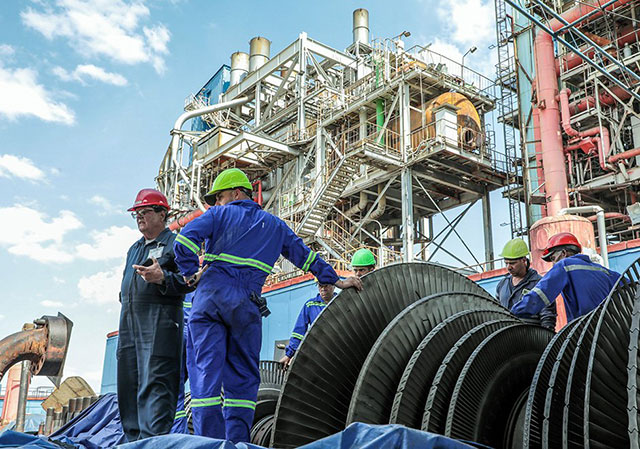
NO TO PRIVATIZATION! Workers of Unión Eléctrica (Cuba’s electrical power company) during maintenance work on the thermoelectric power plant in Camagüey, April 2025. The products of the toil and sweat of the working class must not be handed over to the capitalists. (Photo: Abel Padrón Padilla / Cubadebate)
The following article is translated from Revolución
Permanente No. 14, July 2026, the newspaper of the Grupo
Internacionalista, Mexican section of the League for the
Fourth International.
On June 17 and 18, moving at breakneck pace, the leadership of the Communist Party of Cuba (PCC) introduced, voted on and had the National Assembly of People’s Power (ANPP) approve a plan for “economic and social transformations” that, if implemented – even partially – could unleash a frenzy of privatizations that would threaten the foundations and historic gains of the Cuban Revolution. However, implementing these measures is a big question mark for a country under siege by the world’s most powerful imperialist power, a country lacking hard currency, where there is no capital to invest, and above all where there is no fuel. The “176 measures” are clearly an offer to yield to the demands of the U.S. administration of Donald Trump, but there is no indication that the recipient is interested in the offer. Quite the contrary.
The fact is that U.S. imperialism is doing everything in its power to subject the island to a crippling energy crisis while insisting on “regime change.” It is continuing the policy that has been a constant across all administrations in Washington since 1960: to eliminate the “communist menace” on its doorstep. It is hard to imagine that the intended investments, including the purchase of state-owned enterprises, will take place with the Communist Party in power. The counterrevolutionary gusanos1 in Miami will never recognize the property rights of anyone who negotiated with the current leaders. On the other hand, it is easy to grasp the devastating impact that layoffs and the elimination of product subsidies outlined in the “transformations” would cause. However insufficient the provisions from the ration book (the libreta)2 may be, they are vital.
The Cuban people today find themselves caught between the sword of the U.S. Southern Command and the wall of suffocating electricity shortages. The measures approved by the government go far beyond a mere “reform”: they are the negation of the socialized economy. They are the result of imperialist blackmail, not the inefficiency of state-owned industry deprived of inputs. The working people will pay the price for this privatization, whether it is creeping or galloping. That is precisely why it is crucial to organize opposition to it from within the labor movement. There will surely be a backlash from managers. A political crisis will then arise that urgently needs to be tackled now, before it is too late. Resolving it will depend on broadening the debate to include the working class as a whole, and all those committed to the Revolution.

Each of the 176 measures requires legislation or other action for its implementation. When cynically referring to layoffs (“workers who terminate their employment relationship”), it is specified that these must “follow an evaluation by the collegial management body,3 in agreement with the union, and subject to analysis at a meeting of members and workers.” So it’s necessary to push hard against layoffs in meetings of the “collective” (the personnel), and if management refuses, to impose workers control. Since the supply problems plaguing the Cuban economy cannot be resolved at the level of a single enterprise, it would be necessary to form plant or workplace committees, unite them into workers councils to defend the gains of the Revolution, and convene a national assembly of workers in the socialized economy.4
It must be made clear that there is indeed an alternative to surrender: to fight. And in the face of a crisis unleashed by an imperialist onslaught, this struggle must be, above all, international. Brave as Cuban workers are – coping with hellish conditions, constant blackouts, sometimes lasting more than 24 hours across the entire island, and shortages and scarcity of everything – to defeat a ruthless enemy, it is necessary to mobilize the forces of the working class throughout the Americas. It’s not just the sadistic Trump, the “progressive” presidents of Brazil, Lula da Silva, and Mexico, Claudia Sheinbaum, are responsible for the Cuban people’s ordeal, as they have refused to send oil to the besieged island. Proletarian revolutionaries and class-conscious workers throughout the hemisphere must mobilize to break the energy blockade against Cuba: workers action is urgently needed to send fuel to Cuba, now!
Defending Cuba also requires fighting for the political class independence of the workers. Although many “friends of Cuba” and a large part of the Cuban leadership long for the era of Barack Obama, when the U.S. president traveled to Havana, his administration did not lift the sanctions that have stifled the island’s economy. The Democratic Party has always been and will continue to be a pillar of U.S. imperialism, pursuing the same fundamental goals as John F. Kennedy: the subjugation of Cuba to imperialist capital. In Latin America as well, the policy of many Cuba solidarity campaigns of forming popular fronts with bourgeois sectors can hinder effective solidarity at decisive moments. In contrast, resistance to imperialism anywhere in the world helps Cuba (thus Trump being bogged down in his war against Iran makes it harder for him to launch a military attack on the island).
The grinding crisis in Cuba demands a revolutionary political response. The 176 measures are the desperate response of the leaders of the Cuban bureaucratically deformed workers state who see no alternative to capitulation in the face of the superior economic strength of the empire of the north. With their nationalist outlook, they have pursued the impossible Stalinist dream of “peaceful coexistence” with imperialism, the corollary of the dogma of “socialism in one country,” which is the antithesis of the Leninist program of international socialist revolution. What proved impossible for the Union of Soviet Socialist Republics (USSR), the world’s largest country, is even less possible for a small nation “just 90 miles” from the United States. The urgent defense of Cuba depends on forging a genuinely communist leadership and extending the revolution into the “bowels of the imperialist monster,” as [Cubas’s historic independence leader] José Martí put it.
The U.S. Seeks to Cut Off All Trade with Cuba
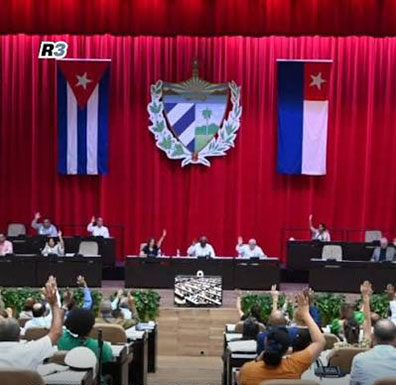 The National Assembly of
People’s Power voted unanimously in favor of the "176
measures" that endanger Cuba’s socialized economy. No to
privatizations! (Photo:
Radio 3 Cadena Patagonia)
The National Assembly of
People’s Power voted unanimously in favor of the "176
measures" that endanger Cuba’s socialized economy. No to
privatizations! (Photo:
Radio 3 Cadena Patagonia)The “Economic and Social Transformations” were presented by Cuban president and first secretary Miguel Díaz-Canel Bermúdez to the Central Committee of the Communist Party of Cuba (PCC), and by Political Bureau member and prime minister Manuel Marrero Cruz to the National Assembly of People’s Power (ANPP), and were explicitly endorsed by former Cuban president Raúl Castro Ruz. They contain a wide range of measures that strike at the heart of the socialized economy. These include: “Transforming socialist state-owned enterprises into commercial corporations with shares or equity interests,” ensuring only that the state maintains a “majority stake” in strategic enterprises. Also included are the sale of state-owned enterprises to “domestic and foreign” individuals or entities; “transition to a model of financial planning” guided by “market signals”; and the introduction of private banks. It calls into question the state monopoly of foreign trade, and much more.
Implementing this plan, as we have pointed out, would result in the dismantling of the planned economy and in privatizations that, given the lack of large quantities of capital in Cuba, would soon turn Cuba into yet another U.S. neocolony. However, although it is very detailed, the plan lacks overall coherence. It is a list of offers that reads more like a real estate prospectus. Are you, the owner of a small or medium-sized business, looking to expand your company? You can now hire more than 100 employees. Are you, a U.S. investor, looking to buy properties for tourism? Foreign investment is now permitted even in Old Havana, and to leave no room for doubt, “real estate businesses may conduct sales transactions for residential units.” Etc., etc. That said, finding a buyer is another matter entirely.
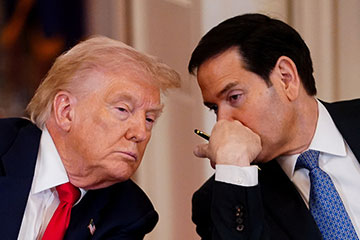 Would-be emperor Donald
Trump and his viceroy Marco Rubio, March 2026: the Yankee
pirates want to "take" the rebel island after strangling it
with their fuel blockade. Defend the Cuban Revolution!
Would-be emperor Donald
Trump and his viceroy Marco Rubio, March 2026: the Yankee
pirates want to "take" the rebel island after strangling it
with their fuel blockade. Defend the Cuban Revolution! (Photo: Nathan Howard / Reuters)
Speaking at the CARICOM5 summit on the island of St. Kitts on February 25, U.S. Secretary of State Marco Rubio said of Cuba, “if they want to make those dramatic reforms that open the space for both economic and eventually political freedom for the people of Cuba, obviously the United States would love to see that. We’d be helpful.” The measures approved on June 17-18 appear to be tailored to these proposals. But when, on March 16, Deputy Prime Minister Oscar Pérez-Oliva declared that “Cuba is open to maintaining a fluid commercial relationship with U.S. companies,” the gusano Rubio immediately responded that this would not be enough, that “they need to put new people in charge.” Donald Trump was more explicit: he said that Díaz-Canel has to go.
The U.S. subsequently issued a series of mandates that make any commercial relationship with Cuba impossible. On May 1, Trump signed Executive Order 14404, which imposes sanctions on any person or company that has “materially assisted, sponsored, or provided financial, material, or technological support for, or goods or services to or in support of, the Government of Cuba.” In particular, it focused on the energy, mining and financial services sectors. It targeted the joint-venture mining company Moa Nickel S.A., a producer of nickel and cobalt. Its Canadian operator, Sherritt, shut down operations at the mine in June. Washington gave banks until June 5 to sever ties with Fincimex, part of the Cuban armed forces’ conglomerate GAESA. On June 6, Visa and Mastercard stopped working in Cuba.
In addition to the total fuel embargo, which has forced ten airlines to cancel service to the island, Executive Order 14404 seeks to block almost all trade with Cuba. In May, two of the world’s largest shipping companies, Hapag-Lloyd and CMA CGM, suspended operations to the country, as did the Melilla and Iberostar hotel chains. On June 10, Secretary of State Rubio imposed sanctions on the Cuban state-owned oil company Cupet. After Cuba authorized the importation of oil by private individuals in February – a move that the League for the Fourth International warned would open the door to imperialist blackmail – a Florida-based company, Vanguard Energy, announced plans to ship up to 250,000 barrels in a tanker. But it was soon forced to cancel the project because the fuel was to be stored in facilities leased from Cupet.
The main target of Trump’s executive order is the Grupo de Administración Empresarial S.A. (GAESA), a business conglomerate within the structure of the Revolutionary Armed Forces that was created during the “Special Period”6 of the 1990s to combat the economic blockade imposed on Cuba. It operates a network of tourist facilities (Grupo Gaviota), runs several supermarkets and gas stations and manages the port of Mariel – all aimed at generating hard currency.7 Using loaded terms like “opaque,” “secretive” and “a mafia-like state within the state,” the imperialist and gusano propaganda machine has tried to portray GAESA as an ogre precisely because it has been a key weapon in defending Cuba against the brutal economic war that U.S. imperialism has waged against it for 65 long years.
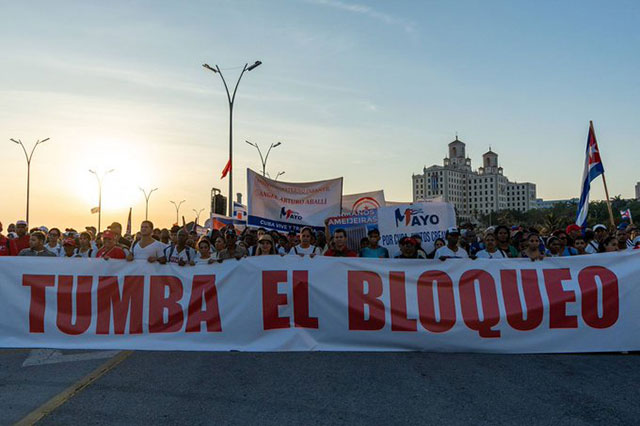
Demonstrators in Havana at daybreak on May Day 2026. Hundreds of thousands came out on the Workers Day to defy the blockade, marching in front of the U.S. embassy. (Photo: Anadolu)
To attract the desired foreign investment envisioned in the
176 “transformations,” approval from Washington is needed.
This endorsement has not been forthcoming, nor will it be,
because what the imperialists seek is to overthrow the
Cuban Revolution. That is the “logic” behind the
ridiculous legal indictment in May against Cuban leader Raúl
Castro for the (justified) downing of the plane carrying the
“Brothers to the Rescue” provocateurs in 1996 (see box).
Then, on June 23, a Washington spokesperson described the
176 Cuban measures as “long overdue and ultimately
superficial smoke signals” from Havana. At the same time,
new sanctions were imposed on five companies, including two
that handle nearly all of Cuba’s international transactions
and one that serves as the main warehousing agency for the
state, private companies and foreign firms.
The “Brothers to the Rescue” Provocation
On 24 February 1996, a plane piloted by members of the organization “Brothers to the Rescue” was shot down by Cuban air defense forces after it entered Cuban airspace heading to Havana, after Cuban air control warned it that it was in danger, having entered a prohibited defense zone below the 24th parallel, and after the Cuban pilot had visually warned the plane to turn back. The U.S. claimed that the mission was to drop leaflets, but a Cuban intelligence agent (Juan Pablo Roque) who had infiltrated the group told the International Civil Aviation Organization that the group had planned to blow up high-tension electrical pylons to disrupt Cuba’s energy supply.
Brothers to the Rescue purported to be a humanitarian organization aiding people who left Cuba on rafts, but its main activities were provocatively flying over Cuba. Cuba’s government sent at least nine diplomatic messages complaining of these provocations to the administration of Democrat Bill Clinton, who did nothing to stop them. Brothers was founded by former members of Brigade 2506, the U.S.-organized Cuban mercenary army that was smashed at Playa Girón (Bay of Pigs) in April 1961. Its leaders included veterans of the Alpha 66 terrorist organization, which boasted of carrying out dozens of sabotage commando raids on the island. The founder and main leader of Brothers was José Basulto, who several years later admitted to having been a CIA agent trained by the agency for sabotage missions in Cuba. In 1962 he fired a 22 mm cannon into a hotel in Havana. In later years Basulto flew supplies to the CIA’s “contra” army fighting against the Sandinista government of Nicaragua.
Workers Vanguard (No. 640, 1 March 1996), at the time the voice of revolutionary Trotskyism, wrote that the shootdown of the plane was “a legitimate defensive measure against a brazen provocation” The Internationalist upholds that statement. The indictment of 96-year-old former Cuban president Raúl Castro Ruz over this is a cynical ploy to prepare for U.S. terrorist actions.
In short, Cuba’s “transformations” will not be viewed favorably by the Trump administration, and without that support, it is nearly impossible for the country to attract foreign investment to increase production (and productivity, which depends on the introduction of new technology). Simply to survive with a minimum standard of living requires breaking the energy blockade, and any improvement requires eliminating or substantially reducing the economic blockade that dates back to the early 1960s. Substantial privatization of industry, energy, communications, etc., will not achieve the supposed increase in efficiency, no matter how rigid state-owned enterprises may be. And in the meantime, the resulting mass layoffs and price increases for basic necessities could lead to internal unrest . . . and a mass exodus.
Abandoning the Planned Economy: Blow Against Workers
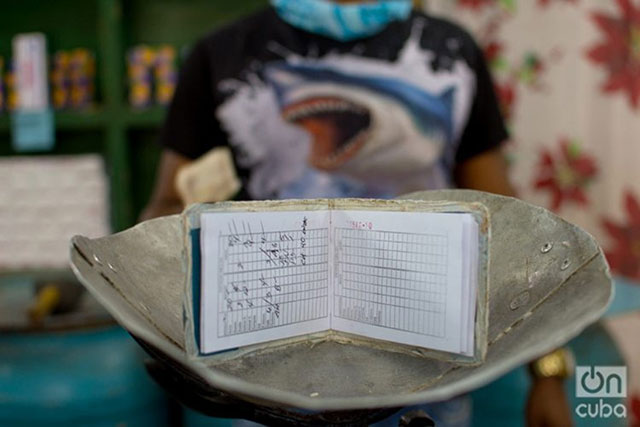
The “Libreta de abastecimiento” (ration book). Despite the limited supplies, eliminating subsidies will lead to hunger for many working people and the poor. (Photo: Otmaro Rodríguez / OnCuba)
The Communist Party leadership insists over and over that the purpose of the 176 measures is “to advance the defense of socialism” (President Díaz-Canel, at the plenary session of the PCC Central Committee on June 17); and that it is “to preserve the achievements of the Revolution and guarantee the continuity of socialism” (Prime Minister Marrero, at the National People’s Power Assembly on June 18). Díaz-Canel told the Congress of the Cuban Workers Confederation (CTC) on June 27, “We do not propose – nor will it ever be our intention – to restore capitalism in Cuba! It is a matter of … saving the Revolution and its undeniable social achievements, because we will never renounce the majority’s aspiration for socialist construction.” He also spoke there of saving “the socialist orientation of the economy.” Aspiration? Orientation? It is the reality of the socialized economy that is at stake.
And in reality, these measures undermine the foundations of the workers state. In addition to the importation of fuel by private and foreign capitalist entities – the dangers of which we have already pointed out – state entities, municipalities and cooperatives are now authorized to export, import and retain foreign currency revenues; “natural persons” (individuals) are permitted to make “commercial imports through non-commercial channels”; and the “partial dollarization of the economy” is formalized. Although it is claimed that such measures “do not imply granting foreign trade powers,” in fact they undermine the state’s monopoly of foreign trade. Combined with the effort to foster by multiple means a substantial capitalist sector (“non-state economic actors”), the measures as a whole threaten the pillars of Cuba’s socialized economy.
The 176 measures refer to “moving toward a model of financial planning in which the state gradually shifts away from the physical allocation of resources, giving greater weight to market signals.” This amounts to abandoning a planned economy. Planning based on financial indicators is by no means socialist; it is practiced by several capitalist countries. France, for example, adopted it after World War II, establishing a Planning Commission that existed until 2006. Although such “indicative planning” can guide the development of different sectors in the medium or long term, in the day-to-day functioning of the economy it would be the market and the (capitalist) law of value that determine what to produce, rather than a decision based on social needs.
Since the state monopoly on foreign trade, economic planning and the entire state sector would be weakened and jeopardized by the impact of the 176 measures, how can the bureaucracy that governs the Cuban state insist that it is defending or saving socialism? When they speak of “socialism,” they invariably point to public education and healthcare, which are indeed great achievements of the Cuban Revolution and a beacon for all of Latin America. But while they are achievements of a socialized economy, and officials vow to keep them free of charge, that in and of itself is not incompatible with social-democratic-style capitalism. In reality, these jewels which are Cuba's pride and joy would be undermined in a market-driven economy.
PCC leaders also promise that they will ensure “social justice,” and that the reforms will generate “greater riches,” which they will distribute “with the greatest possible social justice” (Díaz-Canel at the CTC). However, there is no guarantee that the free-market changes will increase production, while it is certain that they will produce greater inequality (this is even their intention, at the Central Committee he himself called for “producing with equity, not with egalitarianism”). And the elimination of subsidies for basic necessities, the introduction of differentiated wages and rising layoffs will, by definition, be acts of social injustice that all class-conscious workers and genuine communists must resist with workers action. To put it bluntly, promises of future wealth do not put food on the table.
Chinese and Vietnamese
“Models”?
Yankee Imperialists Aren’t Buying It
There is a lot of talk about the “Chinese” or “Vietnamese model.” A “study of the experiences of socialist construction in other countries such as China and Vietnam” was conducted, Díaz-Canel said at the Central Committee meeting. In many respects, the projected structures resemble those in China after 2013, with certain important differences. In China, some strategic sectors remain 100% state-owned, such as electricity transmission (a natural monopoly) and nuclear energy, while in others, operating companies in sectors such as oil, non-ferrous metallurgy, air transport and rail transport have minority private and foreign investment but are controlled by parent companies that are 100% state-owned.8 In the 176 Cuban measures, however, there is no mention of companies that would remain exclusively state-owned.
Beyond the formal structure, the socioeconomic and geopolitical environment is quite different. In China, after several state-owned enterprises were converted into joint-stock companies, they attracted large amounts of financing from commercial banks taking advantage of the extremely high domestic savings rate. In addition, they benefited from a massive influx of foreign investment, including from large “multinationals” eager to enter the vast Chinese market. In Cuba, banks lack a savings base for investment, and international investors are pulling out due to sanctions and the energy crisis. And while China received investments from Chinese capitalists in Taiwan and Hong Kong (for example, the Foxconn factories), with few exceptions, Cuban capitalists in exile will not invest in the island governed by the Communist Party.
The situation in Vietnam is, broadly speaking, similar to that of China, but with an even higher proportion of foreign investment, particularly from the region, in export-oriented sectors. The new policy adopted by the Cuban CP resembles that of those leaders in China whom the Maoists labeled “capitalist roaders,” like Deng Xiaoping. In that case, it led to unprecedented growth of both the state sector and of the capitalist sector, which poses a threat to the socialized economy. In Cuba, due to the fragility of an economy that has been subjected to a criminal blockade for 65 years, and has now intensified to the point of asphyxiation, the same free-market measures could trigger a collapse that capitalist forces would seek to exploit to foment bloody counterrevolution.
To think that privatization and Cuba’s opening up to the global capitalist market can “save socialism” is to live in a fantasy world. In any case, neither the promised riches from foreign investment nor greater productivity will be possible under the current conditions of an almost total blockade. Díaz-Canel may insist that the “transformations” are “a sovereign decision by Cuba,” that they are not “the result of concessions made in the face of U.S. threats,” and are not a response to demands on Cuban authorities made in bilateral discussions. But if would-be emperor Donald Trump and his viceroy Marco Rubio do not give their stamp of approval, the major capitalist conglomerates will not take advantage of the offers: they will have been stillborn. And the White House and the State Department have already nixed them.
For the CP leadership, this is the old Stalinist dream of “peaceful coexistence,” but the enemy is anything but peaceful, nor is it the least bit interested in coexisting. So far, only Russian and Chinese companies have shown interest; all others fear sanctions. It cannot be ruled out that some wily American investor might consider investing in Cuba, but they would need some guarantee that the U.S. government would eventually legalize it, like Trump and Rubio are doing now for U.S. oil companies in Venezuela. Even so, for the frenzied counterrevolutionaries of the Miami gusano crowd, such as the Cuban-American National Foundation, which has become a bastion of the Republican Party in Florida, their sine qua non (bottom line) condition is the destruction of the Communist Party and arrest – or worse – of its leaders.
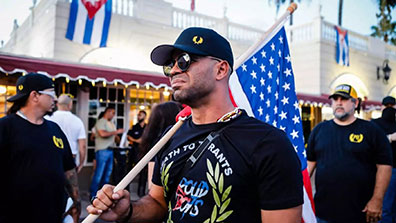 The gusanos in
Florida demand the destruction of the Cuban Communist
Party. In the photo: Enrique Tarrio, the gusano
leader of the fascist Proud Boys, at march in Miami, 16
July 2021. (Photo: Eva Marie
Uzcategui / AFP)
The gusanos in
Florida demand the destruction of the Cuban Communist
Party. In the photo: Enrique Tarrio, the gusano
leader of the fascist Proud Boys, at march in Miami, 16
July 2021. (Photo: Eva Marie
Uzcategui / AFP)Since it must be obvious to all that foreign investors are not going to line up to put their money into a Cuba ruled by the PCC, there is another possibility: that state-owned properties will be sold, auctioned off or simply transferred to those most familiar with them – members of the bureaucracy or their relatives. In China, which remains a bureaucratically deformed workers state despite the growth of a substantial – and dangerous – capitalist sector of the economy, some children of high-ranking bureaucrats became corporate executives because of their high-level connections. It cannot be ruled out that something similar might happen in Cuba. This underscores the importance of mobilizing workers to use their power against privatizations, particularly when local proto-bourgeois elements are involved.
Resist the Surrender of the Socialized Economy at Every Step
While the dreamed-of wave of foreign investment is not about to materialize, what is coming is the elimination of subsidies, layoffs and a sharp rise in prices for food and other necessities – all attacks on the workers that must be opposed and resisted. The measures which are truly urgently needed go in the opposite direction: mobilizing the creativity and power of the workers, fighting for workers control in the enterprises. It’s necessary to impose the will of the workers collective against those petty-bourgeois managers who dream of privatizing them (and allying with those administrators who oppose privatization), Workers mobilization is needed to block foreign capitalists who seek to snap up at bargain prices what has been built by the toil and sweat of the Cuban workers. Are there suspicions of corruption at GAESA? Let a workers commission inspect its books, as part of defending the socialized economy!
Díaz-Canel said at the CTC Congress, “To this day, no one has explained – much less demonstrated in practice – how socialism is to be built in a nation under the conditions of siege that Cuba has endured at the hands of the world’s greatest power since the very beginning of the victorious Revolution….” This goes to the heart of the matter. It is not possible to “build socialism in a single country” (Stalin’s anti-Marxist formula), especially not in a small country on the doorstep of U.S. imperialism; instead, international workers struggle is required, extending throughout Latin America and into the very heart of U.S. imperialism. Resistance by workers in Cuba against measures similar to those being imposed on workers, peasants, and indigenous peoples in Bolivia could inspire a proletarian response across the entire continent.9
Although Trump has imposed a total blockade on Cuba, he doesn’t hold “all the cards,” in his favorite phrase. The president in Washington wants to repeat his Venezuelan lightning coup, when he kidnapped President Nicolás Maduro and seized control of the country’s oil. Trump envisioned repeating that “feat” against Iran, with disastrous results for U.S. hegemony. And Venezuela is not the same as Cuba. The “Bolivarian” government was, and is, a bourgeois-nationalist regime, based on a capitalist economy with all the contradictions that entails. Cuba, on the other hand, is, and has been for decades, a workers state – although deformed by a bureaucratic government – with a socialized economy. The Cuban state has a cohesion that the Venezuelan regime lacked.
The regime of Stalin and his successors in the Soviet Union, after seven decades in power, finally succumbed to the economic and military pressure of imperialism in 1989-92. In contrast to Stalinism’s illusory nationalist policy, Leon Trotsky – co-leader, alongside Lenin, of the October Revolution of 1917—outlined the perspective of permanent revolution. This holds that in countries under the yoke of imperialism, even democratic tasks – such as real national independence – can only be achieved by the proletariat taking power, supported by the peasantry, and by extending the socialist revolution into the heart of imperialism. Genuine Trotskyists always defended the USSR, just as today they defend Cuba, China, Vietnam and North Korea against imperialist siege and counterrevolution.
The Cuban government is, without a doubt, bureaucratic. The fact that it approved the 176 measures, which entail a fundamental change in the entire Cuban economic system, by unanimous vote at back-to-back meetings of the Central Committee of the PCC and the ANPP in just 48 hours is proof positive. A true revolutionary workers democracy would have given rise to vigorous debate over these “transformations,” which can only wreak havoc on the household budgets of working people. In Bolivia, when the reactionary government enacted a sweeping package (paquetazo) of measures in December 2025 that eliminated fuel subsidies, it raised the minimum wage to an utterly inadequate amount of 3,300 bolivianos, equivalent to US$316. Under the Cuban paquetazo, the new minimum wage will be 3,120 CUP, equivalent to US$5 – impossible to live on and meet basic needs at market prices!
So, if workers truly have a “voice and a vote,” as Díaz-Canel asserted to the CTC Congress, if they determine the country’s course – as it should be in a workers state – then it is imperative for genuine communists to oppose and organize resistance against these anti-worker measures, which seek to sell off the assets of the working class to capital. But serious resistance against this disastrous policy cannot be merely reactive; it must present an alternative. To defend the socialized economy and the gains of the Cuban Revolution, a proletarian political revolution is necessary, based on an assembly of workers councils. And the axis of such a revolutionary Marxist policy is that there is no solution just within the narrow confines of a Cuba besieged to the point of suffocation. The struggle must be escalated to the international level. For starters, we call on the workers of Latin America to demand that their governments immediately send oil to Cuba, and to enforce this through workers action.10
In the face of the capitulatory stance of the government leadership, genuine communists must make use of cracks in the bureaucratic wall to defend the interests of the working class and the Revolution. In a speech at the CTC Congress, Díaz-Canel admitted that “among the people” there are “those who have doubts and are concerned about the impact these measures may have on socialist construction,” asserting that “this is for the best” because they, too, “are defending the Revolution.” So, when in debates over layoffs, for example, the bureaucrats seek to silence the opposition, it is worth citing this. And when the first secretary of the PCC asserts that “the Socialist State Enterprise … will continue to be the fundamental pillar of the economy” (Díaz-Canel’s speech at the Central Committee), one can recall these words as they try to sell those enterprises (or parts of them) to capitalist bidders.
This does not mean that all small-scale privatization should be rejected: nationalization in Cuba sometimes reached extremes, and petty-bourgeois sectors can make a valuable contribution to socialist construction. Moreover, at times it is necessary to take a step back, as in the NEP (New Economic Policy) of the 1920s in the USSR. But that temporary policy, which has been cited ad nauseam to justify pro-capitalist reforms in Cuba, is light-years away from the 176 measures that undermine the core of the collectivized economy. We must combat, step by step, these counter-reforms that harm workers and benefit the capitalists who exploit their labor to enrich themselves. And we must emphasize the need to adopt an overall program, the only one that can save the Cuban Revolution: the program of Lenin and Trotsky for international socialist revolution.
The Pseudo-Trotskyists: Obstacles to Defense of the Cuban Revolution
There is a trio of groups that claim (falsely) to be Trotskyist and have issued statements against the measures recently adopted by Havana; what they have in common is that they are abandoning the defense of the Cuban workers state, if they have not already done so. The Revolutionary Communist International (RCI, formerly International Marxist Tendency) titled its article, “Faced with unbearable imperialist pressure, Cuba moves towards capitalist restoration” (In Defence of Marxism, 22 June). The text asserts that the 176 measures, “taken as a whole ... if implemented, spell the end of the planned economy and the restoration of capitalism.” While the end of the article mentions “defending the Cuban revolution,” these are empty words since for them, capitalist restoration has already been decided on (and carried out in China and Vietnam).
The Current for Permanent Revolution (CPR, formerly Trotskyist Fraction), for its part, writes that “the restorationist turn … is being completed,” and that we have now reached “the end of the cycle of ‘reforms,’ in terms of capitalist restoration” (Izquierda Diario, 28 June). The article’s title is interesting: “Cuba: Capitalist Restoration by Decree?” But instead of rejecting such nonsense (for Marxists, counterrevolution will not be carried out by virtue of a few words on paper), they leave the question open. The CPR asks rhetorically, “how can one even imagine for a moment that it would be possible to defend what remains of the achievements of the 1959 revolution while ‘reaching out’ to Cuban investors in Miami?” and concludes the article saying: “One thing is certain: it will not be possible to defend the Revolution or the island’s sovereignty in the event of direct U.S. intervention with the leaders of this system.” This is the opposite of Trotsky’s policy of unconditional defense of the workers state.
The International Communist League (ICL, better known as the Spartacist tendency) has adopted a more modulated, and deceptive, language to present a position similar to that of the RCI and CPR: treating capitalist restoration, if not yet as a fait accompli, at least as a matter that has been decided. Thus, it describes the 176 measures as “a series of economic reforms that, if implemented, could well lead to the destruction of the gains of the Cuban Revolution” (Spartacist supplement, 20 June) without mentioning the very real obstacles standing in the way of their implementation. While it advocates forming “a left opposition to the PCC leaders’ course” based on “a fighting socialist perspective,” it does not explain what the policy of this generic opposition should be, aside from opposing Díaz-Canel’s measures. This is yet another example of its now-typical irresponsible light-mindedness in the service of an all-round opportunist policy that could be summed up as “unite for unity.”
A subsequent article (“Cuba: How to Stop the Catastrophe,” Spartacist supplement, 30 June) advocates “a radically new course.” It criticizes “weaknesses” in the statements by the RCI and CPR, namely that “they do not outline a concrete line of struggle for the Cuban masses today.” The same can be said of what the ICL has written. Of the three points they highlight at the end, the first (“break the blockade”), as fundamental and essential as that is, is not controversial on the left. The second (“for radical egalitarianism” and “no to bureaucratic privileges”) paints an idyllic picture (“no privileges, no corruption, no speculation: total equality”). In reality, the greatest privilege in Cuba today – access to dollars – excludes the vast majority of PCC members, while many anti-communist “dissidents” are on the U.S. payroll.
And the third point of its three-point program (“for workers’ democracy”) omits the qualifier “revolutionary” – that is, in the framework of defending the Cuban Revolution. This could prove significant, given that U.S. agencies always seek to foster a counterrevolutionary “worker” opposition, as they did with Solidarność in Poland. Moreover, the ICL demands, “Stop the attacks on protests calling for equality and an end to poverty.” In doing so, it glosses over the fact that explicitly anti-communist slogans have been chanted at some of the recent protests, and that the “cacerolazos” (pots and pans demonstrations) have not been physically suppressed. And with its call on “security personnel to end the repression,” the ICL would paralyze defenders of the Revolution in the face of a counterrevolutionary riot.
It is striking that in the statements by the ICL, as well as those by the RCI and the CPR (the latter two supported Polish Solidarność), there is no mention of an anti-communist opposition, which is very real and was mobilized during the protests of 11 July 2021. Unlike all those who have prettified those protests – including the ICL – we of the League for the Fourth International (LFI) investigated in great detail what happened that day, explaining that:
“While fueled by desperation over food shortages, lack of medicine and blackouts that have beset the island in the wake of the coronavirus pandemic, the marches were instigated, manipulated and exploited by forces seeking to overthrow the Cuban Revolution.”
–“The Truth About the Protests in Cuba: Defend the Revolution Against U.S. Imperialism and Its Frontmen!” The Internationalist No. 64, July-September 2021
As we noted at the time, even the “progressive” wing of the Democratic Party, in the person of Congresswoman Alexandria Ocasio-Cortez, echoed the imperialist propaganda surrounding July 11, declaring: “we solidarize with [the protests] and condemn the anti-democratic actions led by President Díaz-Canel.”
An account of a visit to Cuba by Canadian supporters of the ICL (Workers Tribune, 7 February) referred to the 2021 protests, claiming that “the sheer breadth of the protests in some 30 cities showed that this was not fundamentally a right-wing, U.S.-orchestrated revolt,” directly criticizing the LFI. On the contrary, the protests’ breadth reflected the explosion of calls on social media, originating in Florida, urging people on the island to take to the streets against the Communist Party “dictatorship.”11
To be clear, the protests that have taken place in Cuba over the past month and a half (of which there have been several dozen), have not, with few exceptions, been counterrevolutionary political actions. They have mainly reflected the desperation resulting from the effects of the suffocating fuel blockade imposed by the U.S. government: food shortages, a lack of public transportation, and above all, a series of blackouts due to extended outages of the national power grid. However, as we wrote in April, “If it comes to that, class-conscious workers and all defenders of the Cuban Revolution must mobilize to thwart any counterrevolutionary and pro-imperialist action.” (“For International Workers’ Mobilization in Defense of the Cuban Revolution!” The Internationalist, April 2026).
It is also worth noting that the statements by the ICL, RCI and CPR do not include the terms “deformed workers state,” “Trotskyism” or “Trotskyist.” So when they speak of opposing the “transformations” approved in June, they fail to provide readers with the programmatic and conceptual framework needed to understand what has happened or to act in defense of the Revolution. For decades, the Cuban population has been told that they live in a “socialist” country, when in reality it is a workers state – the “dictatorship of the proletariat” – which should serve as the starting point for achieving socialism, a classless society that can only be built on an economic foundation of abundance, not poverty. Hence the survival of the Cuban Revolution and its achievements depends on extending the revolution.
It must also be understood that this workers state is ruled by a bureaucracy; in other words, it is a deformed workers state. This relatively privileged petty-bourgeois stratum rests on the foundations of the socialized economy, and its nationalist and conservative policies are the result of its own history and the Stalinism it imbibed from the USSR. Thus, in the cases of both Nicaragua and Venezuela, the Cuban government, and Fidel Castro himself, advised the Sandinista and Bolivarian leftist movements that they should not follow the path of the Cuban Revolution and should instead seek coexistence with imperialism. But it turned out that the Yankee imperialist sharks were not, and are not, interested in tolerating even bourgeois-nationalist regimes, much less a “communist” outpost 90 miles from their shores.
Return to the Program of Lenin and Trotsky
As for what is to be done, in Lenin’s famous phrase, the answer cannot be a return to a Castro-era “golden age,” as disappointed Fidelistas and Guevarists (of whom there are surely many among those who have doubts about the new measures) might think. Let’s be clear: the approval of the 176 “transformations” is a declaration of political bankruptcy by the Communist Party. Not only does it renounce the line it has defended for decades (with, as noted, its fundamentally Stalinist character), but it would also throw overboard the most fundamental interests of Cuban workers. Yet there are hundreds of thousands of communists in the PCC, as well as unaffiliated leftists, who wish with all their hearts to defend the revolution to which they have dedicated their lives. We want to discuss with them, because there is indeed a revolutionary way out, an alternative to the Stalinist dead end, and that path is to return to the internationalist program of Lenin and Trotsky, the program of Red October.
The League for the Fourth International, whose founders were leaders and cadres of the ICL when it was the voice of revolutionary Trotskyism, continues the program of the Spartacist tendency that today’s reborn ICL has almost completely discarded. Ours is the history of the authentic Trotskyists who fought against the capitalist reunification of Germany, calling in the DDR (the German Democratic Republic, the deformed workers state in the east) for a proletarian political revolution in order to fight on both sides of the Cold War border for a “red Germany of workers councils” in a Socialist United States of Europe. We also fought to the end in the USSR against the Yeltsin-Bush counterrevolution. In both cases, we reached out to cadres of the Stalinist Communist Parties, as well as to military personnel, who wanted to fight for genuine communism. The core of this revolutionary and internationalist program that we defended then is crucial today in defending Cuba (and also China, which remains a central target of the imperialist war drive).
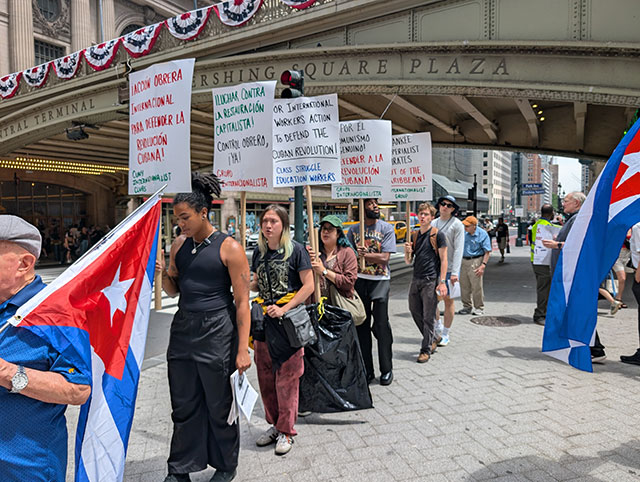
Internationalist demonstrators call to defend the Cuban Revolution, New York City, July 11.
(Photo: The Internationalist)
When we speak of the international spread of the revolution, it is important that those inside and outside the besieged island who wish to defend it grasp the enormous impact the Cuban Revolution had, from the Southern Cone of South America to Mexico and throughout the Caribbean, all the way to the United States and Europe, as well as Africa and many other parts of the world. An intrepid struggle of the workers against abandonment of the socialized economy and the surrender of the Revolution’s gains to its sworn enemies – against the transformation of the rebel island into a client state and neocolony of Uncle Sam – could inspire a new generation of young activists around the world, a working class under attack from relentless and racist anti-union campaigns, war-weary populations of imperialist countries and oppressed peoples beset by imperialist wars.
The primary responsibility for making the prospect of international socialist revolution a reality rests with those who are fighting in the imperialist countries that are besieging Cuba – in the U.S. and also in Europe – and in the countries of Latin America, where capitalist governments (including those in Mexico and Brazil, which in the past have posed as “friends of Cuba”) have bowed to the threats of the Yankee plunderer Trump and are complicit in the energy stranglehold on Cuba. Urgently needed is international workers mobilization to break the suffocating blockade, and to fight to forge communist parties like the Bolsheviks of Lenin and Trotsky. ■
- 1. Gusano: literally “worm,” referring to Cuban exile opponents of the Revolution.
- 2. Starting in 1962, every Cuban household was issued a ration book (see illustration later in the article) to ensure equitable distribution of food. Originally covering most foodstuffs, particularly since the cutoff of Soviet oil supplies in 1992 the amount of food supplied has fallen. In principle providing rice, sugar, cooking oil, coffee, eggs, pasta, grains and chicken at greatly subsidized prices, in recent years, partly due to falling agricultural production but also to hoarding and speculation by private traders, deliveries have become erratic and most food consumed in Cuba is now purchased on the open market.
- 3. State enterprises in Cuba have management bodies consisting of departmental directors and worker representative(s) designated “in conjunction with the union at that level.”
- 4. See “The Truth About Cuba Protests – Defend the Revolution Against U.S. Imperialism and Its Frontmen,” The Internationalist No. 64, July-September 2021.
- 5. The Caribbean Community, an interstate organization including 15, mainly English-speaking, countries of the Antilles Islands.
- 6. This is the Cuban phrase for the period following the imperialist-led counterrevolution that brought down the USSR in 1992, abruptly cutting off Soviet trade with Cuba, particularly oil, which had been paid for with Cuban exports of sugar.
- 7. “Hard currency” refers to globally traded currencies that are freely exchangeable, notably the U.S. dollar and the European euro. The Cuban peso (CUP) is not exchangeable anywhere outside the country.
- 8. For example, the oil companies Petrochina and Sinopec Corp. are publicly traded corporations with private and foreign minority shareholders, but are subsidiaries of holding companies – China National Petroleum Corporation and the Sinopec Group, respectively – which are 100 percent state-owned and, in turn, are controlled by the State-Owned Assets Supervision and Administration Commission (SASAC).
- 9. See “Bolivia: de la rebelión popular hacia la revolución obrera,” Revolución Permanente, June 2026.
- 10. See “Grupo Internacionalista Demands Oil for Cuba” and “Mexican Workers: Break the U.S. Oil Blockade Against Cuba!” The Internationalist, April 2026.
- 11. An article analyzing digital media traffic on 11 July 2021 has just been published (by a group of journalists aligned with the Cuban government): “11J: How a Foreign Interference Operation Is Fabricated” (in Spanish), Cuba Debate, 14 July 2026.